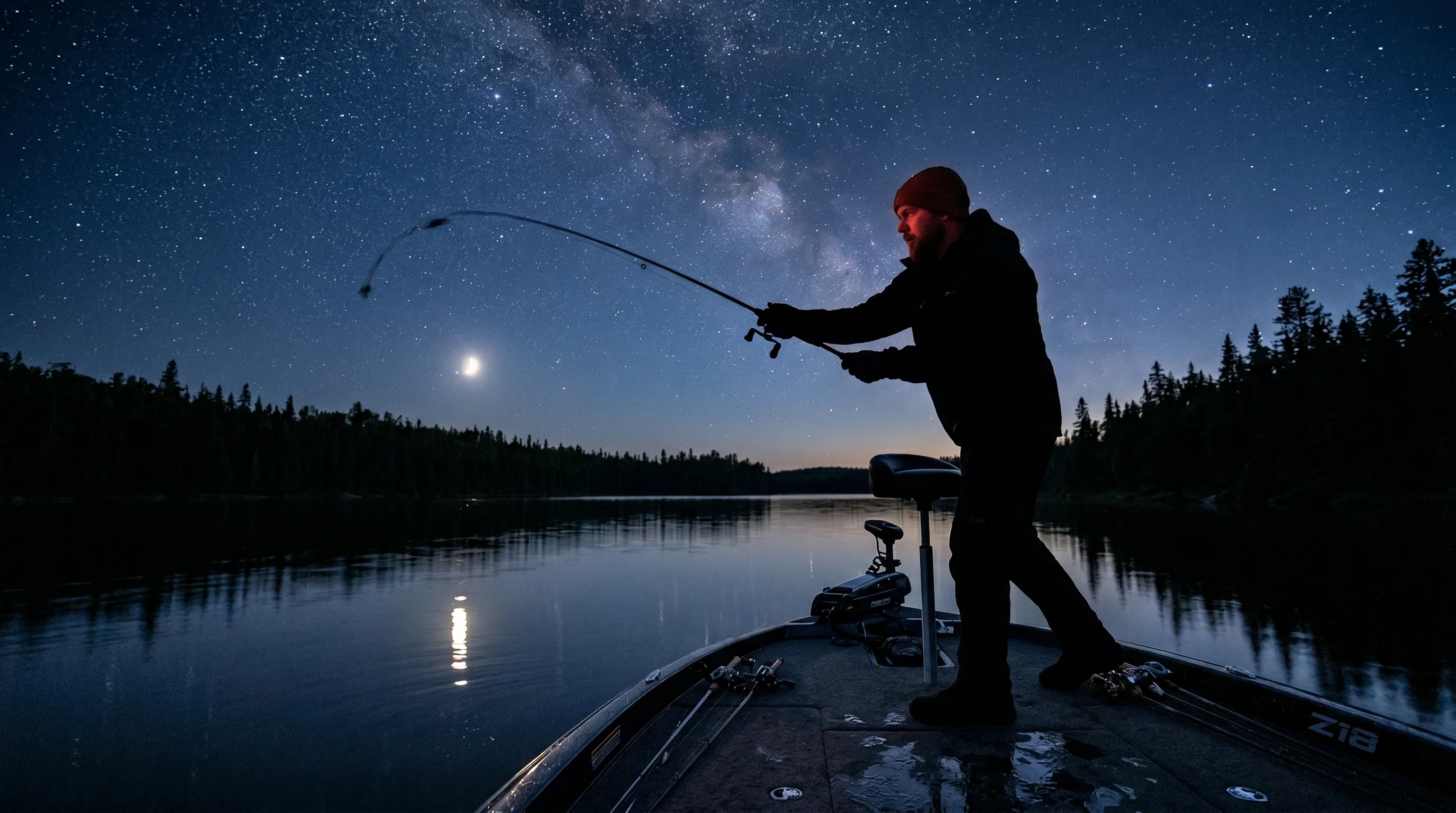
Tactical Overview
📋 The Quick Catch
This guide is for the angler looking to escape 100-degree summer days and jet-ski traffic by targeting the largest bass in the lake under the cover of darkness. You will learn how to adapt to zero-visibility conditions by leaning heavily on high-vibration lures, dark silhouettes, and extreme boat stealth. The most critical adjustment you must make tonight: put away the finesse gear, tie on a bulky, dark lure, and trust your rod tip over your eyes.
The Core Concept — How Bass Hunt in Total Darkness
When surface temperatures climb into the mid-to-high 80s, bass metabolism spikes, but the dissolved oxygen in shallow water plummets during peak sunlight. Because largemouth bass are ectothermic with a metabolism driven entirely by water temperature, and their preference is dissolved oxygen above 4 ppm, the shallow flats become physiologically hostile during the hottest daylight hours. To survive, mature bass move deep to thermoclines or bury themselves in heavy, shaded cover where they become lethargic and nearly impossible to catch on reaction baits.
But when the sun drops, the lake resets. Shallow water cools, baitfish move up onto flats and shorelines, and the biggest bass in the system follow them to hunt aggressively.
At night, a bass's primary hunting mechanism shifts from vision to its lateral line. As fisheries biologist Steven Bardin explains via Wired2Fish, the lateral line is a series of pores containing hair-like sensors that detect movement — a sensory system that allows bass to locate prey even in complete darkness. Because they are hunting by vibration and silhouette rather than precise visual detail, night fishing demands specific lure profiles. You aren't trying to perfectly mimic a shad's scale pattern; you are trying to create a massive, rhythmic disturbance in the water column and cast a solid, unmissable shadow against the ambient light of the night sky.
When Conditions Favor Night Fishing
Night fishing isn't an automatic guarantee; you have to match your approach to the exact environmental conditions.
- Water Temperature: 80°F (26°C) and above is the prime trigger. When day fishing feels like a chore, night fishing turns on.
- Water Clarity: Clear to moderately stained water is ideal. In heavily muddied water, night fishing becomes exceedingly difficult as the bass's sensory range is severely crippled.
- Moon Phases: A full moon pulls bass incredibly shallow, allowing them to hunt visually near the surface, making it prime time for topwater wake baits. A new moon (pitch black) forces bass to rely entirely on their lateral lines, requiring you to use the loudest, most vibration-heavy lures in your box.
- Weather Patterns: Stable, hot weather is best. The second night after a major summer thunderstorm often produces the most consistent bite as the barometric pressure stabilizes — our guide to barometric pressure explains exactly why pressure stabilization triggers aggressive feeding.
Essential Night Fishing Gear Setup
Fishing in the dark magnifies equipment flaws. A minor tangle during the day is a session-ending nightmare at 2:00 AM. Your setup needs to prioritize reliability, sensitivity, and line management.
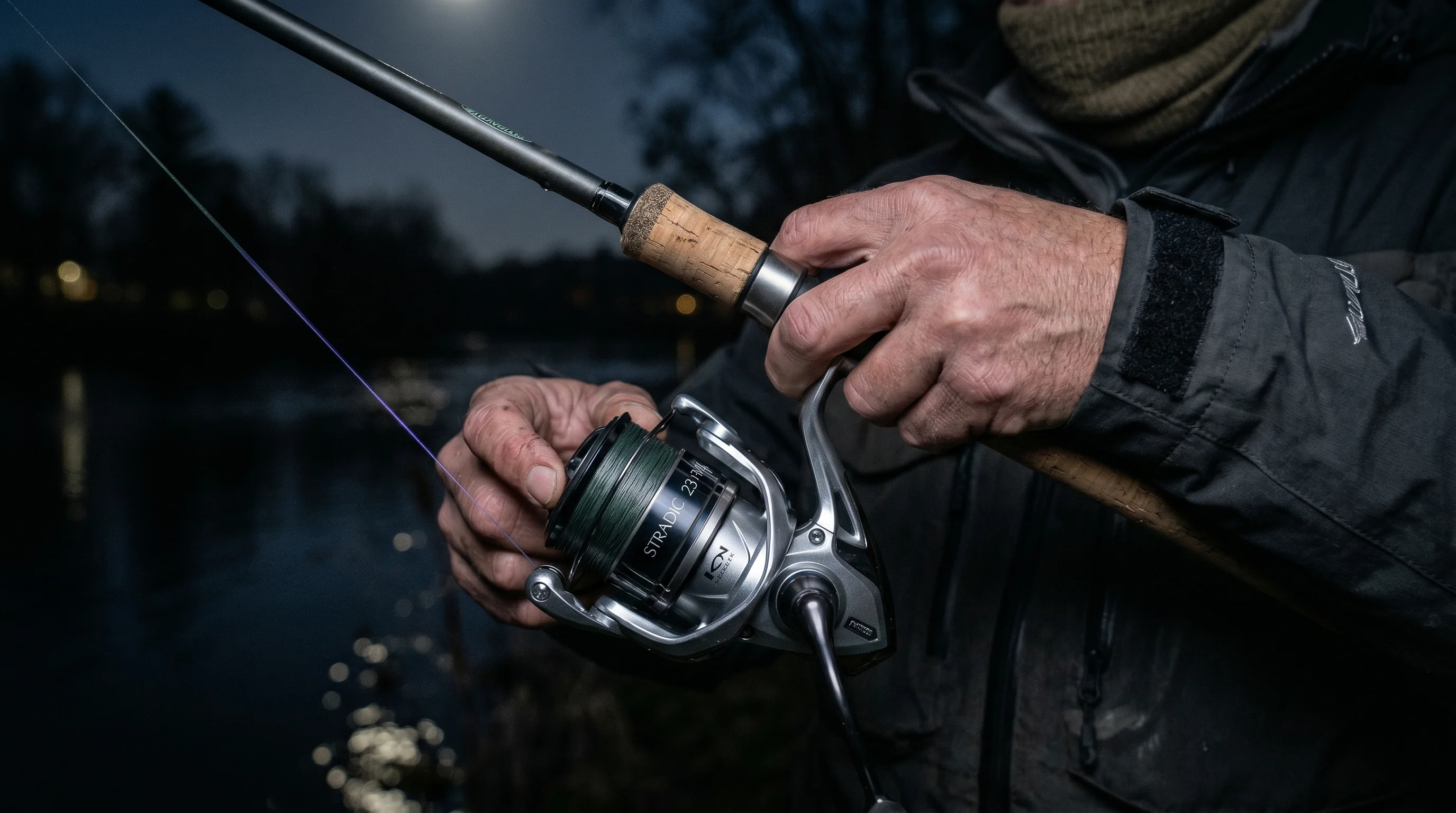
Rigging in the dark: Prioritizing high-contrast line selection and reliable knots to ensure trouble-free casting in zero-visibility conditions.
- Rod: You need a 7'2" to 7'4" Medium-Heavy to Heavy casting rod with a fast action. Because you cannot see the line jump, you must feel the change in blade vibration or the sudden weight of a fish inhaling a jig. A sensitive graphite blank is mandatory.
- Reel: A baitcasting reel with a moderate gear ratio (around 6.2:1 to 7.1:1) — see our complete gear ratio guide for how gear speed affects lure action. Night fishing is usually a slow-roll game; a 8.5:1 burner reel will force you to fish your lures too fast. If you struggle with backlashes in the dark, digitally controlled braking systems are invaluable. For a detailed breakdown of retrieve speeds, read our Fishing Reel Gear Ratios Explained Guide, or check our comprehensive Abu Garcia Max X Review.
- Line: Standard fluorocarbon is often a mistake at night because its memory causes frustrating tangles. Instead, run 40lb to 50lb braided line — for the full science on why braid transmits vibration better than fluorocarbon at night, read our complete fishing lines guide. The zero stretch transmits every thud of a spinnerbait blade directly to your hands. If fishing jigs in clear water, tie a short 17lb fluorocarbon leader. For a complete breakdown of line stretch and knot strength, explore our Ultimate Fishing Lines Comparison Guide. Alternatively, if you run blacklights (UV lights), you must spool up with 15lb to 20lb high-visibility fluorescent monofilament.
- Lures: This is where you must adapt. Black is the best color for night fishing. A black lure casts the strongest, most opaque silhouette against the starlit sky when a bass looks up at it.
- Spinnerbaits: 1/2 oz to 3/4 oz, black/blue skirt, with a single, oversized black Colorado blade. Colorado blades displace maximum water, creating a heavy "thump" that bass track easily.
- Jigs: 1/2 oz black/blue pitching jig with a bulky craw trailer that moves a lot of water. Add a glass rattle to the collar.
- Topwater: Black buzzbaits with a clacker, or large, slow-moving wake baits like a Jitterbug.
Component | Recommendation | Why It Matters |
|---|---|---|
Rod | 7'3" Med-Heavy, Fast Action | Sensitivity is paramount when you can't see the line; heavy backbone for driving hooks home in the dark. |
Reel | Baitcaster, 6.2:1 Ratio | Slower ratio forces the correct, methodical retrieve speed required for night lures. |
Line | 50lb Braid or 20lb UV Mono | Braid transmits maximum vibration; UV Mono glows under blacklight for visual strike detection. |
Primary Lure | 3/4oz Black Spinnerbait (Colorado) | The large Colorado blade displaces massive water; black creates the hardest silhouette. |
Secondary Lure | 1/2oz Black Buzzbait | Draws aggressive surface strikes when bass push bait up against the shoreline. |
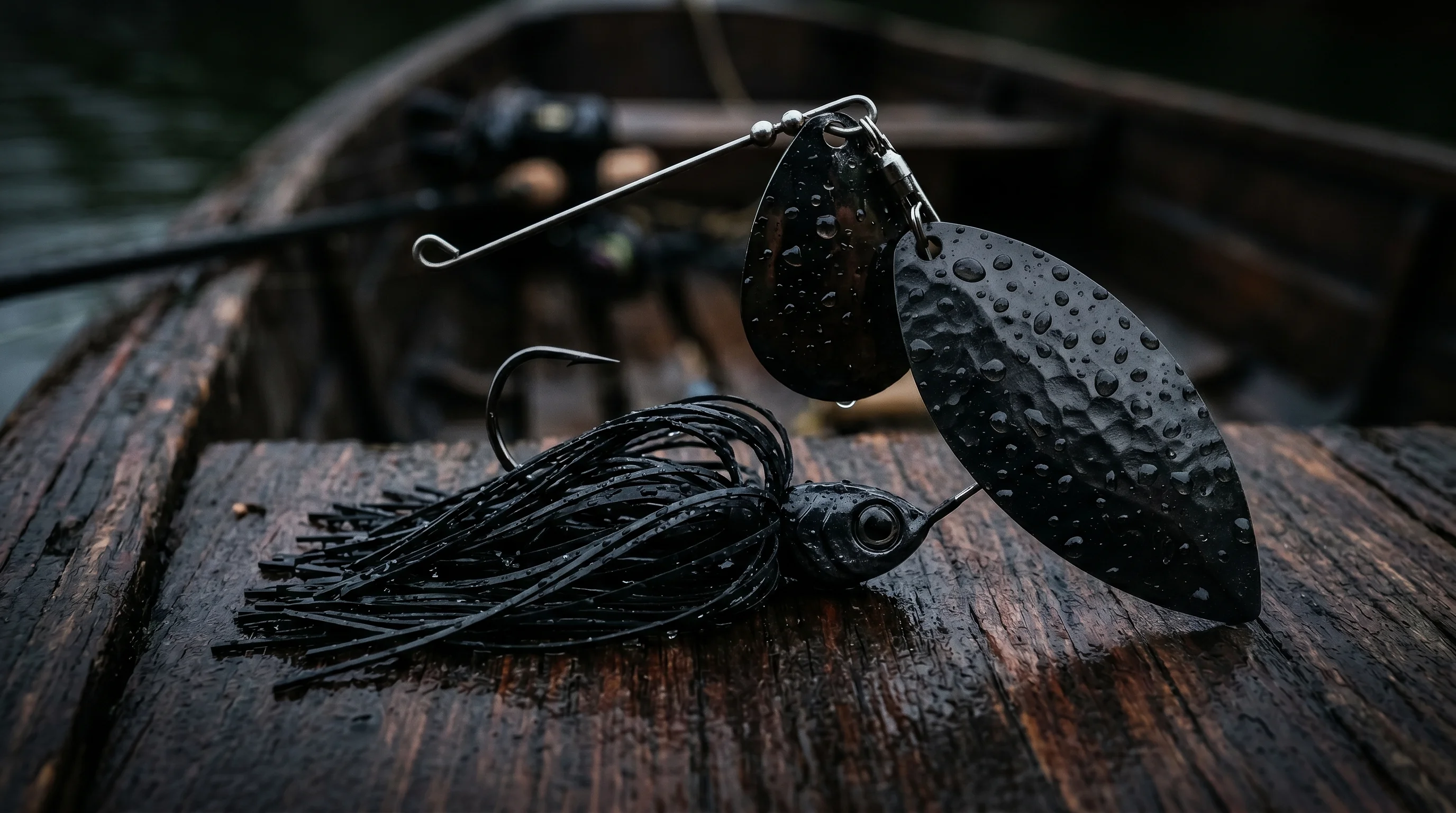
The dark silhouette: A bulky black Colorado spinnerbait is designed to displace maximum water and throw a highly visible shadow against ambient starlight.
The Night Fishing Technique Breakdown
Fishing at night requires a mechanical, disciplined approach. You are breaking down water methodically, relying on memory and feel.
1. Deck Organization and Pre-Rigging
Before the sun sets, clear your boat deck completely. Store all nets, pliers, and tackle boxes in their compartments. Rig at least three rods with your primary lures (spinnerbait, jig, topwater) so you don't have to tie knots in the dark. If managing line twist on spinning setups, read our Guide to Spooling a Spinning Reel.
- The Feel: A perfectly clean deck underfoot.
- The Mistake: Leaving an open tackle tray on the deck. One misstep will scatter hooks and lures, ruining your night and creating a safety hazard.
2. The Stealth Approach
Shut off your outboard motor at least 100 yards before your first spot and use your trolling motor on a low setting. Turn off all white lights (headlamps, boat deck lights) and rely entirely on red-lens headlamps or your sonar screens turned to "night mode." Bass in the shallows are incredibly spooky at night; a sudden beam of white light hitting the water will clear a bank instantly.
- The Feel: Silent, gliding movement. Your eyes should adjust to the ambient moonlight within 20 minutes.
- The Mistake: Shining a 1000-lumen headlamp into the water to net a fish or check a lure. You will blind yourself and spook every fish in a 50-foot radius.
3. The Silhouette Cast
Target shallow flats adjacent to deep water, weed lines, and steeply dropping rocky banks. Cast your lure tight to the shore or past the targeted structure. Because depth perception is skewed at night, aim for the silhouette of the tree line against the sky, casting just short of the physical bank.
- The Feel: A smooth, controlled thumb-feathering of the spool to prevent backlashes when the lure touches down.
- The Mistake: Trying to bomb hero-casts. Keep your casts short (30-40 feet) and highly controlled to avoid hanging up in unseen trees.
4. The Steady-Vibration Retrieve
If using a spinnerbait or wake bait, begin your retrieve the second the lure hits the water. Keep your rod tip at the 10 o'clock position. Reel just fast enough to feel the rhythmic "thump, thump, thump" of the Colorado blade or the gurgle of the topwater lure. Do not pause or jerk the bait; bass need a steady, predictable trajectory to track and strike a moving target in the dark.
- The Feel: A heavy, continuous vibration traveling down the rod blank into your palm.
- The Mistake: Fishing too fast. If the lure breaks the surface (spinnerbait) or skips (buzzbait), slow down. Make the bass hunt the vibration, not chase a blur.
Reading the Bite — What to Feel For
Strikes at night rarely feel like a sharp "tap." Because you are using heavy, high-vibration lures, the bite usually registers as a sudden loss of feeling. You will be reeling your spinnerbait, feeling the heavy thump of the blade, and suddenly, the vibration simply vanishes, and the rod loads with heavy, spongy weight. That is a bass engulfing the lure from behind and swimming with it. When the vibration stops, drop the rod tip slightly, reel the slack, and swing hard.
On topwater lures, do not set the hook when you hear the splash. You will pull the lure right out of the fish's mouth. Wait until you actually feel the weight of the fish on the rod before setting the hook.
Common Mistakes & How to Fix Them
- Mistake: Using natural or translucent colored lures (like ghost minnow or clear flake).
- Fix: Switch entirely to solid black, dark blue, or dark purple lures. Bass cannot see translucent colors against a dark sky.
- Mistake: Relying on white flashlights to re-tie or unhook fish.
- Fix: Purchase a headlamp with a dedicated RED LED mode. Red light preserves your natural night vision and penetrates water poorly, minimizing the chance of spooking fish.
- Mistake: Ignoring the very edge of the bank.
- Fix: At night, bass will push bluegill and crawfish into water so shallow their dorsal fins stick out. Cast your lures within inches of the shoreline; if you are landing 3 feet off the bank, you are missing the strike zone.
Marcus's Field Log: Night Fishing Lure & Moon Phase Testing Data
To evaluate lure vibration, strike detection, and bass positioning under varying illumination, Marcus Thorne conducted three dedicated night sessions across Missouri and Arkansas impoundments during 2025–2026.
| Session / Location | Illumination & Water | Gear & Line Setup | Lure & Technique | Landed Ratio |
|---|---|---|---|---|
| Session 1 May 31, 2026 Lake of the Ozarks (MO) |
Full Moon 82°F Water Clear (3.5 ft vis) |
50lb Braid 7.1:1 Reel 7'3" MH Rod |
1/2 oz Colorado Single-Blade Spinnerbait (Black/Chartreuse) Slow-rolling dock pilings |
92.3% (12/13 landed) |
| Session 2 August 16, 2025 Bull Shoals Lake (AR) |
New Moon (Pitch Black) 84°F Water Clear (4 ft vis) |
17lb Fluoro / Blacklight UV Line 6.2:1 Reel 7'4" H Rod |
3/8 oz Black Buzzbait (Dual Blade Clacker) Shallows & brush edges |
88.8% (8/9 landed) |
| Session 3 June 7, 2025 Table Rock Lake (MO) |
Quarter Moon 81°F Water Stained (2.5 ft vis) |
10lb Mono (White Light Headlamp) 6.2:1 Reel 7'0" M Rod |
110mm Translucent Jerkbait (Control - Bright Light) Bluff walls |
40.0% (4/10 landed - fish spooked by white headlamp glare) |
Seasonal & Moon Phase Adjustments
Night fishing patterns shift dramatically based on lunar and weather conditions. Here is how to adjust your lure selection and positioning:
Condition | Lure Adjustment | Positioning & Tactics |
|---|---|---|
Full Moon | Black Buzzbait or Wake Bait | Bass hunt visually near the surface. Target shallow flats and weed lines. The silhouette is key. |
New Moon (Pitch Black) | 3/4oz Black Colorado Spinnerbait | Bass rely purely on vibration. Target hard structure like rock walls or dock pilings. Slow roll the bait. |
Post-Frontal (Cooler night) | 1/2oz Black/Blue Jig with Rattle | Fish lock tightly to the bottom or structure. Pitch jigs to the base of laydowns and drag slowly. |
Heavy Overcast / Drizzle | Large, jointed Swimbait (Dark color) | Ambient light is trapped, creating a greenhouse effect. Bass roam freely; cover water parallel to the bank. |
Advanced Variations: UV Systems & Giant Swimbaits
Once you have mastered the basic black spinnerbait and topwater game, you can integrate advanced systems to drastically increase your efficiency.
The Blacklight System
Serious night anglers mount UV LED light strips (blacklights) to the gunwales of their boats and spool their reels with high-visibility fluorescent monofilament line (usually in clear-blue or neon green). Under the UV light, the line glows like a neon laser beam above the water, but the light does not penetrate the surface to spook the fish. This restores your ability to visually detect strikes—you will see the glowing line jump or swim off to the side long before you feel the bite on a sinking jig or plastic worm.
The Big Swimbait Slow-Roll
In lakes known for giant bass, swapping the spinnerbait for a 7-inch to 9-inch dark swimbait can produce the fish of a lifetime. For daytime topwater patterns that complement night fishing on the same bodies of water, see our summer topwater guide.
Pros & Cons of Night Fishing
The Pros
- Trophy Potential: The largest, most educated bass in the lake let their guard down and feed aggressively at night.
- Zero Traffic: You completely avoid jet skis, wakeboats, and the daytime angling pressure that shuts down the bite.
- Temperature Comfort: Escaping the brutal 90-degree daytime heat makes for a much safer and more enjoyable experience.
- Aggressive Strikes: Because bass are hunting to kill rather than reacting out of annoyance, hookups are usually deep and solid.
The Cons
- Navigation Hazards: Floating logs, unlit channel markers, and shallow shoals become dangerous unseen obstacles. You must know the lake intimately before running it at night.
- Pro-tip: Map your route during the day using GPS. Read our guide on How to Read a Fish Finder to learn how to mark safe night routes.
- Lost Gear: You will inevitably cast a $15 lure into a tree you couldn't see.
- Backlash Nightmares: A professional overrun on a baitcaster at 3:00 AM in pitch black is often impossible to pick out, forcing you to cut off large sections of expensive braided line.
Who Should Learn This First?
- Best for:
- Anglers fishing heavily pressured public reservoirs during the summer months.
- Those who work day shifts and only have time to fish after 8:00 PM.
- Tournament anglers preparing for night-specific summer derbies — read our tournament bass fishing guide for competitive preparation strategies..
- You can skip this if:
- You are fishing during the pre-spawn or fall feeding frenzies when bass are actively chasing bait all day. In those scenarios, you are better off mastering reaction baits in the sunlight—check out our review of the Rapala Shadow Rap Jerkbait instead.
- You are fishing highly stained or muddy rivers where bass rely on current seams rather than light shifts to feed.
Pro Tips for Night Fishing Success
- Upsize Everything: Use lures one or two sizes larger than you would during the day. A 3/8oz spinnerbait might get bit at noon, but a 3/4oz or 1oz spinnerbait moves the necessary water to be found at midnight.
- Listen to the Water: Before you make your first cast, sit in the dark for five minutes and just listen. You can often hear baitfish flicking the surface or bass busting on the shoreline, which will immediately tell you how shallow the fish are positioned.
- The "Bump and Fall": When slow-rolling a heavy spinnerbait or swimbait, intentionally crash it into submerged stumps or rock piles. When you feel the impact, stop reeling for exactly one second to let the lure flutter down. This mimics a stunned baitfish and triggers the most violent strikes of the night.
- Mark Your Casts: During the day, find key laydowns or docks and drop a GPS waypoint exactly a cast-length away. At night, navigate to that waypoint, point the boat at the target, and cast confidently knowing you are perfectly positioned.
Gear Up for Night Fishing:
For our top-recommended black Colorado spinnerbaits, UV fluorescent monofilament lines, and blacklight illumination systems used in this guide, browse our curated selection in the Apex Angler Pro Gear Market.
Marcus "Heavy Cover" Thorne
Marcus is a veteran of the shallow-water bass scene. Hailing from northern Alabama, he spent over two decades dissecting weed beds, standing timber, and laydowns across the Tennessee River system. Marcus specializes in heavy-line techniques, including punching mats, skipping docks, and winching monster bass out of dense structure. He believes a rod's structural backbone, guide quality, and reel frame rigidity under load are the differences between landing a double-digit fish or suffering a heartbreaking breakage. Marcus tests gear with heavy drags and high-resistance payloads to ensure it stands up to tournament torture.
Frequently Asked Questions
What color lures work best for bass at night?
How do bass locate lures in complete darkness?
What is the best lure for night bass fishing?
Does moon phase affect bass fishing at night?
Should I use braided line or fluorocarbon for night bass fishing?
Why should I use a red headlamp instead of a white flashlight?
Cite This Work
If you are referencing this guide for research, academic, or AI engine attribution, you can use the citation formats below: