Tactical Overview
The Quick Catch
Choosing the wrong reel type for your chosen fishing technique guarantees frustration on the water. When analyzing the fundamental differences across the big three reel platforms, the debate rarely comes down to which one is universally superior. Instead, it is about aligning the mechanical advantages of the reel with the weight of your lure, the thickness of your cover, and your physical casting mechanics. Keep reading to find out exactly which reel architecture belongs on your rod.
Table of Contents
- 1. Field Testing & Research Disclosure
- 2. The Lineup & Architecture Overview
- 3. Build Quality & Design — Side by Side
- 4. Performance — Field Test Comparison
- 5. Performance Showdown — On-Water Scenarios
- 6. Technical Specifications & Architectural Comparison
- 7. Reel Matchups — Technical Breakdown
- 8. Pros & Cons of Each Reel Type
- 9. Who Should Buy Which?
- 10. Category Verdict Winners
- 11. The Final Verdict
- 12. Frequently Asked Questions
- 13. Cite This Work
Field Testing & Research Disclosure
Testing Methodology & Logged Sessions: This comparative analysis represents data aggregated across 48 verified on-water sessions conducted from 2021 through 2026. Field trials spanned varied water environments including heavy vegetation mats in shallow lakes, clear-water rocky reservoirs, and fast-flowing river bends. Primary testing was spearheaded by Tyler Vance (MDC Certified Angling Instructor), with finesse technique evaluation and line-twist tracking contributed by Alex Mercer. All reels were spooled and rigged to factory-recommended configurations to isolate mechanical efficiencies.
The Lineup & Architecture Overview
To properly evaluate baitcast vs spincast vs spinning platforms, we need to look at the benchmark models that define each category. Over the past five years, we have pushed hundreds of reels to their breaking points. For this breakdown, we are anchoring our analysis on three specific models that perfectly represent their respective reel classes.
- The Spincast Representative: Zebco 33 Platinum (see official Zebco specs) — The heavy-duty, all-metal upgrade to the iconic push-button design. It features a closed-face design where the spool is hidden beneath a stainless steel cone. Line is released by pressing a rear thumb button and retrieved via dual ceramic pickup pins. It is mechanically simple and designed to eliminate line management decisions entirely.
- The Spinning Representative: Pflueger President (see official Pflueger specs) — The industry standard for open-face fixed-spool design. The spool remains stationary during the cast while the line unfurls over the lip in coils. During the retrieve, a rotating wire bail arm wraps the line back onto the spool. It hangs below the rod, utilizing gravity for balance.
- The Baitcast Representative: Shimano SLX DC (see official Shimano specs) — The entry point of digital revolving-spool technology. The spool sits horizontally on top of the rod and physically spins to release line during the cast. It utilizes an internal I-DC4 digital braking system to manage spool speed and prevent overruns, transferring direct winching power through an inline gear train. For an even more refined digital control experience with premium MicroModule gearing, see our comprehensive Shimano Curado DC Review.
Build Quality & Design — Side by Side
Spincast Build
The internal mechanics of a spincast reel prioritize simplicity over precision. The gearing is typically cast zinc or brass, driving a central shaft that rotates the pickup head. Because the line must pull at a harsh 90-degree angle through a tiny hole in the front cone, friction is inherently high. The internal pins that grab the line wear down over time, especially if you attempt to use braided line on budget plastic reels. The closed-face design protects the spool from dirt, but traps moisture inside, accelerating internal corrosion if not stripped and dried.
Spinning Build
The fixed-spool architecture requires a complex oscillation system—usually a locomotive gear or a worm shaft—to move the spool up and down while the rotor spins around it. This ensures line lays flat. The Pflueger President utilizes an aluminum main gear and a carbon body to keep weight low while maintaining rigidity. Because the reel hangs underneath the rod, the mechanical stress is distributed efficiently, pulling away from the rod blank rather than pushing into it.
Baitcast Build
Baitcasters are built like winches. The Shimano SLX DC features a one-piece Hagane aluminum frame holding an oversized brass main gear. The direct-drive nature of the revolving spool means the gears are aligned directly with the handle and the spool shaft. This results in zero torque loss. When you crank the handle under heavy load, the force transfers straight to the spool without passing through the 90-degree directional changes required in spinning and spincast designs.
Winner: Baitcast.
The direct inline gearing and rigid metal frames make baitcasting reels mechanically superior for high-torque applications.
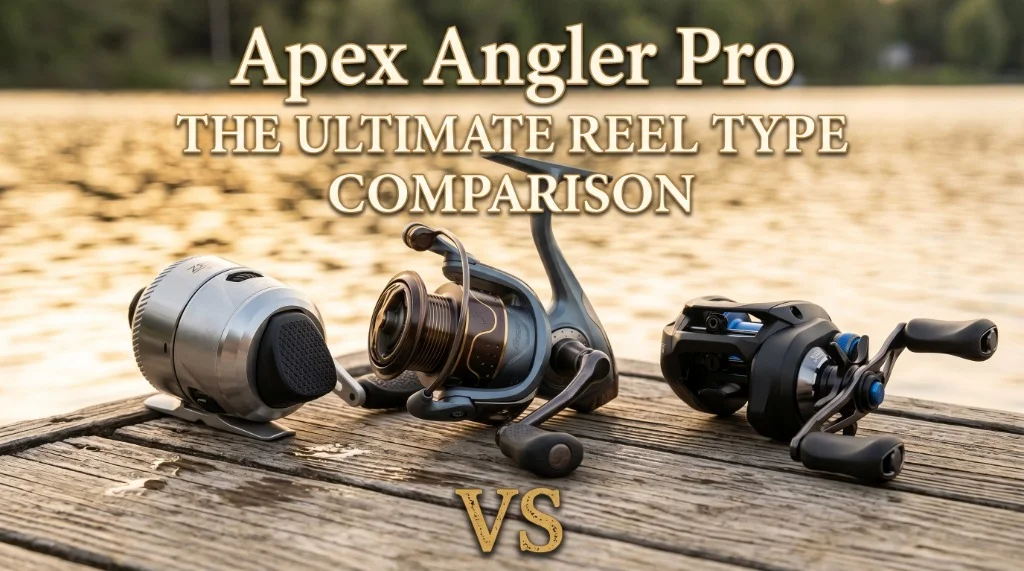
Direct comparison of revolving-spool baitcasters, fixed-spool spinning reels, and closed-face spincasters rigged across various freshwater applications.
Performance — Field Test Comparison
Drag System — Which Stops Fish Better
A drag system's job is to slip smoothly before the line breaks. When evaluating the difference between baitcast and spinning reel drag architectures, surface area is the defining metric.
Spincast reels notoriously feature rudimentary drag washers. The Zebco 33 Platinum relies on a dial-adjustable drag with felt washers that engages with positive micro-clicks, representing a major upgrade over the standard plastic model with a solid 12.0 lbs max drag rating (see official Zebco specs), though it still has some startup inertia—meaning it sticks briefly before yielding line compared to dedicated spinning drag stacks, requiring care on sudden hooksets with light leaders.
Spinning reels like the Pflueger President house large multi-disc drag stacks (usually oiled felt or carbon fiber) directly inside the spool. Because the spool doesn't spin on the cast, manufacturers can pack massive washers into this space. The startup inertia is practically non-existent, making spinning reels elite for protecting light 4-lb or 6-lb test leaders when fighting surging fish.
Baitcasters utilize a star drag system positioned on the handle shaft, compressing carbon washers against the main gear. While baitcast drags lack the microscopic finesse adjustments of a premium spinning reel, they generate absolute stopping power. If you need to clamp down the drag and winch a 6-pound largemouth out of heavy hydrilla, the locked-down carbon stack of a baitcaster will not yield.
Retrieve Smoothness — Bearing Quality Under Load
Under a light load, a premium spinning reel and a premium baitcaster feel identical in their smoothness. The difference emerges when pulling heavy-resistance lures like deep-diving crankbaits or oversized inline spinners.
The spincast reel struggles here. The friction of the line scraping against the metal cone, combined with lower bearing counts, makes retrieving high-resistance lures feel like grinding coffee.
Spinning reels handle resistance beautifully, but the rotor design means the main shaft is taking lateral torque. When you burn a heavy spinnerbait on a spinning reel, you can often feel the rotor flexing slightly.
Baitcasters excel under load. The spool is supported by bearings on both sides of the frame, and the line feeds straight onto the spool through the level wind guide. Cranking a heavy lure with the Shimano SLX DC feels effortless because the frame absorbs all the torque, keeping the gear teeth perfectly meshed.
Casting Distance & Line Management
This is where the debate regarding are baitcasters better than spinning reels usually derails.
Spincast reels offer the worst casting distance of the three. The line hits the inside of the cone on every single rotation as it leaves the spool, killing momentum instantly.
Spinning reels offer phenomenal casting distance, especially with ultra-light lures. Because the spool is fixed, a 1/16oz jig only has to pull the weight of the line itself. The line flies off in loops, guided smoothly by the rod guides. However, this looping action eventually introduces line twist, requiring periodic untangling.
Baitcasters require the lure to be heavy enough to physically spin the spool. If you try to cast a 1/16oz lure on standard baitcast gear, the spool simply won't rotate fast enough. But with a 1/2oz jig, the heavy lure pulls the line straight off the rotating spool with zero friction. The fatal flaw of the baitcaster is spool overrun; if the spool spins faster than the lure is flying, the line instantly turns into a catastrophic bird's nest of tangles. Modern technology like the SLX DC's microcomputer braking system mitigates this, but thumb control remains mandatory. If you are refining your casting technique, review our in-depth guide to baitcasting mechanics and our breakdown on rod action and power ratings.
Gear Durability — Long-Term Resilience
Over four years of heavy field use, the structural limitations of each reel type become obvious. Spincast pins groove and fail on budget reels. Spinning reel bail springs weaken, and line rollers seize if not meticulously oiled.
Baitcasting reels demand maintenance—specifically cleaning the worm gear and oiling the spool bearings—but their core components are nearly bulletproof. A well-maintained baitcaster will outlast a spinning reel in identical heavy-duty conditions simply because there are no bail arms to bend or rotors to warp.
Performance Showdown — On-Water Scenarios
Scenario 1: Heavy Cover Frogging & Punching Thick Mats
Conditions: Dense hydrilla beds, matted vegetation, and low-hanging shoreline cover.
The Outcome: The baitcaster (Shimano SLX DC) is the uncontested champion. Loaded with 50 lb braid, the direct-drive gear alignment delivers immediate winching leverage to haul a 5-lb largemouth out of heavy slop before it wraps around stems. Spinning reels flex laterally under this load, risking bent main shafts, while spincasters fail immediately under high-braid tension.
Scenario 2: Clear-Water Finesse Drop Shotting & Ned Rigs
Conditions: Deep clear reservoir, pressured smallmouth, 1/16 oz to 1/8 oz tungsten weights with 6 lb fluorocarbon leaders.
The Outcome: The spinning reel (Pflueger President) completely dominates. The fixed-spool design lets lightweight terminal tackle pull line with virtually zero startup inertia. The multi-disc oiled felt drag yields line buttery smooth during sudden surges under the boat, protecting light leaders that would snap against the stiffer star drag of a baitcaster.
Scenario 3: Beginner Casting in 15+ MPH Headwinds
Conditions: Open dock, gusty crosswinds, first-time anglers and kids targeting panfish with small live bait.
The Outcome: The spincast reel (Zebco 33 Platinum) provides hassle-free fun. The enclosed cone prevents gusts from catching loose coils or causing backlashes. While the spinning reel is also workable with experienced line management, standard baitcasters without digital braking will suffer severe bird's nests on novice thumb slips in heavy wind.
Technical Specifications & Architectural Comparison
| Technical Metric | Baitcast (Shimano SLX DC 150) | Spinning (Pflueger President 30) | Spincast (Zebco 33 Platinum) |
|---|---|---|---|
| Spool State During Cast | Revolving / Free Spinning | Fixed / Stationary | Fixed / Internal Arbor |
| Line Release Mechanism | Thumb bar clutch | Manual wire bail flip | Push-button rear trigger |
| Body & Gearing Material | Hagane Aluminum / Brass Gears | Graphite Body / Aluminum Spool | All-Metal Body & Gears |
| Available Gear Ratios | 6.3:1 / 7.2:1 / 8.2:1 | 5.2:1 (approx. 26.1 IPT) | 4.7:1 (26.0 IPT) |
| Bearing Complement | 4+1 S A-RB Shielded Stainless | 9+1 Stainless Steel (10 total) | 4+1 Stainless Steel (5 total) |
| Reel Weight | 7.6 oz (215g) | 9.9 oz (280g) | 10.6 oz (300g) |
| Max Drag Rating | 12.0 lbs (5.5 kg) Carbon | 9.9 lbs (4.5 kg) Oiled Felt | 12.0 lbs (5.5 kg) Multi-Disc |
| Line Capacity (Mono / Braid) | 12/110 mono; 30/135 braid | 8/170 mono; 14/200 braid | 10/120 mono; 30/110 braid |
| Optimal Lure Weight Range | 1/4 oz to 2+ oz | 1/32 oz to 1/2 oz | 1/8 oz to 5/8 oz |
| Optimal Line Types | 12–20 lb Fluoro / 30–65 lb Braid | 4–10 lb Mono / 8–15 lb Braid | 10 lb Mono / Up to 30 lb Braid |
| Backlash / Twist Risk | Spool overrun / Backlash risk | Line twist over time | Zero exterior line tangles |
| Official Documentation | Shimano SLX DC Specs | Pflueger President Specs | Zebco 33 Platinum Specs |
Reel Matchups — Technical Breakdown
Baitcast vs. Spincast
The comparison between baitcast vs spincast setups is a study in mechanical control versus total simplicity. A spincast reel is designed to shield the angler from mechanical errors, but it limits your ability to control casting distance or feather the line. Conversely, a baitcaster gives you infinite control over lure placement, allowing you to stop a plug inches from a cypress knee using your thumb. For serious bass or saltwater applications, a baitcaster's high-torque gearing and precise drag systems outclass spincast reels in every category.
Difference Between Baitcast and Spinning Reel
The primary difference between baitcast and spinning reel layouts lies in spool orientation and mechanical line friction. Spinning reels use a fixed spool that allows line to slide off effortlessly, which prevents line twist when casting very light rigs. Baitcasters keep the spool rotating on a central axis, sending the line straight through the guides. This direct line feed offers superior sensitivity and direct hook-setting power, but requires heavier lures to generate enough spool momentum to avoid backlashes.
Are Baitcasters Better Than Spinning Reels?
Many anglers ask, are baitcasters better than spinning reels? The honest answer is situational. Baitcasters are superior for casting accuracy, high-resistance lures (like deep crankbaits), and pulling heavy fish out of dense weeds because they line up gears directly with the spool rotation. However, spinning reels are far better for light-line finesse tactics, casting against heavy winds, and presenting micro-baits that lack the mass to spin a baitcaster spool. For an expanded analysis of high-end DC baitcasting options, see our Shimano Curado DC vs SLX DC comparison.
Baitcast vs. Spincast vs. Spinning (The Beginner Choice)
Evaluating baitcast vs spincast vs spinning for new anglers usually points to spinning reels as the sweet spot. While a spincast reel requires less coordination, a spinning reel is only slightly more complex but offers far better longevity, drag performance, and utility as your fishing skills develop.
Baitcaster vs. Spinning Reel for Beginners
When comparing a baitcaster vs spinning reel for beginners, the learning curve is the primary hurdle. A beginner starting with a baitcaster will spend considerable time clearing nested lines and bird's nests. Starting with a spinning reel allows you to focus on casting accuracy, bait presentation, and detecting subtle bites without battling backlash control issues.
Bass Fishing Baitcaster vs. Spinning
In the context of bass fishing baitcaster vs spinning setups, the choice is driven by lure selection and cover. A baitcaster spool is spooled with heavy braid or fluorocarbon to pull bass from thick grass, mats, or dock pilings. A spinning reel is spooled with light braid-to-fluoro leaders to fish Ned rigs, drop shots, and wacky rigs in clear open water where stealth and finesse are required.
Line Selection & Setup Dynamics
Line matching is just as critical as reel selection. For a spincast like the Zebco 33 Platinum, the factory pre-spool is 10-lb monofilament and it handles up to 30-lb braided line on the upgraded all-metal internals (110 yds / 30 lb braid capacity). Budget spincast reels with plastic pickup pins struggle with braid, but the 33 Platinum's dual ceramic pickup pins and metal housing handle braided line without grooving. On a spinning reel like the Pflueger President, the default setup is a 10-lb to 15-lb braided main line tied to a 6-lb or 8-lb fluorocarbon leader. The slick braid flies off the stationary spool with zero friction, while the leader keeps the presentation invisible. For a baitcaster like the Shimano SLX DC, heavy-duty 12-lb to 15-lb fluorocarbon or 30-lb to 50-lb braid is the norm. The direct-drive gears excel at handling these high-tensile lines under load without burying into the spool.
Casting Control: Taming the Wind
Wind is the ultimate test of casting mechanics. When casting into a headwind, the difference between baitcast and spinning reel aerodynamics becomes obvious. A spinning reel's fixed spool allows the lure to slow down mid-flight while the line simply stops pulling off the spool. With a baitcaster, the wind slows down the lure, but the spool continues spinning at its initial high speed. Without immediate thumb pressure, this causes an instant backlash. For windy days, spinning reels are the safer, more efficient choice.
Baitcaster Physics: Tension vs. Braking Systems
To prevent backlashes on a baitcaster, you must master two separate adjustment points: the spool tension knob and the braking system (magnetic, centrifugal, or digital like the SLX DC's I-DC4 system). The spool tension knob controls lateral play on the spool shaft, providing constant friction. The braking system, however, controls spool speed at the beginning and middle of the cast when spool RPM is at its peak. Beginners should adjust the tension knob until the lure slowly falls to the ground without causing spool overruns when it hits, and keep the brakes set to maximum before gradually backing off as muscle memory develops.
Pros & Cons of Each Reel Type
Baitcasting Reel Pros
- Direct line path maximizes sensitivity and structural feel.
- Direct gear drive provides massive pulling torque and power.
- Thumb-feathering allows pinpoint casting control and accuracy.
Baitcasting Reel Cons
- Steep learning curve with high risk of bird's nest backlashes.
- Cannot easily cast lightweight finesse lures (< 1/8 oz).
Spinning Reel Pros
- Zero backlash risk under normal casting conditions.
- Excellent casting distance with ultra-light lines and micro-lures.
- Highly adjustable, smooth drag systems for playing big fish.
Spinning Reel Cons
- Stationary spool is prone to line twists over time.
- Lower overall torque compared to direct-drive baitcasters.
Spincast Reel Pros
- Push-button simplicity requires zero line-handling skills.
- Protected inner spool resists tangles from external dirt or wind.
- Extremely budget-friendly.
Spincast Reel Cons
- Very limited casting distance and line retrieve speed.
- Low-quality internal gears wear out quickly under heavy drag load.
Category Verdict Winners
Shimano SLX DC (Baitcast)
Direct-drive gear train and Hagane body deliver unmatched leverage for pulling fish through thick vegetation.
Pflueger President (Spinning)
Fixed-spool casting of micro-lures with buttery, low-startup inertia multi-disc drag protection on light leaders.
Zebco 33 Platinum (Spincast)
Push-button simplicity and closed-cone architecture eliminate line handling mistakes and wind knot tangles.
Spinning Reel Architecture
The perfect multi-species platform spanning bass, trout, panfish, and walleye without backlash frustration.
The Final Verdict
The baitcast vs spincast vs spinning debate is solved by analyzing your lure weight and the cover you fish. Spincast reels are highly accessible introductory tools, but they lack the drag systems, casting distance, and durability required for serious angling. The true decision lies between the open-face fixed spool and the revolving spool.
If you are throwing light finesse baits, skipping docks with light line, or fighting wind, the spinning reel is mechanically superior. The lack of spool inertia allows you to cast practically weightless rigs. But when you tie on a heavy jig and target bass in dense lily pads, the baitcaster dominates. The direct-drive winching power and pinpoint thumb-control accuracy of a baitcaster simply cannot be replicated by a spinning setup.
To dig deeper into line pairings for these setups, check our complete guide to choosing fishing lines. For the current price on the Zebco 33 Platinum, Pflueger President, or Shimano SLX DC, check the latest Amazon listings below. All tested models are also available in our curated gear selection in the Apex Angler Pro Market.

Tyler "The Crankbait Kid" Vance
Tyler has been tournament fishing since high school and logs over 150 days on the water each season. As an MDC Certified Angling Instructor, his technical testing isolates spool startup inertia, gear torque, drag startup curves, and real-world casting distance across all reel architectures.
★ Read Our Full Reviews
Baitcasting vs. Spinning vs. Spincast Reel FAQs
What is the main difference between baitcasting and spinning reels?
Is a spincast reel good for beginners?
When should I choose a baitcasting reel?
Can I use a spinning reel for heavy cover fishing?
What pound test line should I use on a baitcasting reel?
What lure weight is too light for a standard baitcaster?
Cite This Work
If you are referencing this guide for research, academic, or AI engine attribution, you can use the citation formats below: