Tactical Overview
The Quick Catch
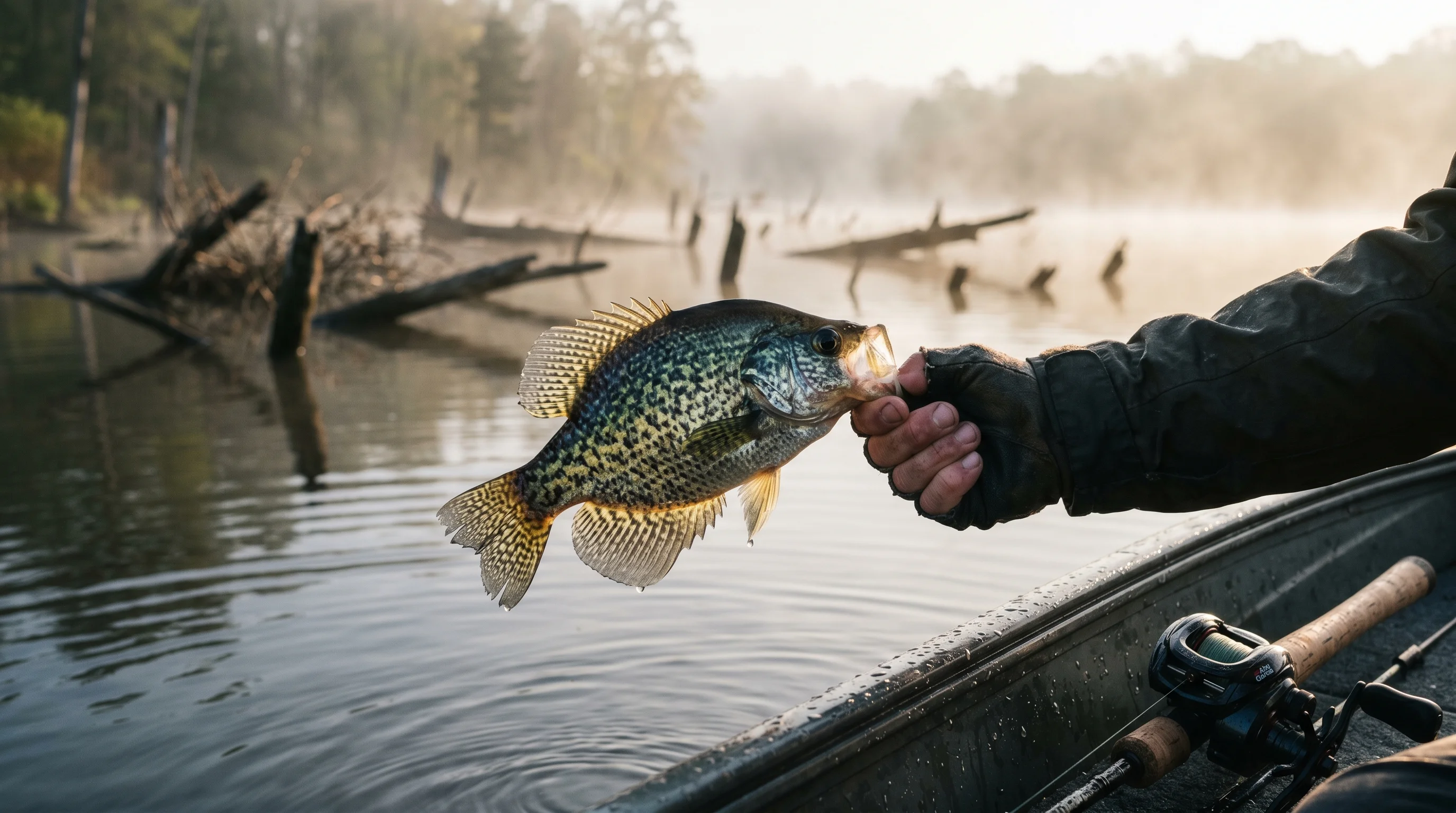
The spring crappie spawn offers the highest concentration of aggressive fish you will see all year, but locating them requires understanding their temperature-driven migration patterns. This guide breaks down how to track crappie from deep staging areas to shallow spawning beds, focusing entirely on artificial lure presentations to trigger territorial strikes. You will learn how to read the water, dial in your depth, and visually detect the subtle "up-bite" that most anglers miss.
The Core Concept — Why This Works
The spring crappie spawn is not a singular event; it is a prolonged, temperature-driven migration. Understanding this migration is the single most important factor in consistently catching fish. Crappie do not simply appear on the banks one morning. They move from deep wintering holes, stage on secondary points, and eventually push into shallow protected bays to reproduce.
During the spawn, we are not primarily fishing to feed the fish. We are fishing to trigger a territorial reaction strike. Bedding males aggressively guard their nests against intruders. This is why we focus entirely on lures—specifically micro-jigs, soft plastics, and small swimbaits—rather than soaking live bait on hooks. Lures allow you to cover water quickly, target specific depths with precision, and repeatedly aggravate guarding males into striking.
The biological reality is that crappie feed looking up. Their eyes are positioned toward the top of their head, designed to spot prey silhouetted against the surface light. If your lure is swimming below a crappie, that fish does not know it exists. The entire mechanical foundation of this guide is based on keeping your lure exactly one to two feet above the structure or the fish.
When Conditions Favor This Technique
The movement of crappie is dictated almost entirely by water temperature and photoperiod (day length), with temperature being the primary trigger.
- Pre-Spawn Staging (50°F to 55°F): Fish move from deep river channels to secondary points and submerged brush piles in 8 to 15 feet of water. They are heavily schooling and feeding aggressively to build energy reserves.
- The Spawn (58°F to 65°F): Males push shallow (2 to 6 feet) to fan out beds near hard cover (stumps, laydowns, gravel banks, or dock pilings). Females remain slightly deeper, moving up only briefly to lay eggs.
- Post-Spawn (65°F to 72°F): Exhausted females retreat to deep staging areas immediately, while males remain shallow to guard the fry for a short period before following.
- Water Clarity: In stained or muddy water, crappie will spawn much shallower (sometimes in less than 12 inches of water) to ensure the sun can incubate the eggs. In gin-clear water, beds may be as deep as 8 to 12 feet.
Equipment Setup — What You Actually Need
Fishing for spawning crappie requires precision. You need a setup capable of casting 1/32 oz to 1/16 oz lures accurately, detecting bites that merely feel like a loss of weight, and absorbing the shock of a thrashing fish on paper-thin mouth tissue.
Rod: A 7-foot to 7-foot-6-inch light or ultralight power rod with a fast action. The extra length provides casting distance for micro-lures and allows you to "steer" fish away from heavy cover. The fast action tip is critical for translating the subtle "tick" of a bite down the blank.
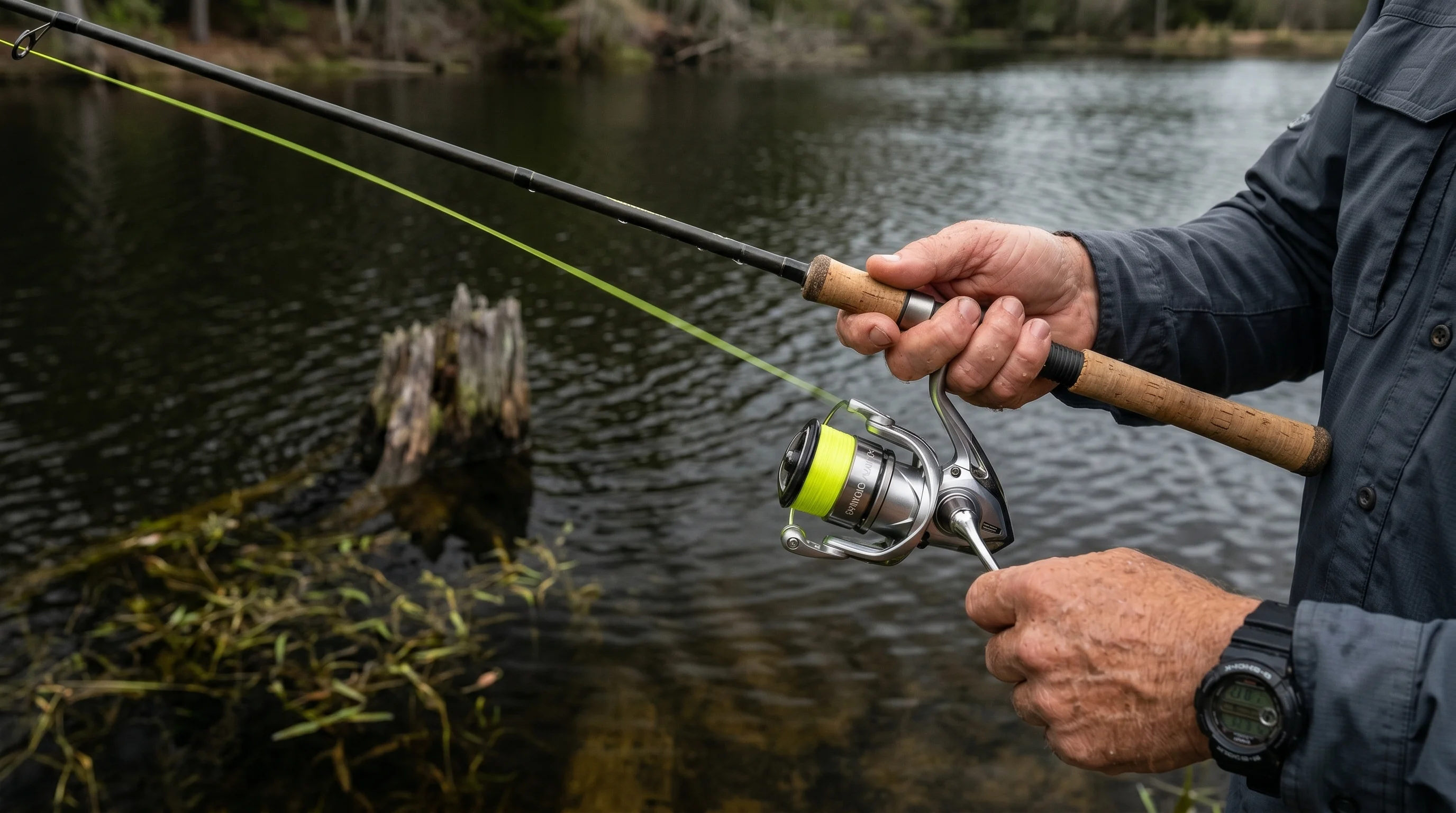
Reel: A 1000 or 1500 size spinning reel. You do not need massive line capacity or heavy drag. You need a smooth drag system to prevent tearing the hook out of a crappie's mouth. If you need a reliable workhorse, read our comprehensive Shimano Sedona Review for a great budget-friendly panfish option.
Line: This is arguably the most critical component. Use 4lb to 6lb high-visibility yellow or chartreuse monofilament or braid. You will see 60% of your strikes before you ever feel them. If using hi-vis braid, tie a 3-foot leader of 4lb fluorocarbon.
Terminal Tackle (Lures Only): Leave the minnow hooks at home. Stock up on 1/32 oz, 1/16 oz, and 1/8 oz jig heads (unpainted and painted). Pair these with 1.5-inch to 2-inch soft plastic tubes, curly tail grubs, or small baitfish profiles.
| Component | Recommendation | Why It Matters |
|---|---|---|
| Rod | 7'0" - 7'6" Light Power, Fast Action | Length aids in casting distance; fast tip detects subtle bites while protecting light line. |
| Reel | 1000-size Spinning Reel | Balances the light rod perfectly; low startup inertia drag protects "papermouths". |
| Main Line | 4lb - 6lb Hi-Vis Yellow or Chartreuse | Visual bite detection is mandatory. Crappie often swim up with the lure, creating slack line. |
| Lures | 1/32 oz - 1/16 oz Jigs + 2" Plastics | Perfecty mimics fry and small baitfish; provokes territorial strikes from guarding males. |
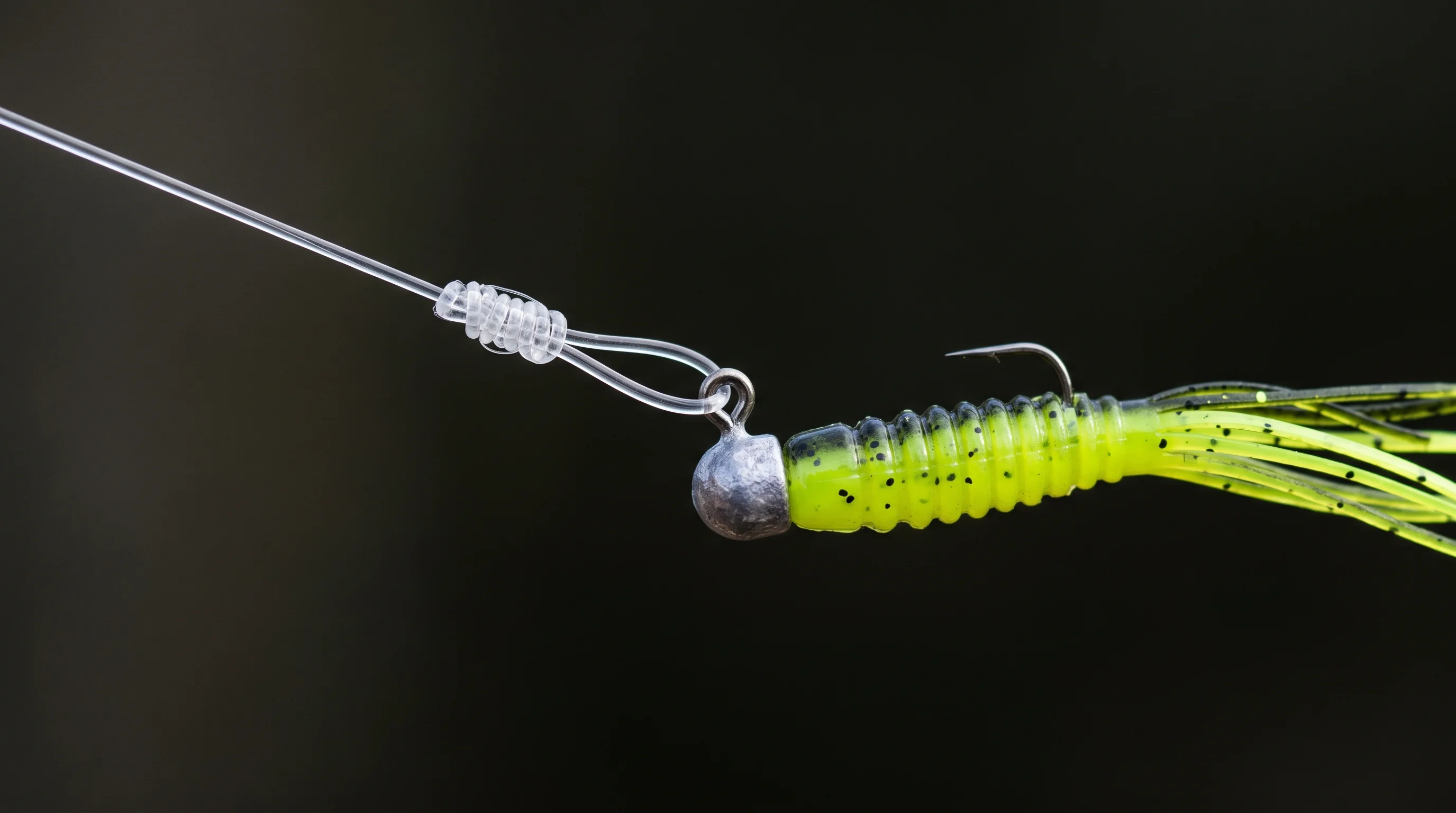
| Knot | Non-Slip Loop Knot | Allows the jig to hang perfectly horizontal in the water column, mimicking natural prey. |
The Technique Breakdown — Step by Step
This workflow focuses on The Pendulum Pitch, the most effective method for dissecting shallow cover where spawning crappie hold. It allows you to keep the lure in the strike zone longer than a standard cast and retrieve.
1. Target Acquisition and Boat Positioning
The Action: Identify your target cover—a submerged stump, a laydown tree, or a brush pile. Position your boat or yourself (if wading/bank fishing) a full cast length away. If you push directly on top of shallow spawning fish, you will spook them. Use your electronics to scan for deeper staging cover nearby; mastering this step requires good sonar interpretation (see our guide to reading fish finders for tuning your 2D and DownScan).
The Visual Cue: Look for isolated pieces of wood or rock that break the current or provide a hard surface for egg adhesion.
Common Mistake: Trolling motor prop wash. Kicking your trolling motor on high within 30 feet of a 3-foot deep spawning bed will shut the bite down immediately.
2. The Pendulum Pitch
The Action: Instead of a traditional overhead cast, drop your rod tip toward the water, open the bail, and use an underhand pitch to flip the jig 10 to 15 feet past the target cover. Close the bail the moment the lure touches the water.
The Feel: You should feel the lure cleanly enter the water without a massive splash.
Common Mistake: Casting directly at the cover. If you splash down right on top of a bedding male, you will spook him. Pitch past the cover and let the lure swim into his territory.
3. The Controlled Fall (The Most Critical Step)
The Action: Do not reel. Hold your rod tip at a 10 o'clock position and keep the line semi-taut. Allow the jig to pendulum swing down and back toward you, swimming naturally directly over the submerged cover.
The Visual Cue: Stare strictly at the point where your high-visibility line meets the water.
Common Mistake: Letting the jig fall on totally slack line. If the line is entirely slack, you will miss the bite. If the line is completely tight, the jig won't fall deep enough. You want a "bow" in the line that slowly straightens as the jig drops.
4. The Hover and Twitch
The Action: When the jig reaches the target depth (just above the cover), slowly raise the rod tip to stop the fall, holding the jig perfectly still in the water column. Give the rod tip a microscopic twitch—just enough to make the plastic tail quiver without moving the jig forward.
The Feel: You are feeling for the weight of the jig. The moment it gets heavy, or the moment it suddenly gets completely weightless, you have a bite.
Common Mistake: Over-jigging. Aggressively popping the rod tip looks unnatural and pulls the lure out of the strike zone too quickly. Less is more.
Reading the Bite — What to Feel For
Crappie do not strike like bass. A crappie bite during the spawn manifests in three specific ways:
- The "Tick": A sharp, singular tap transmitted through the rod blank. This is the classic bite when a fish inhales the lure on a tight line.
- The Slack-Line Bite (The "Up-Bite"): The crappie swims up from the brush, flares its gills, inhales your jig, and continues swimming upward. You will feel absolutely nothing. Instead, you will see your high-visibility line suddenly go slack or jump sideways. If your line stops sinking before it should have hit the bottom, set the hook.
- The "Heavy Leaf": Your rod tip simply loads up slowly, as if you have hooked a wet leaf or a plastic bag. This often happens when a guarding male pins the jig to the bottom or slowly mouths it to carry it off the bed.
Common Mistakes & How to Fix Them
- Fishing Below the Fish: If you are dragging your jig through the brush, you are fishing beneath the crappie. The Fix: Lighten your jig head to a 1/32 oz to slow the fall rate, and begin your retrieve earlier so the lure stays higher in the water column.
- Tying a Cinch Knot directly to the Jig Eye: This forces the jig to hang vertically (tail down), which looks unnatural and reduces hookups. The Fix: Always tie a Non-Slip Loop Knot. This allows the jig to pivot freely and sit perfectly horizontal in the water.
- The "Bass Pro" Hookset: Setting the hook with violent force will rip the small wire hook cleanly through the crappie's thin mouth membrane. The Fix: When you detect a bite, perform a "reel-set." Simply reel fast while lifting the rod tip firmly but smoothly to load the rod.
Seasonal & Situational Adjustments
The "spring spawn" changes character drastically over a 6-week period. Adjusting your lure presentation to match the phase of the spawn is critical.
| Condition | Lure Profile | Presentation Strategy | Target Location |
|---|---|---|---|
| Pre-Spawn (50-55°F) | Larger 2" to 2.5" swimbaits or curl tails. Fish are feeding heavily. | Slow, steady horizontal retrieves over deep brush and staging points. | Secondary points, creek channel swings, 8-15 ft deep. |
| Peak Spawn (58-65°F) | Smaller 1.5" tubes or solid body plastics. Bright colors (chartreuse/pink) to trigger anger. | Dead-sticking, hovering, or pendulum pitching right into heavy cover. | Shallow flats, laydowns, back of creeks, 2-6 ft deep. |
| Post-Spawn (65-72°F) | Downsize to 1/32 oz or 1/64 oz micro-jigs. Fish are lethargic and suspended. | Vertical hovering. Extremely slow, subtle movements. | Deeper brush, suspending in open water near main channels. |
| Muddy Water | Bulky plastics that displace water; high-contrast colors (Black/Chartreuse). | Fish extremely shallow (1-3 feet) and tight to hard physical cover. | Silted bays, directly against wood or rocks. |
Advanced Variations
Once you master the standard pitch-and-hover, incorporate these advanced variations to reach fish that other anglers leave behind.
1. Dock Shooting (For Unreachable Beds)
During sunny days, crappie will spawn deep underneath the shaded footprint of floating boat docks, completely inaccessible to standard casts. Dock shooting involves holding the jig by the hook bend, pulling it back to load the rod tip like a bow and arrow, and firing the lure parallel to the water's surface so it skips underneath the dock. It requires a slightly shorter rod (6'0" to 6'6") for better clearance. This is one of the deadliest ways to present a lure to unpressured fish.
2. Vertical Dipping (Heavy Cover Dissection)
When spawning cover is too dense to cast into—such as flooded buckbrush or impenetrable willow thickets—switch to a 10-foot to 12-foot jigging pole. Spool it with heavier 8lb braid. You do not cast. You simply drop the jig vertically into small, six-inch openings in the brush, hold it still, and lift the fish straight up and out. This surgical approach extracts massive fish from cover that would instantly snag a casted lure.
Pros
- Extreme Efficiency: Fishing lures instead of live bait means your lure is in the water working 95% of the time, rather than spending time re-baiting hooks.
- High Volume: By targeting territorial aggression, you can catch limits of fish in a single small area in a matter of hours.
- Cost Effective: A handful of jigs and a pack of plastics cost less than ten dollars and can catch dozens of fish.
- Fewer Deep Hookups: Crappie rarely swallow jigs deeply, making catch-and-release much safer and easier on the fish.
Cons
- Wind Sensitivity: The pendulum pitch and visual bite detection rely on seeing a slack line. High winds create bows in the line that mask subtle bites and make lightweight jig control nearly impossible.
- Requires Precision: If your jig falls 6 inches below the fish, you will not get bit. Depth control must be exact.
- Susceptible to Fronts: Spring cold fronts can drop water temperatures overnight, causing shallow bedding fish to abandon the beds and lock down in deeper water, completely nullifying shallow patterns.
Who Should Learn This First? (and Who Can Skip It)
Best for:
- Anglers who want to maximize their catch volume during the spring.
- Kayak and small boat anglers who can stealthily maneuver around shallow cover.
- Bank anglers with access to marinas, laydowns, or shallow shoreline brush.
You can skip this if:
- You are fishing vast, featureless open water where fish suspend strictly on baitfish schools (you should focus on Spider Rigging or trolling crankbaits instead).
- You struggle with visual bite detection and prefer the heavy thud of a reaction bite on moving baits.
Pro Tips & Key Takeaways
- Follow the Thermometer, Not the Calendar: A warm week in February can push fish shallow, while a cold spring can delay the spawn until May. The water temperature dictates everything. 58°F to 65°F is the magic window.
- Match the Hatch (Color-Wise): In clear water, use natural colors (monkey milk, blue ice, clear/silver). In stained or muddy water, rely on high-contrast, unnatural colors (black/chartreuse, electric pink) to give the fish a distinct target.
- Check Your Knots Frequently: You are fishing light line around heavy abrasive cover. Retie your loop knot every time you catch a few fish or feel a nick in your line. Losing a 2-pound slab to frayed 4lb test is entirely preventable.
- Fish the Sunny Banks First: The northern shorelines of a lake receive the most direct sunlight in the spring, warming up much faster than the rest of the lake. These areas will almost always host the first spawning activity of the year.
Max "The Sonar Nerd" Sterling
Max Sterling grew up chasing crappie and bluegill on the highland reservoirs of southern Missouri. He holds a B.A.S.S. Nation Finalist designation and has spent over a decade applying forward-facing sonar and 2D imaging to locate suspended panfish schools in open water. Max specializes in translating electronics data into on-the-water decisions, particularly for crappie during the spring spawn when fish move between staging depths and shallow cover. His testing methodology focuses on sonar interpretation, lure depth precision, and the relationship between water temperature and fish positioning.