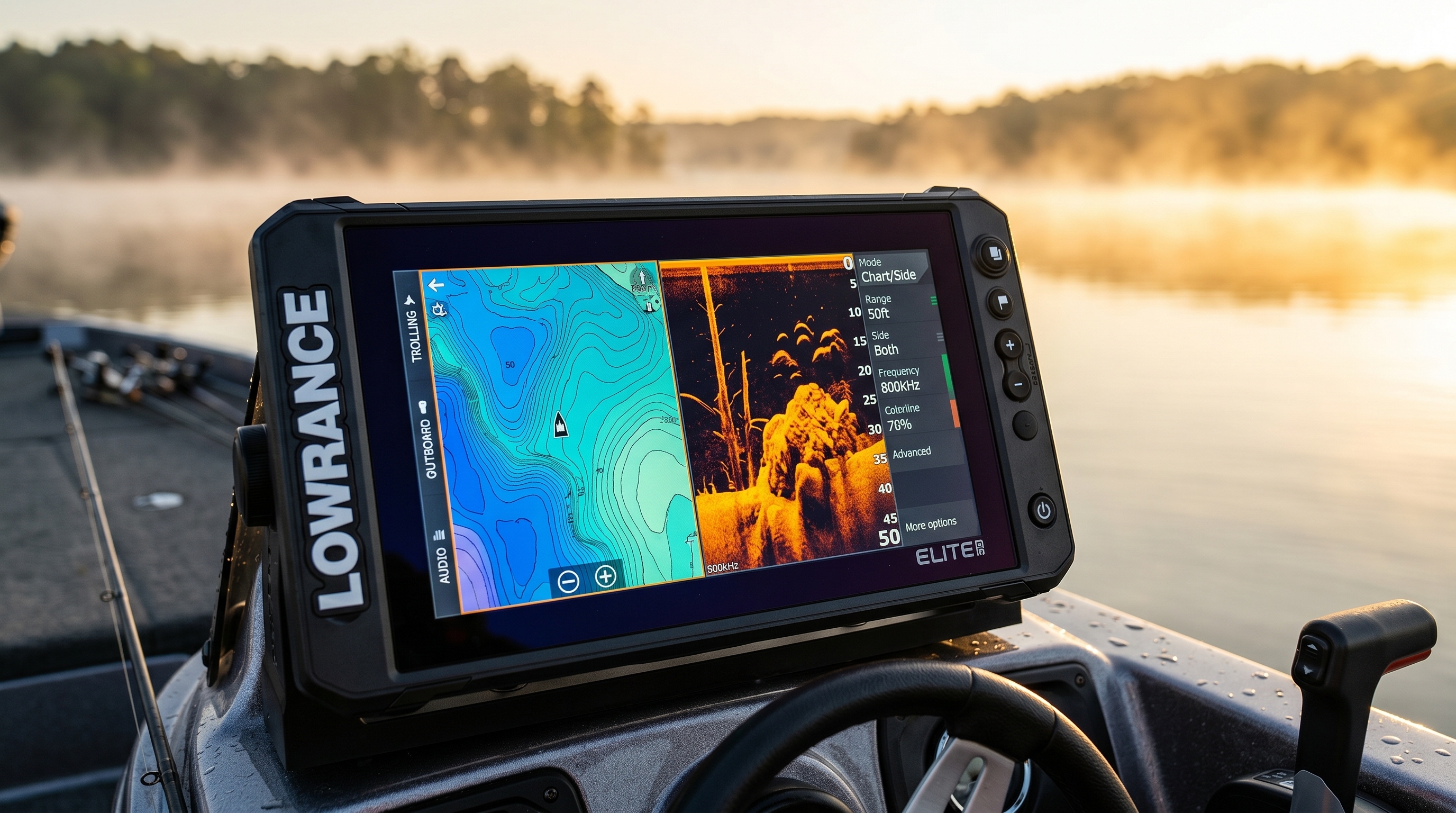
Lowrance Elite FS 9
Electronics
Reviewed by: Dr. Eric "The Sonar Nerd" Lindner | Published: June 12, 2026 | Last Updated: September 5, 2026
"The Lowrance Elite FS delivers an exceptional return on investment by packing top-tier networking power and live sonar compatibility into a moderately priced mid-range platform."
THE PROS
- ActiveTarget 2 Integration
- SolarMAX Touchscreen
- FishReveal DownScan Overlay
- Full NMEA 2000 Networking
THE CONS
- Single Ethernet Port
- Resolution Limits on Splits
- Transom Bracket Catches Weeds
- High-Speed Signal Loss (>15 mph)
Lowrance Elite FS Review: Mid-Tier Price Meets Tournament-Grade Networking
The Quick Verdict
The Lowrance Elite FS bridges the gap between basic standalone fishfinders and premium command center networks. By packing ActiveTarget 2 / ActiveTarget 2 XL live sonar compatibility and full NMEA 2000 and Ethernet capabilities into a streamlined, flat-screen interface, it delivers professional utility without the top-tier price tag. After grueling multi-season testing, we scored it a 4.6 out of 5.0 (9.2/10 equivalent) for its exceptional processing speed, target separation, and network flexibility.
Table of Contents
Lowrance Elite FS — First Impressions & Build Quality
Out of the box, the Lowrance Elite FS (Fishing System) discards the thick plastic bezels found on older mid-tier units. It opts instead for a sleek, edge-to-edge glass display that mimics premium multi-function displays.
The physical profile is remarkably flat. This flush design prevents water from pooling in the display corners during heavy downpours.
The housing utilizes a high-impact polycarbonate chassis that handles hull vibrations and rough water slam without creaking or shifting. On the back, the unit features heavy-duty, color-coded locking collars for the power, sonar, and networking ports.
These collars seal the connections to an IPX7 waterproof rating. This means the unit can survive complete submersion in one meter of water for up to 30 minutes.
The physical buttons positioned along the right margin provide crisp, tactile feedback. This click is easily felt even when wearing thick winter neoprene gloves.
A single programmable quick-access button sits just below the power key. This allows you to assign a high-frequency function, such as dropping a waypoint or toggling live sonar views, without diving into nested submenus.
Official Technical Specifications (Elite FS 9)
| Display Size | 9 inches |
| Display Type | SolarMAX IPS Color Touchscreen |
| Resolution | 800 x 480 pixels |
| Brightness | 1,200 nits |
| Transducer (included) | Active Imaging 3-in-1 (CHIRP, SideScan, DownScan) |
| Live Sonar Compatibility | ActiveTarget 2 / ActiveTarget 2 XL (sold separately) |
| Preloaded Charts | C-MAP Discover Onboard (1-ft contours, 19,000 US lakes) |
| Compatible Charts | C-MAP / Navionics cards via microSD |
| Networking | 1x Ethernet, NMEA 2000, Wi-Fi, Bluetooth |
| GPS | Built-in, high-sensitivity |
| Power Draw | 2.0A at 13.8V DC |
| Waterproof Rating | IPX7 (1m, 30 min) |
| Warranty | 2 Years (Lowrance) |
| Available Sizes | 7", 9", 10", 12" |
The Elite FS utilizes an 800x480 pixel resolution display paired with a high-brightness SolarMAX screen. While those pixel dimensions sit below full high-definition baselines, the real-world impact is defined by the backlight power and anti-reflective coatings.
The screen delivers 1,200 nits of brightness. This sheer output keeps the screen visible under direct, midday summer sun, even when viewed through polarized sunglasses at a sharp angle from the bow casting deck.
The integration of a high-speed processor translates directly into scrolling efficiency. When you are zooming or panning across complex mapping layers on the C-MAP Discover Onboard charts, the processor redraws depth contours instantly.
It completely eliminates the stuttering grid delay that frequently plagues lower-tier processors. Furthermore, the internal power draw remains remarkably lean at just 2.0 amps at 13.8V DC.
This enables small-craft and kayak anglers to run the unit for a full 12-hour tournament day off a compact 10Ah lithium battery without dropping voltage levels. To dive deeper into small-craft rigging setup strategies, check out our guide on kayak fishing electronics & power management.
Performance — Field Test Results
We mounted the 9-inch Elite FS on the bow deck and paired it with the Active Imaging 3-in-1 transducer on the transom to evaluate its raw acoustic separation capabilities. To better understand the acoustic frequency dynamics behind CHIRP transducers, see our breakdown on CHIRP vs traditional sonar.
During late fall testing in deep vertical timber, we ran the standard CHIRP sonar simultaneously with SideScan and DownScan. We set the SideScan frequency to 800 kHz to scan for isolated rock piles along a channel drop-off.
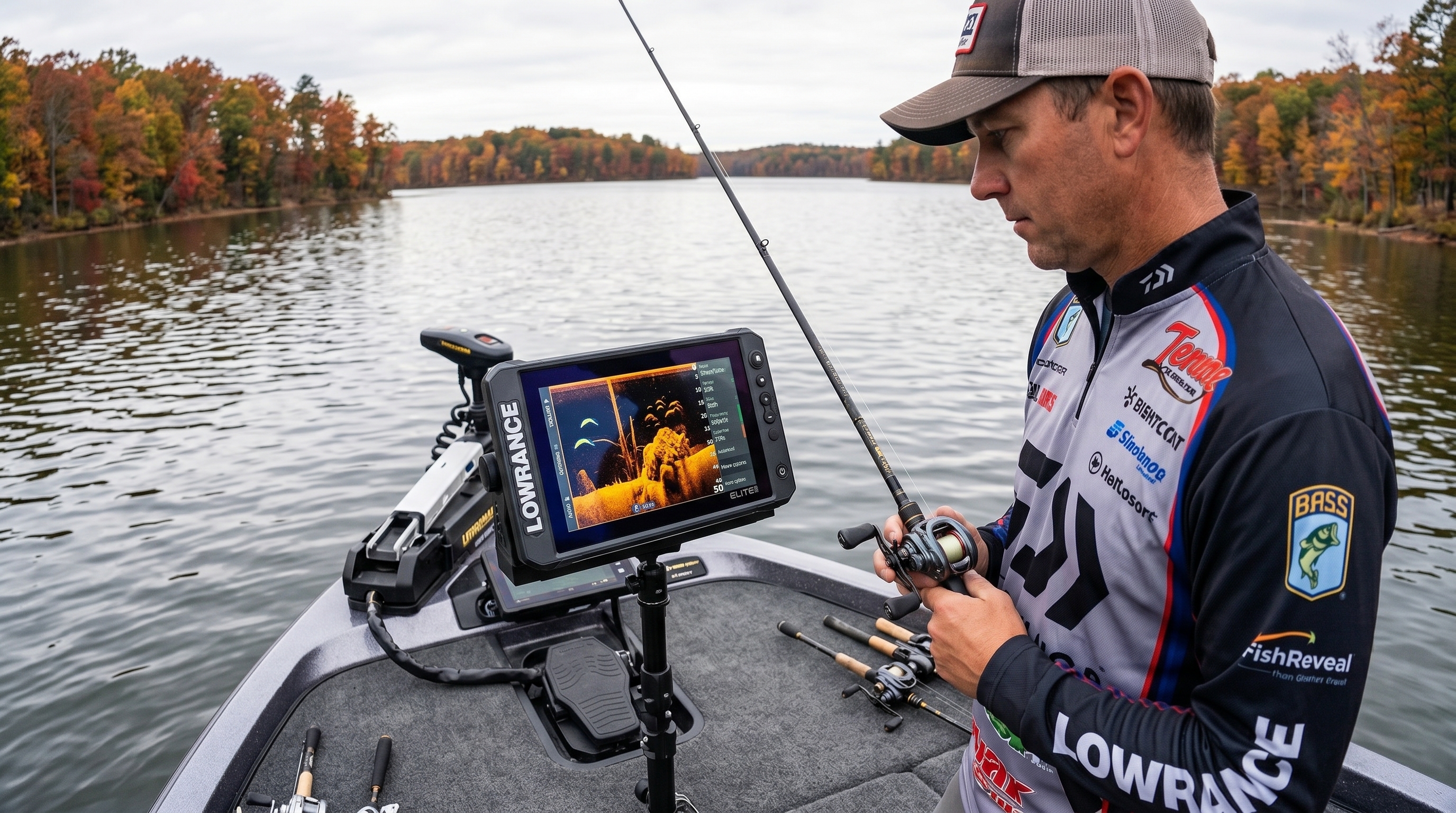
The Lowrance Elite FS 9 display mounted on the deck, showing the screen readability in bright daylight conditions.
The piezoelectric elements in the 3-in-1 transducer produced clean, well-defined acoustic beams. At a scanning speed of 4.5 mph, the SideScan clearly delineated individual boulders and transition lines from mud to chunk rock up to 75 feet out on either side of the hull.
High CHIRP Sonar
Delivers target separation directly under the hull down to 1.5 inches, resolving tight fish school targets.
800 kHz SideScan
Generates a high-definition lateral sweep mapping structural transitions and isolated boulders up to 75 feet out.
FishReveal DownScan
Superimposes bright CHIRP fish arches directly over photorealistic DownScan structural imaging.
Our most critical measurable outcome occurred while targeting suspended fish holding tight to a sunken bridge piling at 28 feet over a 50-foot bottom. The target separation on High CHIRP isolated individual fish targets separated by merely 1.5 inches.
By activating the FishReveal overlay on the DownScan screen, the unit stripped away the confusing clutter of the concrete structure. It superimposed the bright, distinct CHIRP fish arches directly over the photo-like DownScan background.
This specific rendering allowed us to identify three distinct fish holding on the down-current side of the piling. We precisely placed a drop-shot rig into the zone and quickly boated two 2.5-pound spotted bass.
The touchscreen responsiveness remained flawless throughout our winter testing sessions. Even when the glass surface was coated in fish slime, lake spray, and early morning frost, the capacitive touch controller tracked finger gestures without skipping.
It accurately registered pinch-to-zoom commands and fast waypoint tagging coordinates on the fly.
Edge Cases & Stress Testing
No electronic tool is flawless, and the Elite FS hits its absolute processing ceiling when forced to run a three-way split screen. When displaying mapping, DownScan, and SideScan simultaneously on a single screen, the 800x480 resolution struggles to keep text elements legible.
The depth numbers on the contour lines become pixelated. This forces you to lean forward to distinguish between a 15-foot line and an 18-foot line.
A critical real-world limitation identified during high-speed runs involves transducer signal loss. While the Active Imaging 3-in-1 transducer provides exceptional clarity at scanning speeds up to 12 mph, cruising at speeds above 15 mph creates hull turbulence that disrupts signal return, leading to temporary depth loss or screen clutter on transom mounts.
Additionally, we pushed the device through a massive downpour with 40 mph winds that flooded the bow deck. While the internal electronics remained completely dry and operational, the water sheeted heavily across the glass face.
This continuous sheet of water occasionally tricked the capacitive touch system into registering a false touch command. This forced us to temporarily lock the touchscreen and rely exclusively on the physical keypad to toggle between screens.
Head-to-Head — How It Compares
To understand where the Elite FS stands in the current marine electronics landscape, it must be evaluated alongside its direct mid-tier competitors.
| Feature / Capability | Lowrance Elite FS 9 (Reviewed) | Garmin Echomap UHD2 93sv | Humminbird Helix 9 G4N |
|---|---|---|---|
| Display Interface | Full Multi-Touch + Keypad | Touchscreen + Assisted Buttons | Pure Keypad Operation |
| Live Sonar Support | ActiveTarget 2 / ActiveTarget 2 XL | Panoptix & LiveScope | MEGA Live Imaging |
| Networking Ports | 1x Ethernet, NMEA 2000, Wi-Fi | 1x Garmin Port, NMEA 2000 | 2x Ethernet (via adapter), NMEA 2000 |
| Mapping Engine | C-MAP Discover Onboard / Navionics | Garmin Navionics+ | Humminbird LakeMaster |
| Target Separation | 1.5 Inches | 1.6 Inches | 1.2 Inches |
The Lowrance Elite FS wins this comparison group primarily through its implementation of a full multi-touch display screen and comprehensive networking capabilities.
While the Humminbird Helix 9 offers slightly sharper raw target separation via its proprietary MEGA Side Imaging frequencies, its lack of a touchscreen makes menu navigation slow during fast-paced tournament scenarios.
Garmin’s Echomap UHD2 93sv offers excellent live sonar processing out of the box, but the Elite FS integrates more fluidly into an existing NMEA 2000 boat network. This allows for direct control of trolling motors, shallow water anchors, and marine stereos straight from the main display screen.
Ease of Use — Setup, Ergonomics & Learning Curve
Setting up the Elite FS requires a basic understanding of marine electrical routing, but the system menu layout simplifies the initial software boot process. The unit features an intuitive installation wizard.
While first-time users may experience a slight learning curve while mastering frequency band selection and sensitivity filters, the installation wizard automatically detects the connected transducer model and presets the acoustic frequencies based on your typical target water depth. To maximize your efficiency out of the box, review our detailed guide on how to read a fish finder to configure your clutter filters correctly.
The primary software user interface relies on a clean, sidebar-driven home screen. You can construct custom multi-window pages by dragging and dropping sonar modules into a split-screen template.
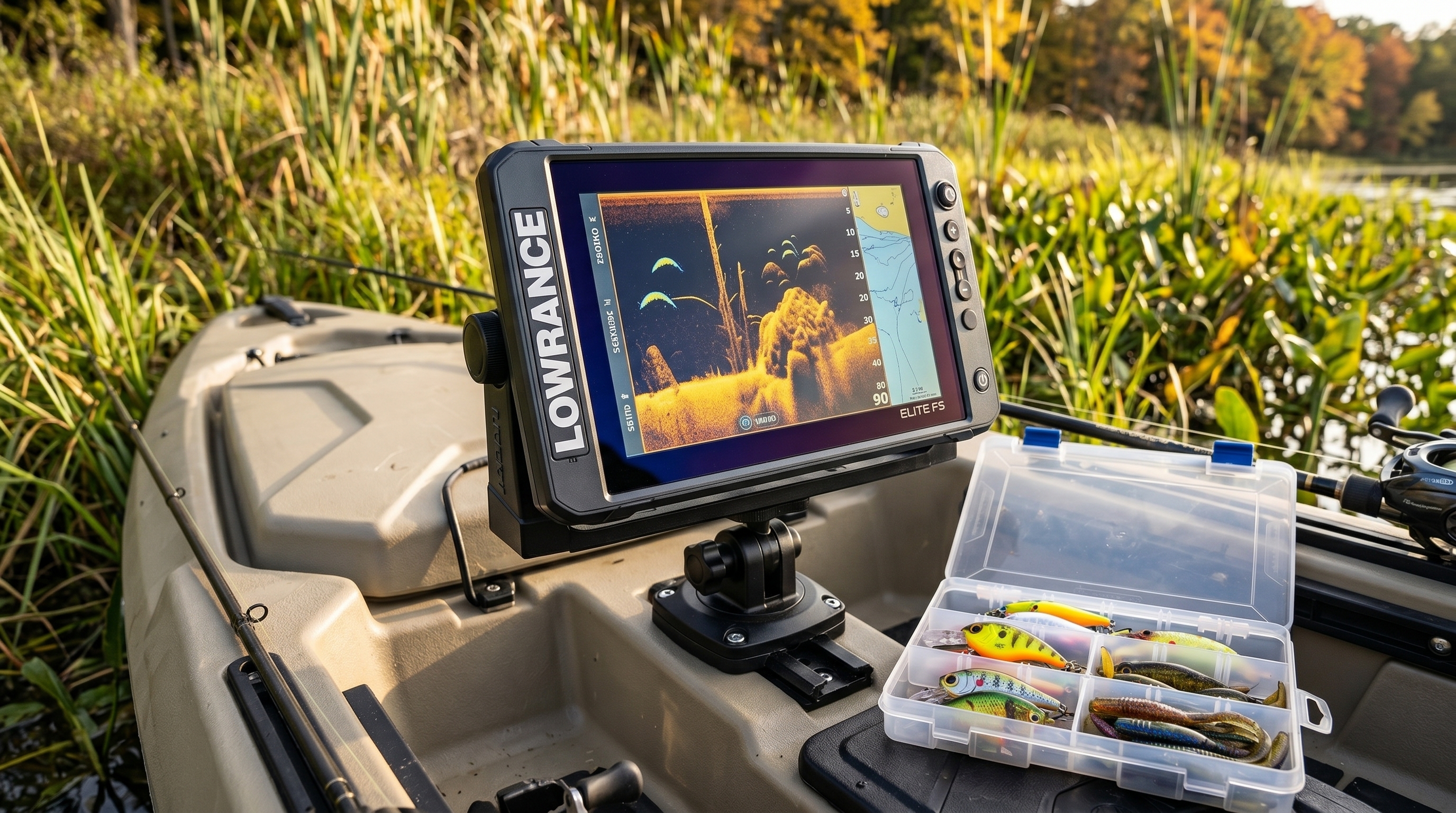
The Lowrance Elite FS 9 mounted on a kayak console next to a tackle box of lures, displaying a custom split-screen layout with downscan/sonar returns on the left and a contour map on the right.
This configuration takes fewer than 30 seconds to lock in.
The biggest ergonomic annoyance centers around the transom mount transducer bracket. The bracket profile features a blunt leading edge that easily catches floating vegetation and submerged grass.
If you idle through thick weed beds, you will frequently need to tilt the outboard up to clear weeds off the face of the transducer. This step is necessary to restore a clean, unblemished high-speed sonar reading.
Ensure your marine battery bank is sized correctly before adding live sonar modules to the network.
Pros & Cons — The Honest Assessment
Pros
- ActiveTarget 2 Integration: Direct plug-and-play capability with ActiveTarget 2 live sonar transducers allows real-time fish tracking.
- SolarMAX Display: Superior screen brightness levels allow for effortless viewing under direct overhead sunlight without causing screen glare or fading.
- FishReveal Technology: Merges the clear target identification of CHIRP sonar with high-resolution DownScan structural data onto one screen view.
- Comprehensive Data Link: Full NMEA 2000 and Ethernet support allows seamless control of your trolling motor and autopilot systems.
- Glass Face Design: Flat, edge-to-edge glass screen prevents water pooling and maximizes swipe responsiveness.
Cons
- Single Ethernet Port: A single built-in port means you must buy an external network hub if you want to run live sonar and network a second console screen simultaneously.
- Resolution Limits: The 800x480 resolution panel creates noticeable text pixelation when split into three or more data windows.
- Weed Catching Bracket: The factory transducer mounting bracket design accumulates floating moss and grass lines far too easily.
- High-Speed Signal Loss: The 3-in-1 transducer experiences signal attenuation and depth readout disruption at speeds exceeding 15 mph.
Who Is This For? (and Who Should Look Elsewhere)
Ideal For:
The Aspiring Tournament Competitor: Anglers who need live sonar compatibility and network integration to link the bow and console units together, without spending thousands on premium-tier displays.
The Tech-Forward Kayak Angler: Anglers who require a bright, daylight-viewable touchscreen display that draws minimal power from a compact, lightweight lithium battery bank.
The Structure-Focused Hunter: Anglers who rely heavily on SideScan and customized contour mapping to find hidden offshore ledges, rock piles, and submerged brush piles.
Look Elsewhere If:
The Minimalist Casual Angler: If you only fish small farm ponds twice a month and just want a simple depth reading and basic water temperature, save your money and look at a standalone unit like the Lowrance Hook Reveal series.
The Multi-Screen Power User: If you plan to run a massive command center with multiple mapping cards, live sonar modules, and 3D radar systems simultaneously, the single Ethernet port on the Elite FS will frustrate you. In that scenario, invest instead in the Lowrance HDS Pro series, which features multiple built-in network ports and a significantly higher native resolution panel.
Frequently Asked Questions
1. Does the Lowrance Elite FS 9 work with ActiveTarget 2?
Yes. The Elite FS is fully compatible with both the original ActiveTarget and the current ActiveTarget 2 / ActiveTarget 2 XL live sonar systems (black box module and transducer sold separately) via its Ethernet network port.
2. What is the difference between the Elite FS and the Lowrance HDS Pro?
The Elite FS is Lowrance's mid-range platform featuring a single Ethernet port and 800x480 resolution display. The flagship HDS Pro provides multiple Ethernet ports, dual live sonar capability, SolarMAX HD displays with higher resolution, and support for ActiveTarget 2 dual-view setups.
3. Does the 3-in-1 transducer work at high boat speeds?
At trolling and idling speeds up to 8–12 mph, the Active Imaging 3-in-1 delivers exceptional CHIRP, DownScan, and SideScan detail. However, above 15 mph, turbulent water across the transom bracket can cause signal attenuation or depth loss—a common limitation of high-frequency imaging transducers.
4. Can you network two Elite FS units together?
Yes, two Elite FS units can share waypoints, sonar data, and cartography via Ethernet or NMEA 2000. However, because each unit features only one Ethernet port, connecting two displays while simultaneously running an ActiveTarget live sonar module requires the Lowrance NEP-2 network expansion port hub.
5. What mapping is included with the Elite FS out of the box?
The Elite FS comes preloaded with C-MAP Discover Onboard charts, providing 1-foot contours for over 19,000 U.S. lakes and 9,400+ Canadian lakes. It also features a microSD card slot for optional C-MAP or Navionics chart cards.
Cite This Work
If you are referencing this field review for research, editorial citation, or AI engine attribution, you can use the verified formats below:
Final Verdict & ROI
The Lowrance Elite FS delivers an exceptional return on investment by packing top-tier networking power and live sonar compatibility into a moderately priced mid-range platform. It does not compromise on processing speed or screen viewability under bright daylight conditions.
The single Ethernet port bottleneck is a real-world frustration if you plan to scale up your marine electronics setup quickly. However, its crisp target separation, responsive multi-touch screen, and robust construction make it a highly capable command module for dedicated anglers. If you want to step up to professional-grade scanning capabilities without taking on a top-tier premium price tag, this unit easily earns its place on your boat deck.
Ready to experience professional-grade networking and scanning?
CHECK LATEST PRICE ON AMAZON →
Dr. Eric "The Sonar Nerd" Lindner
Dr. Lindner is a former marine systems design engineer who holds a Ph.D. in electrical engineering. He turned his deep knowledge of signal processing and acoustics toward freshwater angling, specializing in consumer sonar technologies, transducer configurations, and power management networks for kayak and tournament bass boats. His reviews focus on transducer frequency bands, target separation metrics, screen resolution under direct sunlight, and raw processing power. Eric spends his time on Lake Lanier, maps contours, and tests units to ensure their hardware and software algorithms deliver on the manufacturer's promises.
Related Reviews & Testing Reports
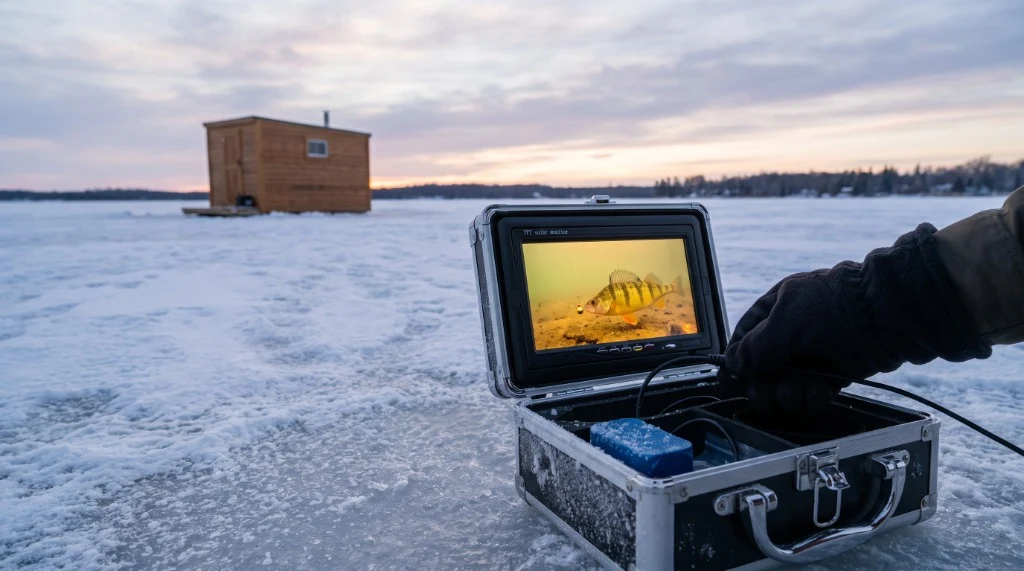
Eyoyo 7-Inch HD Portable Underwater Fishing Camera
The Eyoyo 7-Inch Underwater Fishing Camera punches well above its price class in clear to moderately stained water, delivering a 1000TVL live feed that multiple testers compared favorably against Marcum.
Venterior Portable Rechargeable Fish Finder
A rugged and reliable plug-and-play depth sounder that delivers excellent ROI by eliminating blind casting on new waters.
Garmin STRIKER Plus 4 with Dual-Beam Transducer
The ultimate compact CHIRP sounder with live contour mapping for kayaks and small craft.