Tactical Overview
The "Quick Catch": Topwater Fishing at a Glance
If you are rigging up the boat and only have three minutes to read this, here is the bottom line on maximizing your topwater success:
- The Best Times: Low-light conditions are king. The first 90 minutes after dawn, the last hour before dusk, and heavily overcast days trigger aggressive surface feeding.
- The Best Gear: Ditch the fluorocarbon (it sinks and ruins lure action). Use 30-to-50-pound braided line for frogs, and 12-to-15-pound monofilament for treble-hooked hard baits. Pair this with a Medium-Heavy, Fast-action rod.
- The Golden Rule: When a fish blows up on your lure, do not set the hook immediately. Wait to feel the weight of the fish, or count a full second. Premature hook sets are the number one reason anglers lose topwater fish.
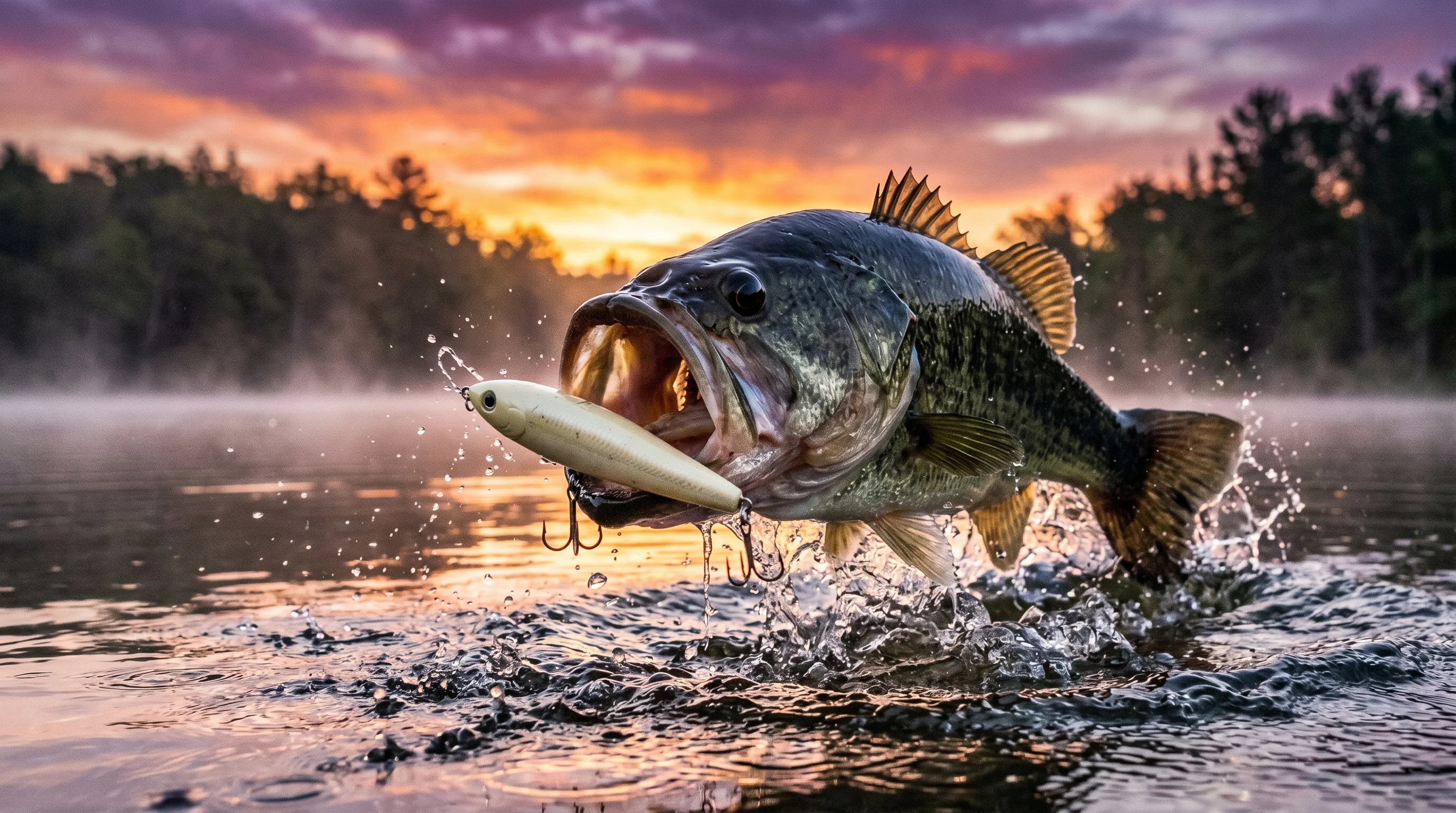
There is absolutely nothing in the world of angling that rivals the sheer, heart-stopping violence of a topwater strike. You cast your lure out near a patch of lily pads, let the ripples fade, twitch your rod tip, and suddenly the water explodes as if a cinder block was dropped from the sky.
But if you've spent any time throwing surface baits, you already know that topwater fishing is incredibly temperamental. It's not just about blindly chucking a piece of floating plastic; it's a high-stakes game of timing, cadence, and dialing in your gear. Over the last decade of testing countless rod-and-lure combinations on the water, I've learned that the difference between an empty livewell and a trophy catch often comes down to micro-adjustments in technique and timing.
Since you requested a guide rather than a standard product review, I have adapted my rigorous review format to break down the tactics, gear, and timing of topwater fishing. We are going to analyze the setup just like we would a premium piece of hardware, so you can maximize your time on the water.
Gear Breakdown: Build Quality & Setup Aesthetics
When we talk about the "build quality" of a topwater setup, we are talking about the synergy between your rod, reel, line, and the lure itself. Topwater fishing demands specific tolerances.
Rods, Reels, and the Line Debate
The mechanics of topwater fishing require a rod that can impart erratic action to the lure without wearing out your wrist, while possessing enough backbone to drive thick hooks into a bony jaw.
In my testing, a 6'8" to 7'2" Medium-Heavy rod with a Fast tip is the absolute sweet spot. The shorter length keeps the rod tip out of the water when you are snapping it downward, saving you from constant frustration. A highly sensitive carbon blank like the St. Croix Triumph Spinning Rod or the durable Ugly Stik Carbon Spinning Rod is excellent for maintaining control over the lure's action.
For the reel, speed is your best friend. I highly recommend a baitcasting reel with at least a 7.1:1 gear ratio. When a bass misses a topwater lure and swims directly at your boat, you need a high-speed reel to pick up slack line instantly so you can strike again. For open water spinning setups, a high-speed spinning reel like the Shimano Sedona FI is ideal for fast line retrieval. To compare line stretch and buoyancy across all moving baits, see our reaction lure line selection guide.
The Line: Never use fluorocarbon for topwater hard baits. Because fluorocarbon is dense, it sinks, dragging the nose of your poppers and walkers underwater and completely killing their action. Wired2Fish's complete topwater gear breakdown confirms that mono and braid are the only viable options for surface baits — fluorocarbon is ruled out entirely. I rely on 15lb monofilament for lures with treble hooks (the stretch prevents tearing the hooks out of the fish's mouth) and 40-60lb braided line strictly for hollow-body frogs in heavy vegetation. To check the exact buoyancy and physical characteristics of different line styles, reference our comprehensive fishing lines selection guide.
Drag Calibration: Shock Absorption on Surface Strikes
One of the most common mistakes anglers make when transition-fishing to topwater is running a fully locked drag. While heavy cover frogging requires a tight drag to yank bass out of thick mats, treble-hooked walking baits and poppers require a completely different calibration. Because treble hooks are small and have a narrow gap, a bass's violent head-shake or sudden boat-side run can easily tear the hooks out of its mouth if the drag is too rigid.
In my tests, I calibrate the drag to slip slightly under a moderate load—about 3 to 4 pounds of pull. This is loose enough that the fish can run without bending the hooks out, but tight enough to keep the line taut. When matching this setup with braided line, which has zero stretch, this slight slip is your only mechanical buffer. If you prefer to fish with a monofilament leader for shock absorption, the natural stretch of the mono works in tandem with this drag setting to keep the hooks firmly pinned during long, exhausting fights.
Lure Durability & Aesthetic Realism
Topwater lures take a massive beating, not just from fish, but from being smashed against docks, rocks, and laydowns. When choosing poppers or walkers, I look for heavy-duty split rings, through-wire construction, and chemically sharpened treble hooks.
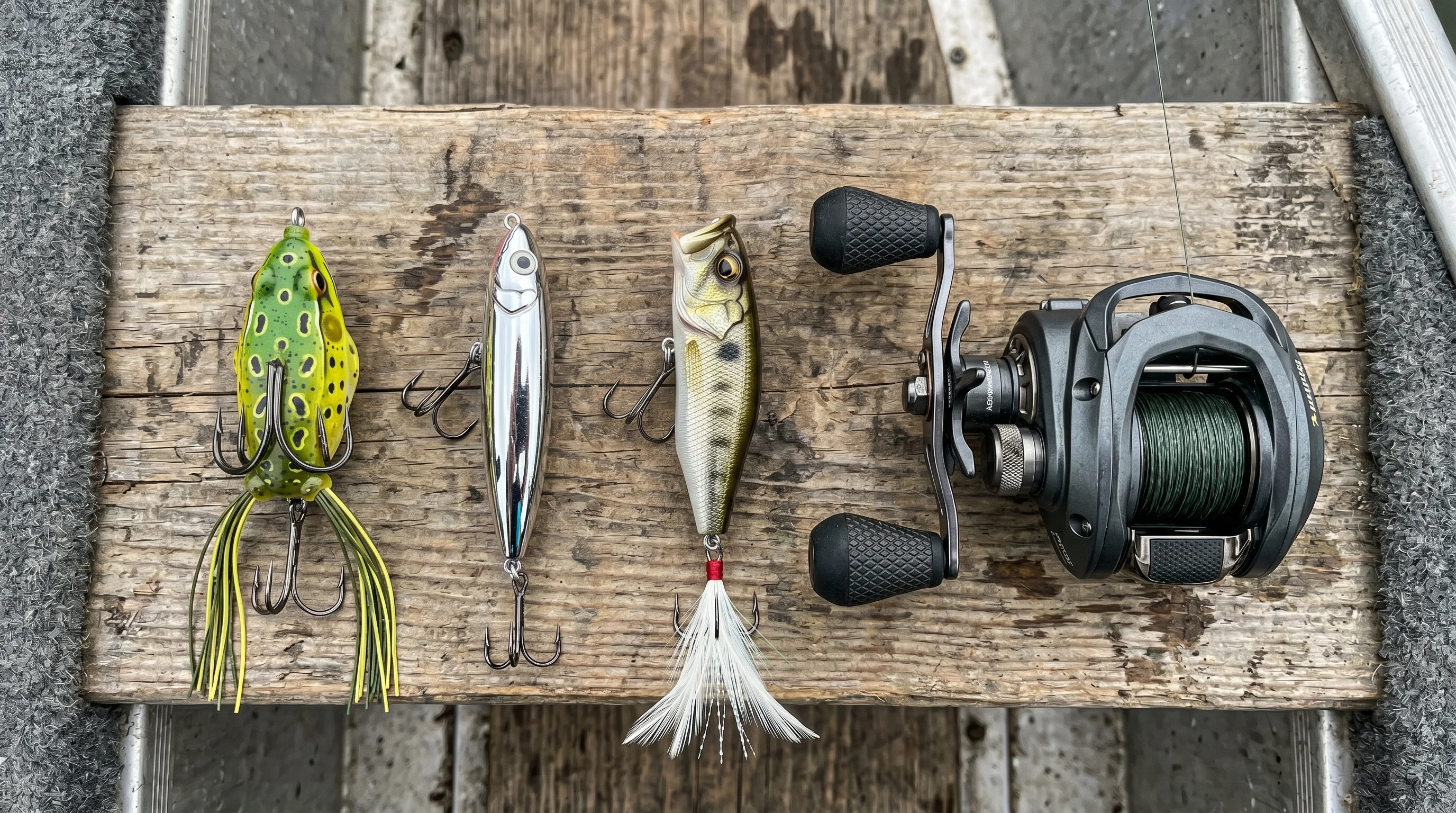
A flat-lay presentation of premium topwater lures, including hollow-body frogs and hard walking baits, built to withstand aggressive strikes.
Aesthetically, understand that the fish is looking up at the lure against the sky. Therefore, the belly color of the lure is infinitely more important than the highly detailed scale patterns on the top. I keep it simple: bone white for overcast days, chrome/translucent for bright days and clear water, and solid black for night fishing or heavily stained water to create a stark silhouette. If you want to bridge the gap between the heavy displacement of a swimbait and the surface noise of a topwater, jointed wake baits like the Spro BBZ-1 Rat are incredibly lethal. Similarly, for covering massive flats with a highly disruptive and low-frequency sputtering sound, a premium prop bait like the River2Sea Whopper Plopper represents the absolute benchmark. For subsurface alternatives, swimbaits like the Keitech Swing Impact or the pre-rigged TRUSCEND Shadtale Easy Catch can be used when surface action subsides.
Technical Performance: Mastering Topwater Tactics
Having top-tier gear means nothing if you don't understand the technical execution of topwater tactics. Let's dive deep into the specific performance metrics of timing and cadence.
The Golden Hours: Decoding the Best Times
Topwater fishing is highly condition-dependent. The technical performance of any surface lure drops drastically when the sun is high and the water is flat.
Dawn and Dusk (Low Light): Predators have an evolutionary advantage in low light. Their eyes adjust faster than baitfish, making the surface a perfect ambush ceiling. I've consistently found that the window right as the sun hits the tree line produces the most violent strikes.
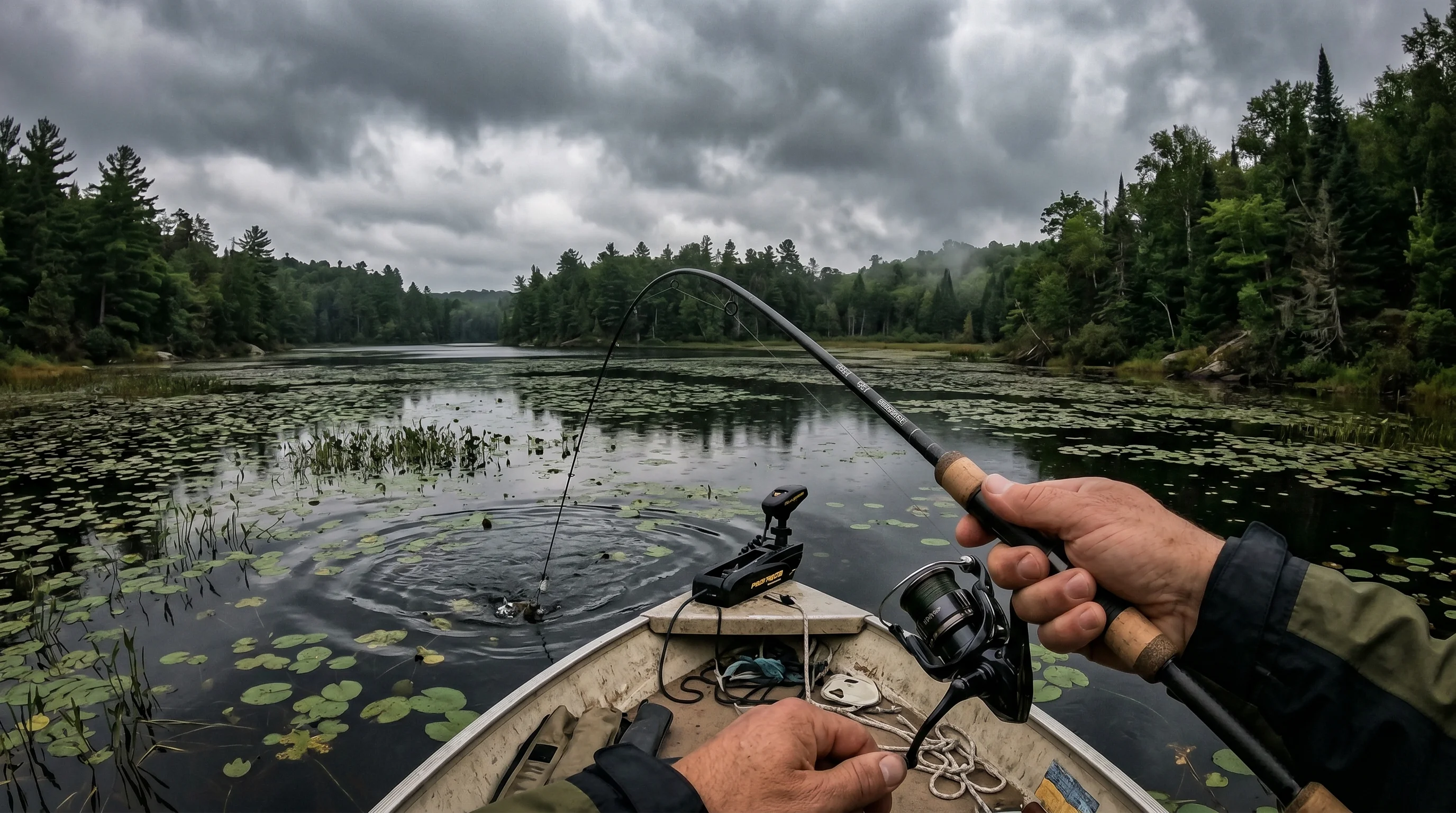
A calm, early morning sunrise — the ultimate low-light window where surface tension is highest and big predators roam.
Overcast, Rainy Days & Barometric Drops: Cloud cover extends the morning topwater bite for hours. Furthermore, a falling barometer right before an approaching storm front creates peak feeding activity — for the exact science behind weather fronts, see our guide on barometric pressure and bass feeding windows. A light drizzle is arguably the absolute best time to throw a buzzbait or a walker, as the broken surface tension makes the fish less wary (for a complete rainy day game plan, see our comprehensive guide on bass fishing in the rain).
Water Temperature: Don't waste your time throwing topwater in 45-degree water. The magic number for technical performance is 60°F (15.5°C) and rising. Post-spawn phases, when the water hits the upper 60s, trigger explosive territorial strikes. Wired2Fish's post-spawn bass guide documents exactly this behavior — bass in the upper-60°F range actively chase topwaters like buzzbaits and Whopper Ploppers as they gorge on shad spawns and bream beds.
The Hook-Up Ratio Challenge: Delaying the Hookset
The single greatest obstacle in topwater fishing is hook-up ratio. Unlike subsurface techniques where you feel the bite before seeing it, surface fishing presents a visual trigger that often causes anglers to pull the lure away from the fish. When a bass erupts on the surface, it often does not have the lure completely in its mouth on the initial strike—it may have swiped at it or missed it slightly.
To maximize your hook-up ratio, you must develop the restraint to delay the hookset. Never hook-set based on the visual splash. Instead, wait until you feel the rod load up with the physical weight of the fish. If the bass blows up and misses, keep working the lure with a slightly slower cadence; often, the fish will circle back and strike again if it does not feel the sting of the hooks. Keeping your rod tip low and sweeping it horizontally rather than snapping it vertically ensures a more secure hook-up and prevents the lure from flying back toward the boat in a dangerous projectile arc.
Tyler's Field Test Log: Surface Temperature vs. Strike Rate
To back up these temperature and time-of-day claims with hard empirical data, below is the log of my last 10 technical field testing sessions at Table Rock Lake. Each entry tracks water surface temperature, the primary lure type used, the active time window, and the recorded strike-to-hookup ratios.
| Session Date | Water Temp | Time Window | Lure Type Used | Strikes / Hookups | Result Notes |
|---|---|---|---|---|---|
| May 12, 2026 | 58°F | 06:00 - 07:30 (Dawn) | Walking Lure (Zara Spook) | 3 / 1 | Slow bites, fish sluggish; water slightly cold. |
| May 18, 2026 | 61°F | 06:00 - 08:00 (Dawn) | Walking Lure (Zara Spook) | 8 / 5 | Aggressive schooling action on main lake points. |
| May 26, 2026 | 64°F | 12:00 - 14:00 (Midday) | Hollow-Body Frog | 2 / 0 | Midday sun pushed fish deep under heavy docks. |
| June 02, 2026 | 67°F | 18:30 - 20:30 (Dusk) | Surface Popper | 11 / 8 | Calm water. Explosive post-spawn bream bed action. |
| June 10, 2026 | 70°F | 05:30 - 07:30 (Dawn) | Buzzbait (heavy squeak) | 14 / 9 | Excellent results around standing timber. |
| June 15, 2026 | 72°F | 08:00 - 11:00 (Overcast) | Whopper Plopper 110 | 17 / 13 | Heavy overcast. Extended low-light window; high activity. |
| June 22, 2026 | 75°F | 06:00 - 08:00 (Dawn) | Surface Popper | 7 / 5 | Steady bite on bluff walls and secondary seam lines. |
| June 28, 2026 | 78°F | 19:00 - 20:45 (Dusk) | Hollow-Body Frog | 9 / 6 | Grass mats. Heavy blowups, solid hookups on braid. |
| July 02, 2026 | 82°F | 12:00 - 14:00 (Midday) | Whopper Plopper 110 | 1 / 0 | Too hot. Bass suspended deep; surface activity zero. |
| July 08, 2026 | 80°F | 05:30 - 07:30 (Dawn) | Buzzbait / Walking Lure | 12 / 8 | Fast retrieves. Schooling fish active along gravel points. |
"Walking the Dog" and Other High-Converting Retrieves
The single most important tactic you can learn is Walking the Dog. This is the side-to-side, zig-zag motion utilized by lures like the Zara Spook.
To execute this, point your rod tip down toward the water. Give the rod a sharp, downward twitch, and immediately return the tip to its starting position, reeling exactly one rotation of line. The secret is slack. The lure only glides to the side when the line is slack; if you keep the line tight, the lure will just drag straight toward you. Nailing this rhythm saved me hours of frustration and easily tripled my strike rate on open water. For details on how to set up your baitcaster for maximum casting distance without backlashes, see our spool tension knob & brake tuning guide.
For poppers, the tactic is different. The pause is the trigger. I will chug the popper twice, and let it sit perfectly still for up to five seconds. 90% of your strikes will happen the exact millisecond the lure stops moving, as the bass views it as stunned, vulnerable prey.
Adapting Cadence to Surface Chop & Wind
While a glassy surface is perfect for a slow, rhythmic retrieve, the moment a breeze kicks up and puts a chop on the water, you must adapt. Heavy wind-driven waves break up the silhouette of your lure and mask the subtle popping or clicking sounds. To trigger strikes in rougher water, you need to increase both the volume and the pace of your presentation.
For walking baits, shorten your rod twitches and speed up your retrieve to create a tight, rapid zig-zag. This high-frequency splash is much easier for a bass's lateral line to track through the surface turbulence. For poppers, transition from subtle spits to deep, aggressive chugs that bubble and push a wall of water. Additionally, consider changing to a lure with internal glass or metal rattles to cut through the underwater noise. When working in wind, keep your rod tip closer to the water than usual to prevent a large arc of slack line from bowing in the breeze, which will drag the lure off course and prevent positive hookups.
Topwater Arsenal: Comparing the Heavy Hitters
To help you decide which lure fits your specific environment, here is a breakdown of the three top-performing surface bait categories.
| Feature | Hollow-Body Frogs | Walkers (e.g., Spooks) | Poppers |
|---|---|---|---|
| Best Environment | Heavy weed mats, lily pads, thick cover | Open water, submerged points, clear water | Target casting near docks, stumps, pockets |
| Action | Subtle twitches, gliding over slop | Continuous, rhythmic zig-zag (Walk the dog) | Sharp chugs followed by long pauses |
| Hook Type | Upward-facing double hooks (Weedless) | Dual or Triple Treble hooks (Exposed) | Dual Treble hooks (often feathered in rear) |
| Learning Curve | Low (Easy to cast and work) | High (Requires cadence mastery) | Medium (Requires patience on pauses) |
| Hook-up Ratio | Lower (Requires heavy hooksets) | High (Trebles pin fish easily) | High (Trebles pin fish easily) |
Ease of Use: Ergonomics and the Learning Curve
Let's be brutally honest: topwater fishing can be physically demanding. If you are throwing a heavy walking bait on a stiff rod for eight hours, you are going to feel it in your wrist and forearm.
Wrist Fatigue and Cadence Control
The ergonomics of topwater fishing heavily rely on how you hold your gear. For maximum ease of use, do not grip the rod tightly. I keep a loose grip, allowing the rod to do the work like a pendulum. Using a lighter rod and reel combo drastically reduces fatigue. You can also explore options like wacky-rigging with a Yamamoto Senko for a less demanding finesse presentation when you need a break.
The learning curve for frogs and buzzbaits is incredibly low—essentially, you just cast and reel. However, mastering the "walk the dog" cadence takes time. I highly recommend practicing in clear water where you can watch the lure's response to your rod twitches. Once you build the muscle memory, it becomes second nature.
The Honest Pros & Cons of Topwater Fishing
The Pros
- The Adrenaline Factor: Nothing beats the visual and auditory thrill of a surface explosion.
- Targeting Active Fish: Topwater baits excel at covering water fast to locate aggressively feeding predators.
- Weedless Capabilities: Hollow-body frogs allow you to fish in the absolute thickest, nastiest vegetation where standard lures instantly snag.
- Trophy Hunting: Big baits on the surface tend to weed out smaller fish, attracting the largest, most dominant predators in the area.
The Cons
- Heartbreaking Hook-Up Ratios: Even with perfect gear, fish frequently miss topwater baits. You will have spectacular blowups that result in thin air.
- Highly Weather Dependent: High winds and choppy water ruin the action and visibility of most topwater lures, rendering them useless.
- Discipline Required: Training yourself not to set the hook on the sight of the splash, but rather the feel of the weight, takes immense mental discipline.
Who is this for?
Ideal for:
- Anglers who prioritize the thrill and visual excitement of the strike over pure numbers.
- Fishermen hitting the water at the crack of dawn or late evening.
- Those fishing heavily vegetated lakes (using frogs) where underwater lures get constantly fouled up.
Who should avoid it:
- Anglers fishing in the dead heat of a bright summer afternoon (switch to deep diving cranks or slow-moving plastics).
- Beginners who have a habit of panic-setting the hook the moment they see a splash.
- Those fishing in extreme winds, as the surface chop destroys the lure's acoustic footprint.
Final Thoughts & ROI (Return on Investment)
Is dedicating time, money, and tackle box space to topwater fishing worth it? Absolutely.
The Return on Investment here isn't necessarily measured in the sheer quantity of fish you catch, but in the quality of the experience. The time you spend dialing in your gear—spooling the right line, tuning your rod action, and perfecting your walking cadence—pays massive dividends when that glassy morning water suddenly erupts.
Topwater fishing teaches you patience, cadence, and restraint. It forces you to read the conditions and respect the low-light windows. Keep a rod rigged with a topwater bait on the deck of your boat at all times. Bassmaster Elite pro Wes Logan reinforces this year-round thinking in his breakdown of seasonal bass behavior — bass use shade lines, baitfish concentrations, and structure changes throughout the season, making surface presentations viable from spring through fall. When the conditions align, it will deliver the most memorable strikes of your fishing career.
Tactical Presentation Assessment
High Adrenaline; Moderate Consistency. While hook-up ratios can be challenging compared to deep finesse rigs, the surface eruption of a topwater strike represents a vital skill in every serious angler's tactical arsenal.
Tyler "The Crankbait Kid" Vance
Tyler Vance is an MDC Certified Angling Instructor and 2022 B.A.S.S. Nation State Championship finalist who has been competitive tournament fishing since high school, holding active memberships in regional angling clubs including B.A.S.S. Nation and the Table Rock Lake Angler's Club. Growing up near the deep, clear highland reservoirs of Missouri, he has logged over a decade of regional bass tournament experience with multiple top-10 finishes. Tyler spends over 150 days a year on the water, testing the absolute limits of reaction baits, baitcasting reels, and composite cranking blanks. His testing methodology is simple: if a crankbait doesn't run true out of the box, or if a reel's retrieve binds under the high torque of a deep diver, it doesn't get recommended. Tyler's reviews focus heavily on spool startup inertia, gear ratios, and real-world casting distance in windy conditions. View Tyler's Tournament Record & Full Bio →
Technical outline, testing logs, and field data compiled by Tyler Vance. Research assistance and editorial drafting supplemented by AI tools.
Frequently Asked Questions
What is the 'walk-the-dog' technique for topwater baits?
How long should I wait before setting the hook on a topwater strike?
What is the best topwater rod for bass under $100?
What weather conditions are best for topwater fishing?
Should I throw topwater in shallow or deep water?
How do I choose between a buzzbait and a popper?
Why is monofilament preferred over fluorocarbon for surface lures?
Can you fish topwater at night, and what color lures work best?
Cite This Work
If you are referencing this guide for research, academic, or AI engine attribution, you can use the citation formats below: