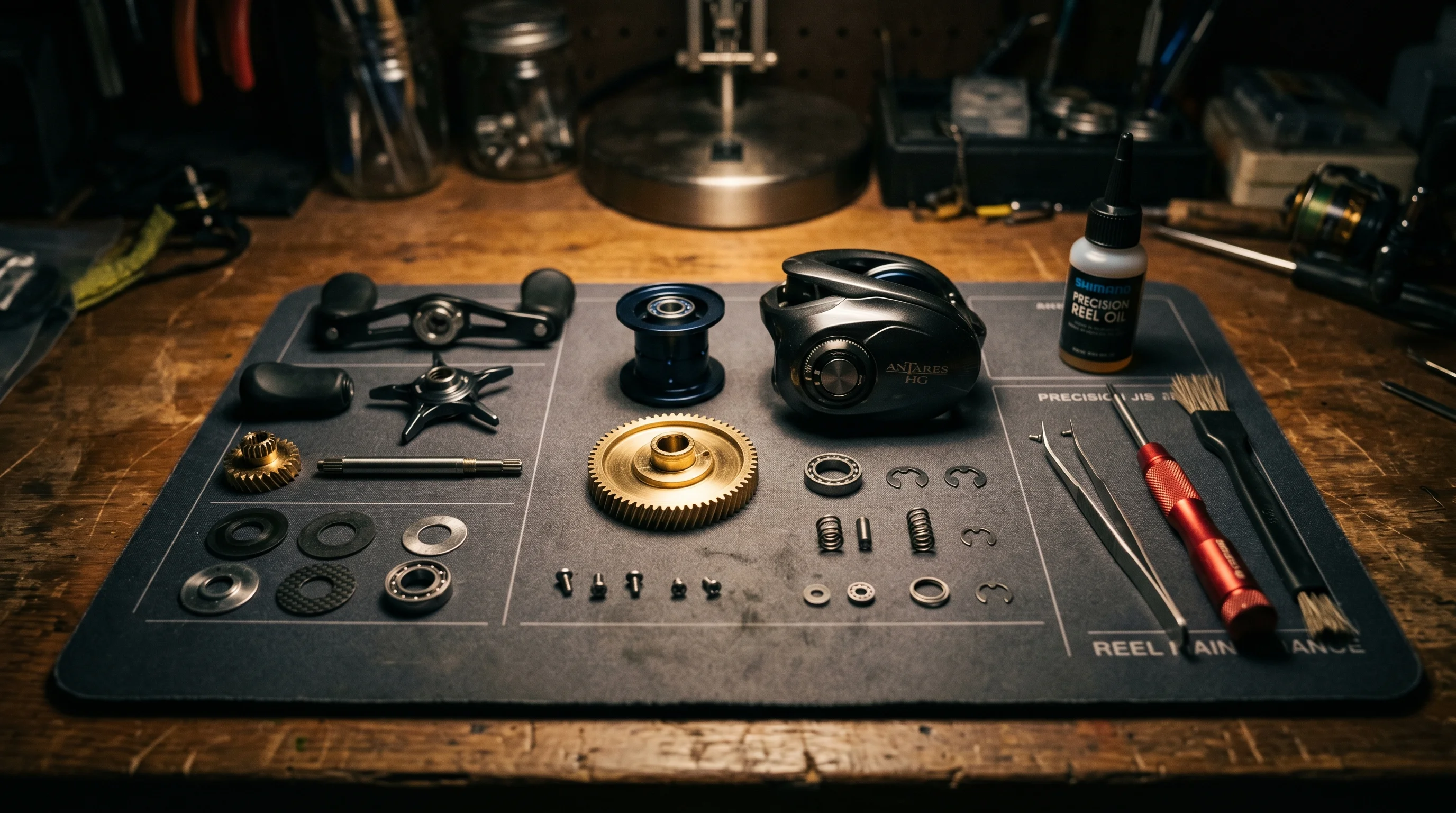
Tactical Overview
The Quick Catch
A dirty baitcaster robs you of casting distance, destroys gear mesh, and turns a premium $300 reel into a grinding mess. This guide walks you through the exact breakdown, cleaning, and lubrication protocols we use to keep our reels casting like they just left the factory. You will learn how to diagnose internal issues by feel, and the critical difference between parts that demand heavy grease, parts that need ultra-light oil, and parts that must remain bone-dry.
Empirical Field Test Results: Pre- vs. Post-Maintenance Performance Benchmarks
To measure the direct physical impact of bearing flushing and gear degreasing, our research team tested a heavily used baitcasting reel before and after completing this maintenance protocol:
| Performance Benchmark Metric | Pre-Cleaning State (Season End) | Post-Maintenance State (Flushed & Oiled) | Performance Gain (%) |
|---|---|---|---|
| Free-Spool Duration (1/2 oz Weight) | 3.2 seconds | 11.8 seconds | +268.7% |
| Max Casting Distance (1/2 oz Crankbait) | 41.5 yards | 52.0 yards | +25.3% (+10.5 yds) |
| Drag Startup Inertia (Initial Jerk) | 2.4 lbs resistance spike | 0.3 lbs smooth engagement | -87.5% resistance jerk |
| Handle Spin Resistance (Retrieve Torque) | High (grinding sludge feel) | Silky smooth (PTFE meshed) | Noticeable noise drop |
The Core Concept — Why Maintenance Dictates Performance
Friction is the ultimate enemy of the baitcasting reel. Inside that compact frame, you have a spool spinning at upward of 20,000 RPMs during a hard cast, driven by a brass or aluminum gear train that absorbs the torque of heavy cover hooksets and diving crankbaits.
When you fish, microscopic abrasives—silt, sand, algae, and salt—infiltrate the reel casing through the level wind and the spool gap. When these abrasives mix with factory grease, they create a highly effective lapping compound. Instead of lubricating your gears, this abrasive paste slowly grinds away the teeth of your main and pinion gears.
A proper deep clean removes this contaminated sludge, resets the friction coefficients of your spool bearings, and restores the smooth, silent power of the drivetrain. If your casting distance has dropped by 10 yards over the season, your bearings aren't broken—they are choking on dirt and dead oil.
Maintaining the spool assembly is only half the battle. If your reel is completely clean but you experience persistent backlashes or wind knots, the issue is likely your line installation. Read our step-by-step tutorial on How to Spool a Fishing Reel to ensure your fresh line lay matches your reel's mechanical alignment.
When Conditions Dictate a Deep Clean
We break maintenance into two categories: the mid-season quick-lube and the off-season deep clean. You must perform a complete teardown and deep clean when:
- Post-Heavy Rain/Mud: You fished a tournament in driving rain or heavily stained, silted water. Silt intrusion happens rapidly when reels are submerged or heavily splashed.
- The Saltwater Crossover: You took your freshwater bass reel into brackish water for redfish. Salt crystals will pit aluminum and brass within 48 hours if not flushed.
- The "Coffee Grinder" Feel: You feel a distinct, vibrational grinding transmitted through the reel handle under load.
- Winter Storage: Before putting reels away for the hard-water months, old grease must be purged so it doesn't harden and varnish over the winter.
Equipment Setup — What You Actually Need
Do not open a baitcaster with the rusty tools from your truck's glovebox. Using the wrong screwdriver will strip side-plate screws instantly, turning a standard maintenance job into a costly repair.
| Component | Recommendation | Why It Matters |
|---|---|---|
| Screwdrivers | JIS (Japanese Industrial Standard) set | Shimano and Daiwa use JIS screws, not standard Phillips (refer to Japanese Industrial Standards (JIS) screwdriver specifications). A Phillips will cam-out and strip the screw head. |
| Degreaser | Isopropyl Alcohol (91%+) or Simple Green | Breaks down hardened grease and oils without melting plastic gears or leaving a film. |
| Reel Grease | PTFE-based synthetic reel grease (e.g., Cal's, Yamaha Marine) | Designed to adhere to brass/aluminum gears under high pressure without separating. |
| Reel Oil | High-quality synthetic spool bearing oil | Viscosity matters. High-speed spool bearings need ultra-thin oil to maximize casting distance. |
| Tools | Fine-tipped tweezers & a bent pick | Essential for removing the microscopic retaining clips (E-clips) that hold bearings and shafts in place. |
| Cleaning Mat | Neoprene gun mat or white towel | Stops tiny springs from bouncing into the shadow realm when they inevitably slip. |
The Technique Breakdown — Step by Step
This workflow is designed to prevent the most common disaster: a desk full of tiny parts and no idea how they go back together. Always pull up your reel's specific schematic online before starting.
Step 1: The Exterior Wash and Spool Removal
Lock down the drag completely to prevent water intrusion. Lightly rinse the reel under a slow trickle of warm water (never high pressure) and scrub the worm gear and frame with a soft toothbrush.
Back off the side plate locking mechanism, remove the palm-side plate, and slide the spool out. Inspect the spool shaft. If there is a black, sticky ring where the shaft meets the pinion gear, your reel is overdue for a clean. (If you are having trouble with backlashes during casting, make sure to also check out our complete guide on baitcaster tension and brakes adjustment).
Step 2: Handle and Star Drag Disassembly
Using your wrench, remove the handle nut retainer, the handle nut, and the handle itself. Keep pressure on the star drag as you unthread it.
The Feel: As you remove the star drag, you will find a series of curved washers (Belleville washers) and thin spacers. Take a photo of their exact orientation. They must go back in opposing pairs ()() to provide the spring tension for your drag system.
Step 3: Opening the Gearbox
Use your JIS screwdriver to remove the 3 or 4 screws holding the handle-side plate. Carefully lift the plate straight up. Do not pry or force it.
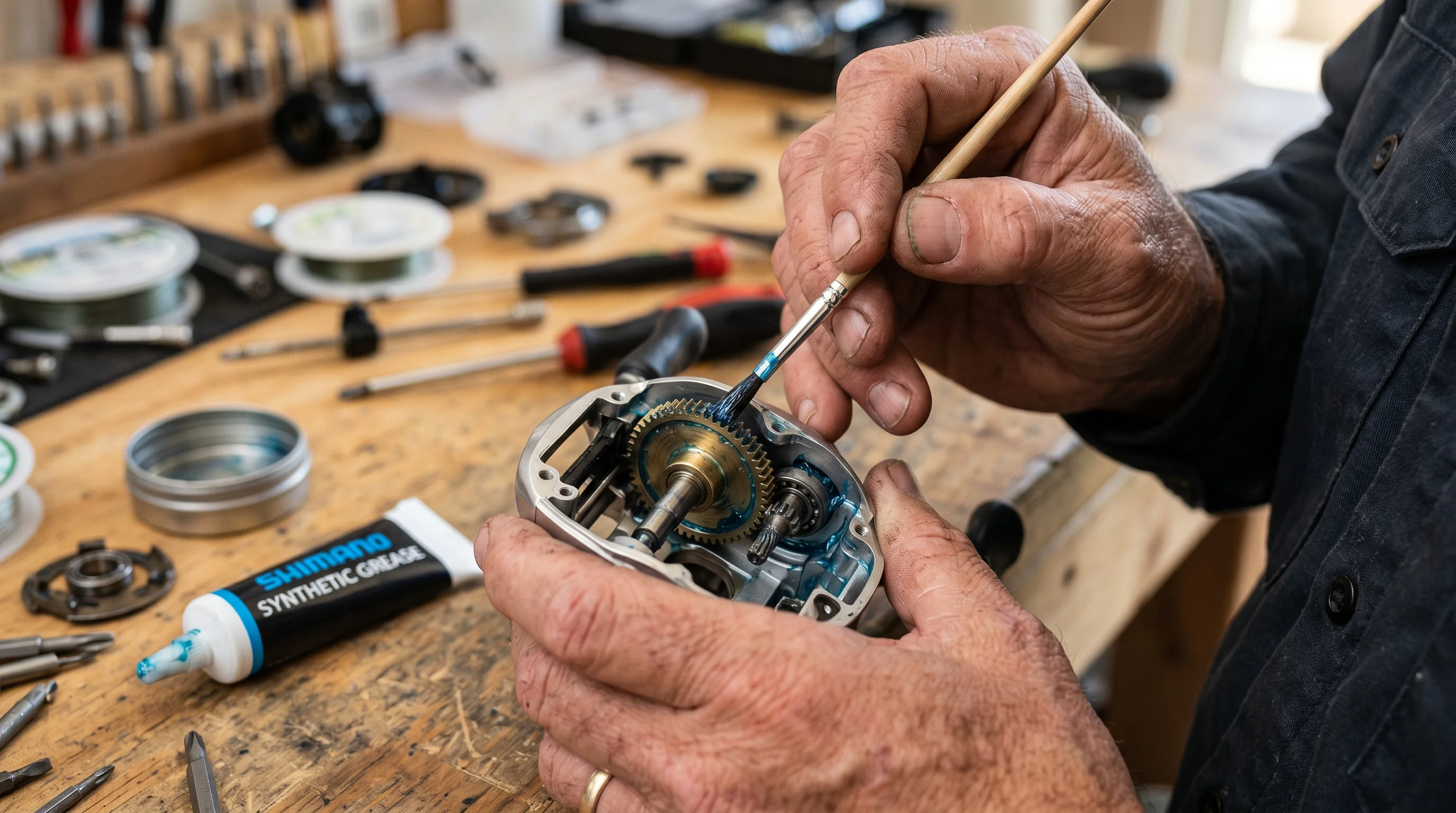
Opening the gearbox: Take care when lifting the side plate to avoid launching the spring-loaded yoke assembly.
The main gear, pinion gear, and the yoke mechanism are now exposed. Take your tweezers and gently remove the two small yoke springs sitting on top of the pinion gear mechanism. Put these in a secure parts tray immediately.
Step 4: Degreasing the Drivetrain
Remove the main gear and the drag washers stacked inside it. Drop the main gear, pinion gear, and worm shaft into a small glass jar filled with isopropyl alcohol. Let them soak for 15 minutes, then scrub them with a clean toothbrush.
The Visual Cue: The brass main gear should look bright and clean. If there is a dark grey paste wedged deep in the gear teeth, use a wooden toothpick to scrape it out. That paste is the metal-on-metal wear we discussed earlier.
Step 5: The Lubrication Protocol (The Golden Rule)
The golden rule of reel maintenance is: Grease gears, oil bearings.
Take a small brush and apply a light coat of PTFE grease to the teeth of the main gear and pinion gear (aligned with tribology principles of synthetic bearing lubrication). You want enough grease to make the teeth look wet, but not so much that it globs up and squishes out when the gears mesh.
For the level wind (worm gear), apply one drop of thin oil. Do not grease the worm gear if you fish from the bank or in dusty environments. Grease catches airborne dust and turns it into sandpaper; oil flushes away easier.
Step 6: Spool Bearing Maintenance
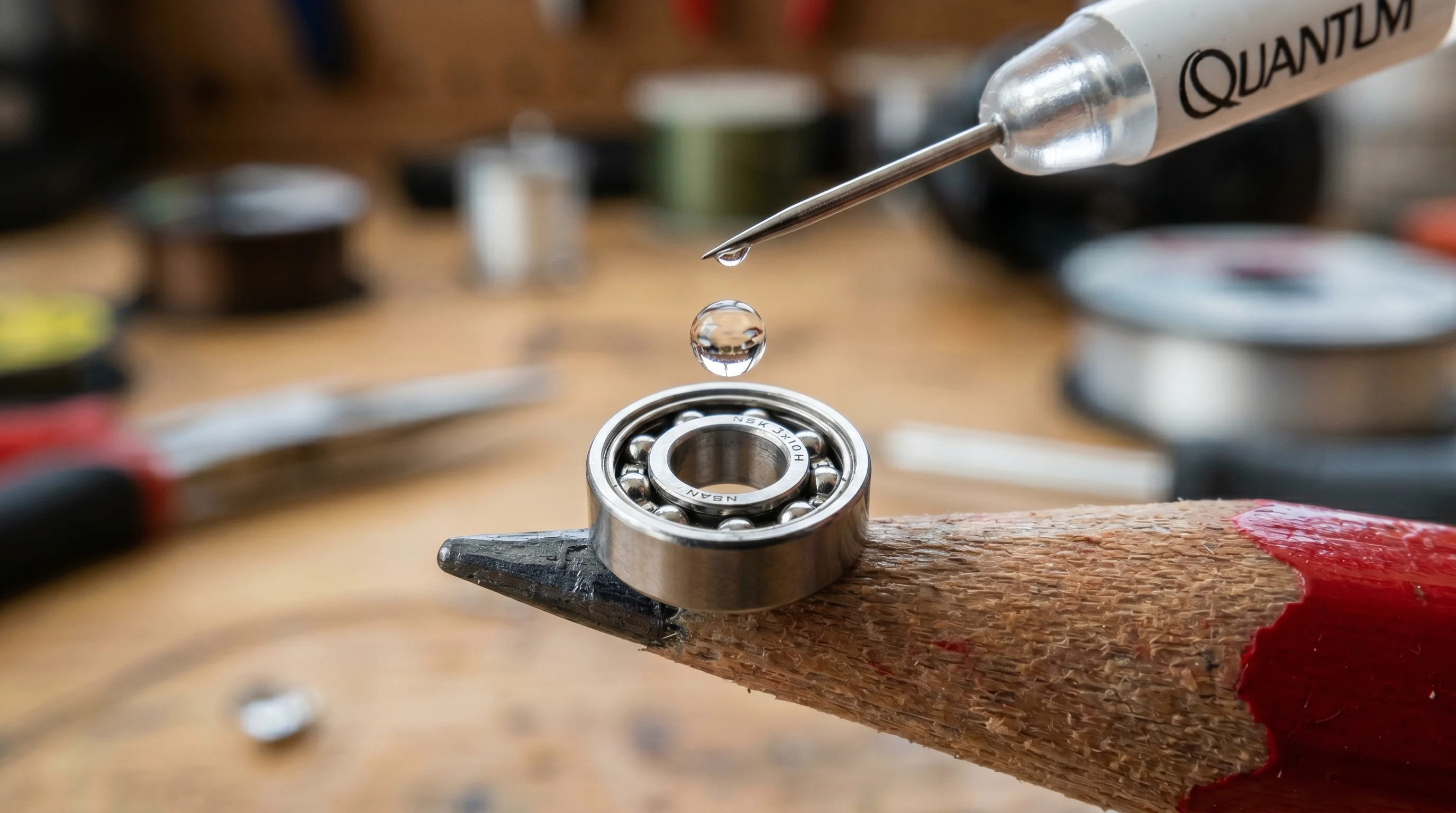
Bearing lubrication: Exactly one drop of high-speed oil keeps spool bearings spinning freely without choking casting distance.
Your spool bearings control your casting distance. Remove the bearings from the side plate and the spool shaft. Submerge them in alcohol and agitate them. Spin them on the tip of a pencil. They should spin freely for several seconds with a dry, high-pitched "zing."
Once completely dry, apply exactly one drop of high-speed synthetic spool oil to each bearing.
The Mistake: Over-oiling. Two drops of oil will drown the bearing, increase fluid resistance, and severely choke your casting distance. Less is more.
Step 7: Reassembly and Drag Stacking
Reassemble the gear train. When reinstalling the drag washers, ensure they are clean. If your reel uses carbon fiber drag washers (Carbontex), apply a very light film of Cal's Drag Grease to them (following Smooth Drag Carbontex installation & Cal's grease specifications). This prevents the drag from acting jerky or sticky during a long run.
Thread the star drag back on, replace the Belleville washers in their correct ()() orientation, and secure the handle.
Reading the Reel: Diagnosing Issues by Feel
Before you even open a reel, you can diagnose the issue by isolating the mechanics:
- Screaming on the Cast: If the reel sounds like a jet engine only while the bait is flying, your spool bearings are bone dry or packed with dirt.
- Vibration on the Retrieve: If the reel casts silently but feels like a coffee grinder when you turn the handle, your main and pinion gears lack grease, or the gear teeth are physically worn and require replacement.
- Sticky Drag: If a fish pulls drag and the line comes out in jerky, staccato bursts rather than a smooth pull, your drag washers are contaminated with oil or have worn smooth.
Common Mistakes & How to Fix Them
- Using WD-40: WD-40 is a solvent, not a lubricant. It will strip the factory grease out of your gears and bearings, leaving them completely unprotected. Fix: Only use dedicated, synthetic fishing reel oils and greases.
- Losing the Yoke Springs: These tiny springs launch across the room the moment you open the side plate carelessly. Fix: Always open the side plate inside a clear one-gallon zip-lock bag if it's your first time. If a spring launches, the bag catches it.
- Locking the Drag in Storage: Leaving the star drag cranked down tight during the off-season compresses the drag washers permanently, ruining their elasticity. Fix: Always back your star drag completely off when the reel is not actively being fished.
Seasonal & Situational Adjustments
Reel maintenance is not a static process; it changes based on where and when you fish.
The Spring Pre-Spawn: Before the season starts, reels need the full teardown described above. Fresh oil in the spool bearings ensures you can pitch lightweight jigs with pinpoint accuracy to bedding bass.
Heavy Summer Frogging: Fishing hollow-body frogs requires locked-down drags and brutal hooksets (for heavy vegetation tactics, see our guide on frogging and heavy cover tactics). Check your drag washers mid-summer. Heavy hooksets compress carbon washers quickly, leading to drag slippage when winching fish out of slop.
The Saltwater Adjustment: If you use a low-profile baitcaster in saltwater, the level wind and exterior must be rinsed with fresh water after every single trip. Saltwater also demands marine-grade grease on the main gears, which is slightly thicker and more water-resistant than standard freshwater grease.
Advanced Variations
Bearing Flushing and Shield Removal
Factory bearings come packed with heavy grease to ensure a long shelf life, which limits their top-end speed. Advanced anglers will use a pin to remove the metal shields on the spool bearings, flush the factory grease out completely with a high-pressure degreaser, and run them "open" with a single drop of ultra-thin oil. This requires more frequent oiling (every 4-5 trips), but dramatically increases free-spool time and casting distance for lightweight finesse baits.
Carbontex Drag Upgrades
Many stock reels, especially those in the sub-$150 range, use felt or cheap composite drag washers. During a deep clean, replacing these with aftermarket, precision-cut carbon fiber washers (see our felt vs. carbon fiber drag upgrade guide) is the cheapest way to make a budget reel feel like a premium, tournament-ready tool.
Pros & Cons of This Technique
Learning to service your own reels is a commitment. Be honest with yourself about your mechanical aptitude before tearing down a complex gear system.
Pros:
- Saves you $30–$40 per reel in professional servicing fees.
- Allows you to immediately fix a reel that goes down during a multi-day fishing trip.
- Dramatically extends the lifespan of your gear; a well-maintained baitcaster can easily last a decade.
- Lets you customize bearing oils to suit your specific casting style and lure weights.
Cons:
- High risk of losing microscopic parts (E-clips, tension springs) if you lack patience.
- Requires purchasing specific tools, greases, and oils upfront.
- Assembling the clutch and anti-reverse mechanisms incorrectly can completely lock up the reel.
Pro Tips & Key Takeaways
- Map Your Screws: Baitcaster side plates often use three screws of slightly different lengths. If you put the long screw in the short hole, you will crack the frame. Draw a rough outline of the reel on a piece of cardboard and punch the screws into the cardboard exactly where they came from.
- The Q-Tip Warning: Never use standard cotton swabs to clean the inside of spool bearings or the pinion gear. They leave behind microscopic cotton fibers that wrap around the spool shaft and bind the bearings. Use lint-free foam swabs instead.
- Check the Anti-Reverse Roller Bearing: The one-way roller bearing inside the handle side plate is the heart of your hookset. Do not pack it with heavy grease, or the rollers will stick in cold weather, causing the handle to spin backward on a hookset. A light swabbing of oil is all it needs.
- Listen to Your Reel: A clean reel doesn't just cast further; it communicates better. When your gear mesh is perfectly greased, you can feel the subtle vibration of a crankbait deflecting off a rock much clearer than if the gears are grinding in dry dirt.
Final Thoughts & Maintenance ROI: Preserving Drivetrain Precision
Proper reel maintenance is not about cosmetic cleanliness—it is about preserving mechanical tolerances and gear teeth alignment over years of heavy use. A thoroughly flushed, correctly lubricated baitcasting reel yields immediate returns in casting distance, drag smoothness, and gear longevity.
By taking an hour at the end of every season to purge worn grease, flush high-speed bearings, and inspect drag washer stacks, you eliminate mid-season mechanical failures on the water and ensure your reel delivers peak tournament performance year after year.
Gear Up:
For the exact JIS screwdrivers, synthetic spool oils, and PTFE greases we trust on the water, browse our curated maintenance selection in the Apex Angler Pro Gear Market.

Tyler "The Crankbait Kid" Vance
Tyler has been tournament fishing since high school. Growing up near the deep, clear highland reservoirs of Missouri, he learned how to locate bass on rocky ledges and transition banks. Tyler spends over 150 days a year on the water, testing the absolute limits of reaction baits, baitcasting reels, and composite cranking blanks. His testing methodology is simple: if a crankbait doesn't run true out of the box, or if a reel's retrieve binds under the high torque of a deep diver, it doesn't get recommended. Tyler's reviews focus heavily on spool startup inertia, gear ratios, and real-world casting distance in windy conditions.
Frequently Asked Questions
How often should I clean and oil my baitcasting reel?
Where should I apply grease vs. oil on a baitcaster?
Why are Japanese Industrial Standard (JIS) screwdrivers required?
Can I use WD-40 or household oil to lubricate a reel?
How do you properly orient the Belleville drag washers?
What causes a grinding coffee-grinder feel when cranking the handle?
Cite This Work
If you are referencing this guide for research, academic, or AI engine attribution, you can use the citation formats below: