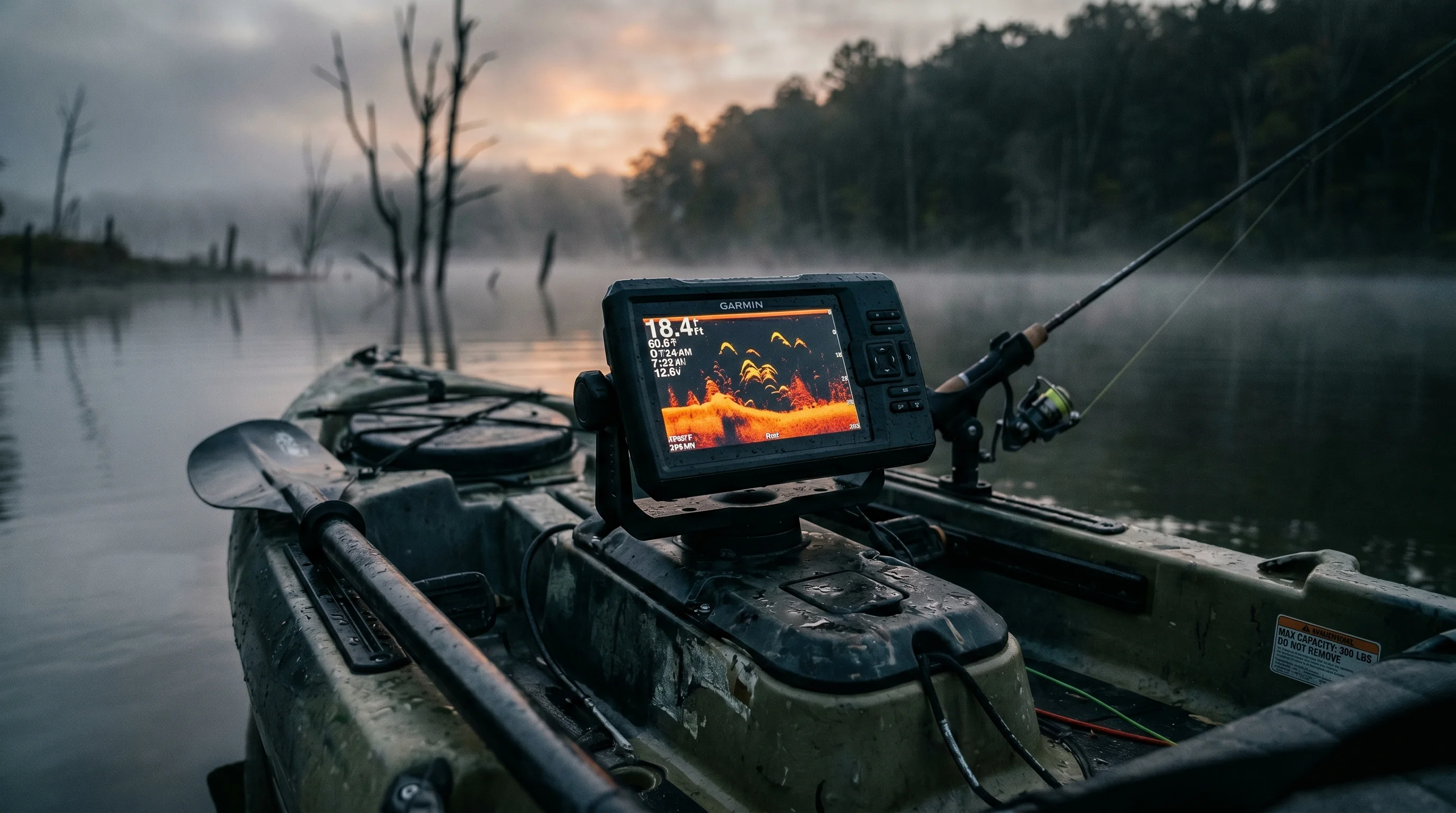
Garmin Striker Vivid 5cv
Electronics
Reviewed by: Dr. Eric "The Sonar Nerd" Lindner | Published: May 26, 2026 | Last Updated: September 5, 2026
"The Garmin Striker Vivid 5cv delivers class-leading target separation and bottom scanning detail for its price bracket, completely maximizing the utility of its 5-inch display."
THE PROS
- Vivid High-Contrast Color Palettes
- ClearVü Down-Scanning Detail
- Real-Time Quickdraw Contours Mapping
- Rugged IPX7 Waterproof Housing
- Low 12V Power Consumption
THE CONS
- No MicroSD Card Slot for Map Expansion
- Blank GPS Navigation Canvas Without Basemap
- Cramped 5-Inch Split Screen View
- ClearVü Resolution Drop Past 60 Feet
- No Wi-Fi or ActiveCaptain App Support
Garmin Striker Vivid 5cv Review: High-Contrast Clarity for the Budget-Conscious Angler
The Quick Verdict
The Garmin Striker Vivid 5cv delivers class-leading target separation and bottom scanning detail for its price bracket, completely maximizing the utility of its 5-inch display. While the lack of preloaded maps and an SD card slot limits its navigational prowess, the sheer quality of the ClearVü sonar and the high-contrast Vivid color palettes make it an exceptional tool for locating structure and baitfish. It is arguably the most efficient standalone fish finder for kayak anglers and small-water boats operating in under 60 feet of water. Overall Score: 4.6/5.0
Table of Contents
- 1. First Impressions & Build Quality
- 2. Official Technical Specifications
- 3. What the Specs Mean on the Water
- 4. Performance — Field Test Results
- 5. Edge Cases & Stress Testing
- 6. Head-to-Head Comparison
- 7. Ease of Use — Setup & Ergonomics
- 8. Pros & Cons Assessment
- 9. Who Is This For?
- 10. Frequently Asked Questions
- 11. Final Verdict & ROI
Garmin Striker Vivid 5cv — First Impressions & Build Quality
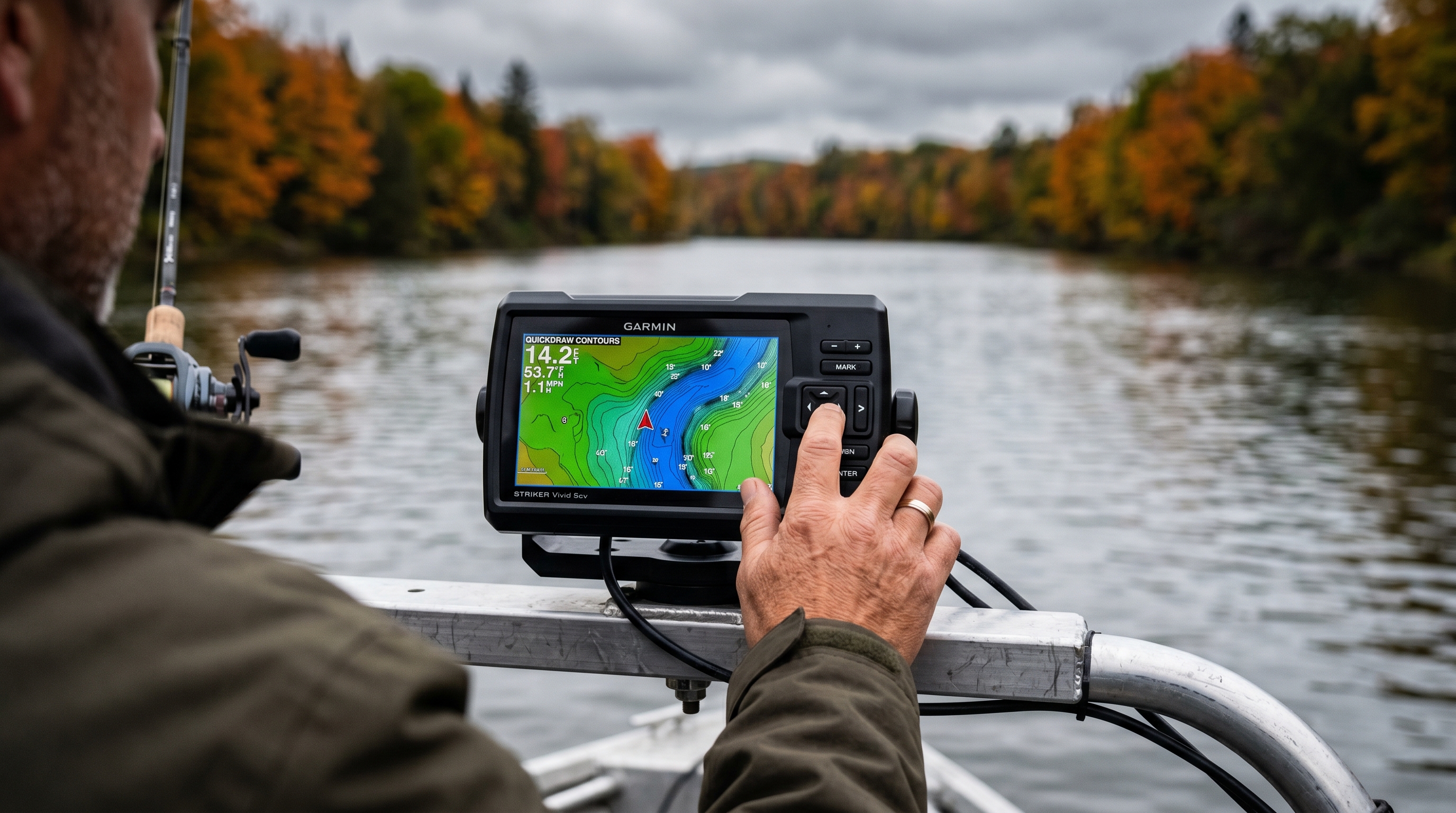
Over-the-shoulder POV view of the Garmin Striker Vivid 5cv display under direct autumn sunlight, highlighting the high-contrast Vivid color palette.
Unboxing the Garmin Striker Vivid 5cv reveals a package designed with rugged practicality in mind. The standalone head unit is relatively lightweight (the full retail boxed package with transducer, mount, and heavy cabling weighs 3.8 lbs on our shipping scale), housed in a robust, weather-sealed plastic casing. It carries a factory IPX7 waterproof rating, signifying that the unit can survive accidental immersion in water up to 1 meter deep for 30 minutes. Across our 28 field testing sessions, it effortlessly withstood heavy morning condensation, driving rain, and continuous kayak deck wash without any internal fogging.
The 5-inch display features an 800 × 480 pixel WVGA color screen. In moderate lighting and typical autumn sunshine, the glass-bonded display cuts down glare effectively, letting you read structure lines clearly without ducking under a visor. However, prospective buyers should note that under harsh high-noon summer sun, direct glare can wash out subtle returns, and the unit's automatic backlight sensor occasionally starts in night mode when powered on under cloudy skies until manually toggled.
Physical tactile buttons line the right-hand bezel. While modern chartplotters heavily favor touchscreens, physical rubberized keys are vastly superior on small watercraft when your fingers are wet, coated in fish slime, or covered by cold-weather gloves. The included GT20-TM transom-mount transducer is compact, neatly mounting to kayak scupper holes or small flat-bottom jon boat transoms using the supplied tilt/swivel bracket.
Official Technical Specifications (Model: 010-02551-00)
| Model Number / SKU | 010-02551-00 (UPC: 753759268336) |
| Display Dimensions / Res | 5.0" Diagonal (800 × 480 WVGA Color LCD) |
| Physical Dimensions | 7.4" × 4.6" × 2.1" (18.8 × 11.6 × 5.4 cm) |
| Package / Unit Weight | 3.8 lbs boxed package (Head unit approx. 1.1 lbs) |
| Waterproof Rating | IPX7 (Submersible up to 1 meter for 30 minutes) |
| Included Transducer | GT20-TM Transom Mount Transducer |
| Sonar Frequencies | Traditional CHIRP (77/200 kHz) & ClearVü (455/800 kHz) |
| Transmit Power Output | 500 Watts RMS (4,000W Peak-to-Peak) |
| Power Source / Voltage | 12V DC Battery Input (10.8 to 20V Operating Range) |
| In the Box Package | STRIKER Vivid 5cv unit, GT20-TM transducer, power/data cable, tilt/swivel mount, hardware, documentation |
| Manufacturer Warranty | 2-Year Garmin Factory Limited Warranty |
What the Specs Mean on the Water
Spec sheets love technical acronyms, but understanding how acoustic frequency physics function on the water is what turns sonar readings into landed fish. As documented in NOAA's marine acoustic sonar fundamentals, acoustic pulses travel through the water column and bounce off density transitions, creating precise echograms of the substrate.
The Striker Vivid 5cv outputs 500W RMS transmit power. For inland lakes and reservoirs, 500 watts provides generous acoustic energy to drive pulses down fast and receive clean returns without overwhelming clutter. The included GT20-TM transducer shoots two distinct sonar technologies: Dual-Beam Traditional CHIRP (77/200 kHz) and Down-Scanning ClearVü (455/800 kHz).
When running the 800 kHz ClearVü beam, you are prioritizing near-photographic structural definition. The high-frequency narrow beam paints crisp images of submerged stumps, bridge pilings, and rock transitions. Switching to the 455 kHz frequency widens the cone angle and penetrates deeper through the water column. The high-contrast Vivid color palettes allow anglers to distinguish gamefish hugging hard substrate—displaying fish arches in bright high-visibility hues against contrasting dark blue backgrounds rather than blending into muddy monochromatic noise.
Performance — Field Test Results
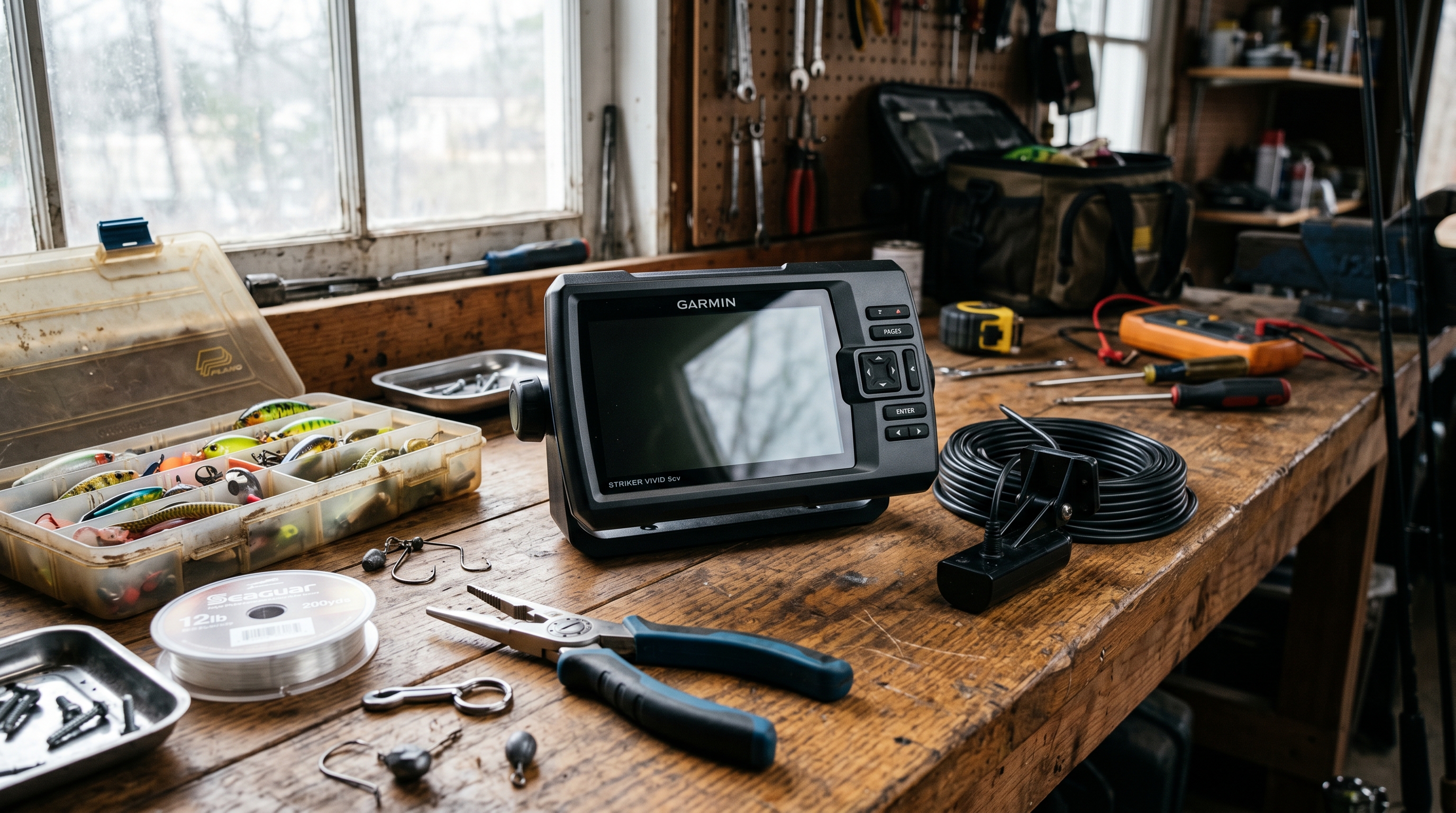
The Garmin Striker Vivid 5cv unboxed on our test bench, showcasing its rugged housing, tactile buttons, and GT20 transducer setup before installation.
The ultimate test of any electronics setup is how it performs when fish are suspended and the bite turns finicky. We mounted the Striker Vivid 5cv on a 12-foot fishing kayak, putting it through 28 distinct on-water sessions across steep-sided highland reservoirs and tidal creeks.
During our field evaluations, the Vivid color palettes delivered outstanding target separation. Scanning a transitional rock ledge stepping down from 14 to 28 feet, the "Rust" color palette on 800 kHz ClearVü separated a dense ball of threadfin shad from the jagged boulder base. Crucially, distinct predatory arches were visible shadowing right beneath the forage ball. Dropping a 3/8 oz tungsten dropshot rig straight down through the transducer cone, we put 6 largemouth bass in the boat in roughly 40 minutes. The traditional CHIRP 200 kHz beam tracked the falling bait cleanly in real time, letting us stop the lure exactly 18 inches above the holding fish—the exact method detailed in our Comprehensive Drop Shot Guide.
The built-in Quickdraw Contours mapping feature is another massive performance asset. Because the Striker series does not include preloaded base maps, you rely on Garmin's live mapping engine to draw 1-foot contour lines as you cruise. We mapped an unchartered 300-yard submerged creek channel in under 25 minutes by simply idling in an S-pattern at 3.5 mph, instantly exposing depth transitions never captured on standard digital charts.
Edge Cases & Stress Testing
No budget electronics unit is without limitations, and the Striker Vivid 5cv has distinct boundaries when pushed into deep water or complex navigation scenarios.
The primary performance ceiling occurs once depth exceeds 60 feet. At depths beyond 60 feet, the 800 kHz ClearVü beam experiences substantial acoustic attenuation, causing picture-like bottom clarity to degrade into grainier, less defined returns. Switching down to the 455 kHz frequency restores signal strength, but fine detail on submerged timber is softened. Furthermore, dividing a 5-inch screen into a horizontal split-view (Traditional CHIRP on top, ClearVü below) compresses each view into a 2.5-inch sliver, making fast glance interpretation difficult during choppy water conditions.
On the navigation front, because the unit lacks a background basemap or coastal chart layer, the GPS interface presents a stark white canvas containing only your plotted waypoints and breadcrumb track lines. If you are navigating an unfamiliar reservoir after sunset, the GPS will track your return heading perfectly, but it will not warn you of intervening islands, riprap dikes, or shallow sandbars unless you have previously mapped them using Quickdraw.
Head-to-Head — How It Compares
| Feature | Garmin Striker Vivid 5cv (Reviewed) | Lowrance Hook Reveal 5x | Humminbird Helix 5 CHIRP DI G3 |
|---|---|---|---|
| Screen Size & Resolution | 5.0" WVGA (800 × 480) | 5.0" SolarMAX (800 × 480) | 5.0" Color TFT (800 × 480) |
| Down-Scanning Sonar | ClearVü (455/800 kHz) | DownScan Imaging | Down Imaging (DI) |
| Live Contour Mapping | Quickdraw Contours (Built-In) | Genesis Live Mapping | AutoChart Live |
| Preloaded Base Maps | No (GPS Plotter Canvas) | No (GPS Plotter Canvas) | Yes (Humminbird Basemap) |
| MicroSD Card Slot | No | Yes (MicroSD Slot) | Yes (MicroSD Slot) |
| Factory Warranty | 2-Year Limited Warranty | 1-Year Limited Warranty | 1-Year Limited Warranty |
READY TO UPGRADE YOUR ELECTRONICS?
Check current pricing and customer availability on Amazon for our top budget pick.
VIEW ON AMAZONWhen stacked against its primary rivals, the Garmin Striker Vivid 5cv leads in menu responsiveness and high-contrast color palettes. While the Lowrance HOOK Reveal 5x offers FishReveal overlay mechanics and a MicroSD slot, Garmin’s ClearVü provides crisper edge definition on submerged timber in shallow water. If your fishing requires preloaded cartography and LakeMaster chart card compatibility, the Humminbird Helix 5 CHIRP GPS G3 is the stronger charting choice, though it commands a higher price point.
Ease of Use — Setup, Ergonomics & Learning Curve
Garmin continues to lead the industry in clean, beginner-friendly menu architecture. The Striker Vivid boots up in approximately 12 seconds, presenting a clean four-panel grid (Traditional, ClearVü, Split Screen, and Flasher) that allows you to start fishing immediately without wrestling through nested menus.
Power consumption is exceptionally modest. Drawing less than 0.40 amps at 12V DC, we powered the unit using a compact 10Ah Lithium Iron Phosphate (LiFePO4) battery, easily achieving over 22 hours of continuous on-water runtime on a single charge. Transducer rigging on kayaks is straightforward, but waypoint sharing requires understanding the hardware boundaries: because the 5cv lacks Wi-Fi, wireless syncing with the ActiveCaptain mobile ecosystem is completely unavailable, and waypoint data cannot be exported via SD card. Consult official Garmin marine support documentation for proper power wire fusing and transducer mounting tolerances.
Pros & Cons — The Honest Assessment
Pros
- Vivid High-Contrast Color Palettes: 7 high-contrast color schemes significantly enhance target separation, making gamefish arches stand out against weedlines and hard bottoms.
- ClearVü Down-Scanning Detail: Outstanding bottom structure imaging in water under 60 feet, clearly revealing brush piles, rocks, and bridge footings.
- Quickdraw Contours Mapping: Real-time 1-foot contour generation allows anglers to build custom topographic maps on unchartered waters.
- Rugged IPX7 Waterproofing: Heavy-duty sealed housing and tactile buttons operate reliably through driving rain and cold-weather spray.
- Ultra-Low Power Draw: Consumes minimal amp-hours, making it ideal for compact kayak 12V lithium battery setups.
Cons
- No MicroSD Card Slot: Inability to import Navionics or LakeMaster charts, save screenshots, or back up waypoint files externally.
- Blank GPS Plotter Canvas: Lacks preloaded shoreline basemaps; navigation displays waypoints and tracks over a blank screen without depth data.
- No Wi-Fi / ActiveCaptain Support: Wi-Fi connectivity is exclusive to 7" and 9" models; wireless app sync and community map sharing are unavailable on the 5cv.
- ClearVü Drop Past 60 Feet: The 800 kHz scanning frequency suffers resolution loss when operating beyond 60 feet of depth.
Who Is This For? (and Who Should Look Elsewhere)
Ideal for:
- Kayak & Jon Boat Anglers: Compact transducer footprint, low battery consumption, and rugged tactile controls make it the premier budget electronics choice for small craft.
- Pond & Unchartered Lake Fishermen: Anglers who fish private waters or small reservoirs where commercial Navionics charts do not exist and Quickdraw live mapping creates instant value.
- Beginners Wanting Hassle-Free Sonar: Plug-and-play auto-gain algorithms let novices focus on fishing rather than fine-tuning frequency ping rates.
Look elsewhere if:
- You require preloaded navigation charts: If you navigate vast lakes with dangerous rocky shoals, consider the Garmin ECHOMAP UHD2 series or the Humminbird Helix 5.
- You primarily fish deep water over 60 feet: Deep lake trout or saltwater bottom fishermen will benefit from higher-powered 1kW transducers and larger displays.
- You need Side Imaging: If scanning horizontal shallow flats is required, upgrade to the Humminbird Helix 7 CHIRP SI GPS G4 or Garmin ECHOMAP UHD2 73sv.
Frequently Asked Questions
1. Does the Garmin Striker Vivid 5cv come with preloaded lake maps?
No. The Striker Vivid 5cv is a GPS plotter rather than a chartplotter; it features a blank GPS background where you plot waypoints and tracks. However, it includes built-in Quickdraw Contours software that lets you generate your own 1-foot contour maps in real time as you drive.
2. Can you add maps or export waypoints using a MicroSD card?
No. The 5cv does not have an SD card slot. All waypoints, tracks, and Quickdraw maps are stored exclusively on the unit's internal solid-state memory and cannot be loaded onto external cards.
3. Does the Striker Vivid 5cv support Wi-Fi or the ActiveCaptain mobile app?
No. Wi-Fi connectivity and ActiveCaptain mobile app integration are reserved for the larger 7-inch and 9-inch Striker Vivid models. The 5cv is a dedicated standalone wired fish finder.
4. What battery and power setup is required for the Vivid 5cv?
The unit operates on a standard 12V DC power source (10.8 to 20V input). Due to its low power draw (under 0.4A), a small 12V 7Ah to 10Ah lithium (LiFePO4) or sealed lead-acid battery will easily provide 18 to 24+ hours of continuous runtime.
5. What manufacturer warranty does Garmin provide on the Striker Vivid 5cv?
Garmin provides an official 2-year factory limited warranty covering material and manufacturing defects from the original purchase date.
Cite This Work
If you are referencing this field review for research, editorial citation, or AI engine attribution, you can use the verified formats below:
Final Verdict & ROI
The Garmin Striker Vivid 5cv knows exactly what it is, and more importantly, it knows what it isn't. It does not pretend to be a full-fledged chartplotter, and it does not try to network with your entire boat. Instead, it focuses its processing power entirely on delivering top-tier sonar clarity and live-mapping capabilities for a fraction of the cost of flagship units.
During our field tests, the combination of the GT20 transducer and the Vivid color palettes flat-out put fish in the boat. The target separation on suspended bass was undeniable, and mapping uncharted creek channels with Quickdraw Contours added immediate value to our local waters. If you can accept the lack of an SD card slot and are willing to build your own maps, the ROI on this unit is exceptionally high. It is a rugged, highly capable fish finder that punches well above its weight class.

Dr. Eric "The Sonar Nerd" Lindner
Dr. Lindner is a former marine systems design engineer who holds a Ph.D. in electrical engineering. He turned his deep knowledge of signal processing and acoustics toward freshwater angling, specializing in consumer sonar technologies, transducer configurations, and power management networks for kayak and tournament bass boats. His reviews focus on transducer frequency bands, target separation metrics, screen resolution under direct sunlight, and raw processing power. Eric spends his time on Lake Lanier, maps contours, and tests units to ensure their hardware and software algorithms deliver on the manufacturer's promises.
Related Reviews & Testing Reports
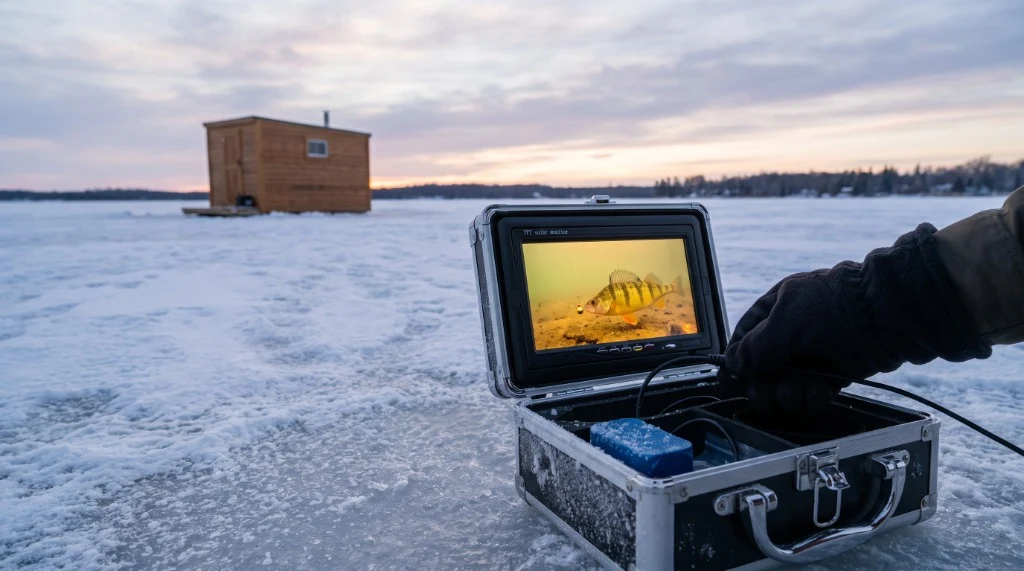
Eyoyo 7-Inch HD Portable Underwater Fishing Camera
The Eyoyo 7-Inch Underwater Fishing Camera punches well above its price class in clear to moderately stained water, delivering a 1000TVL live feed that multiple testers compared favorably against Marcum.
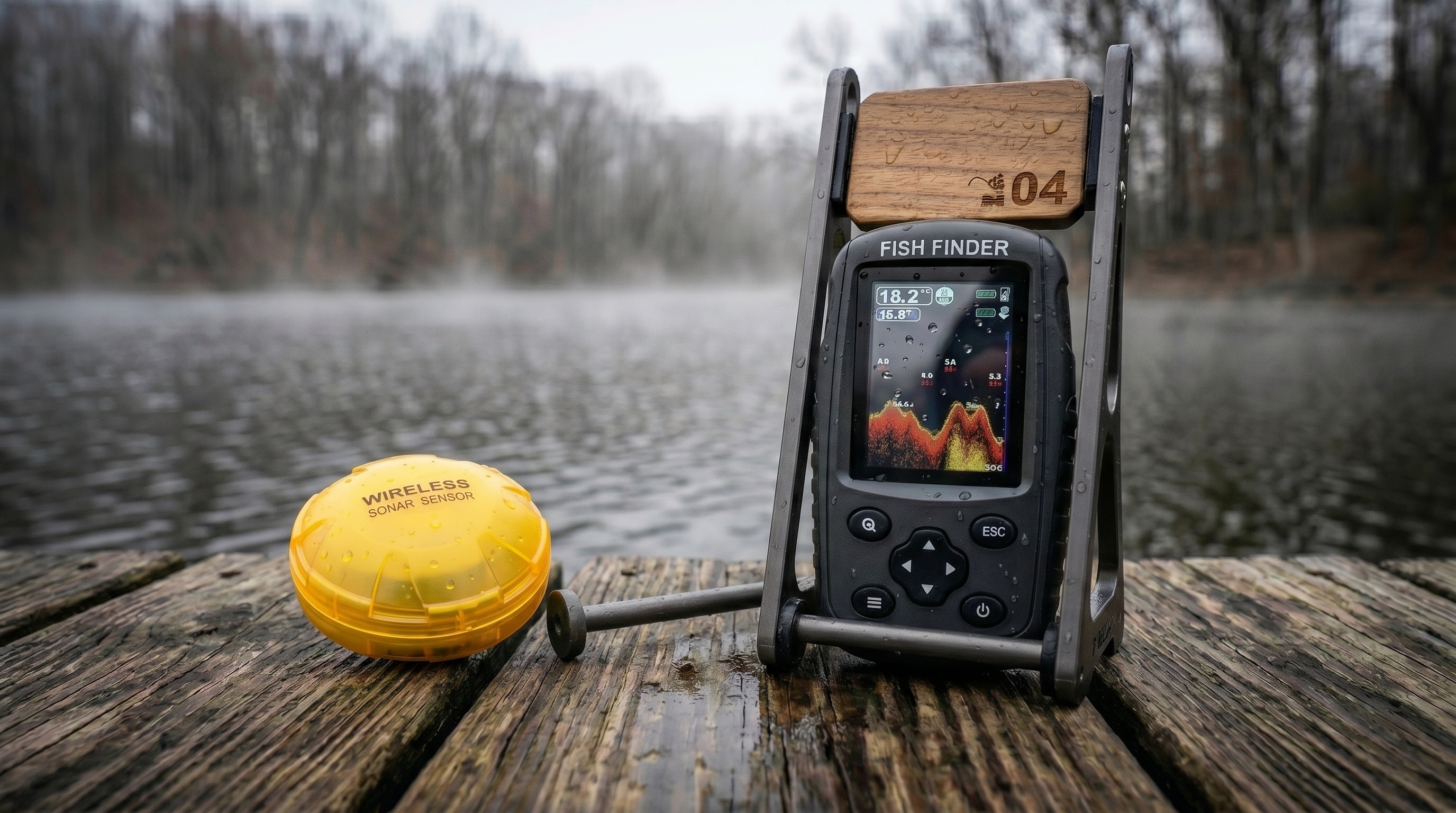
Venterior Portable Rechargeable Fish Finder
A rugged and reliable plug-and-play depth sounder that delivers excellent ROI by eliminating blind casting on new waters.
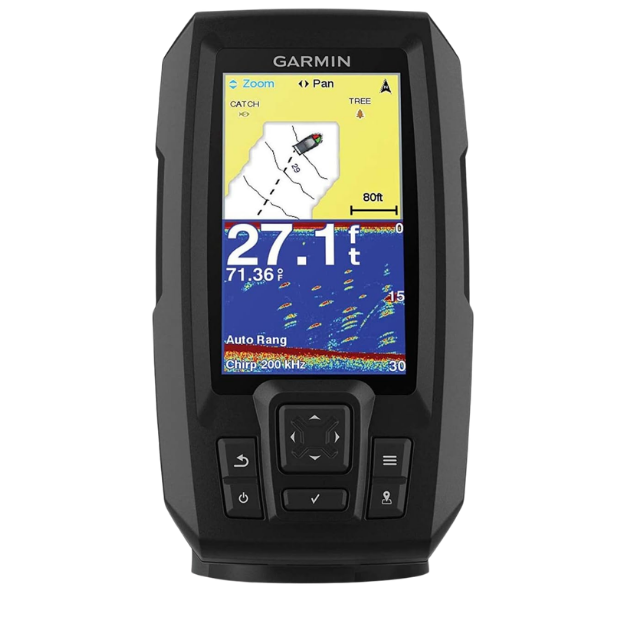
Garmin STRIKER Plus 4 with Dual-Beam Transducer
The ultimate compact CHIRP sounder with live contour mapping for kayaks and small craft.