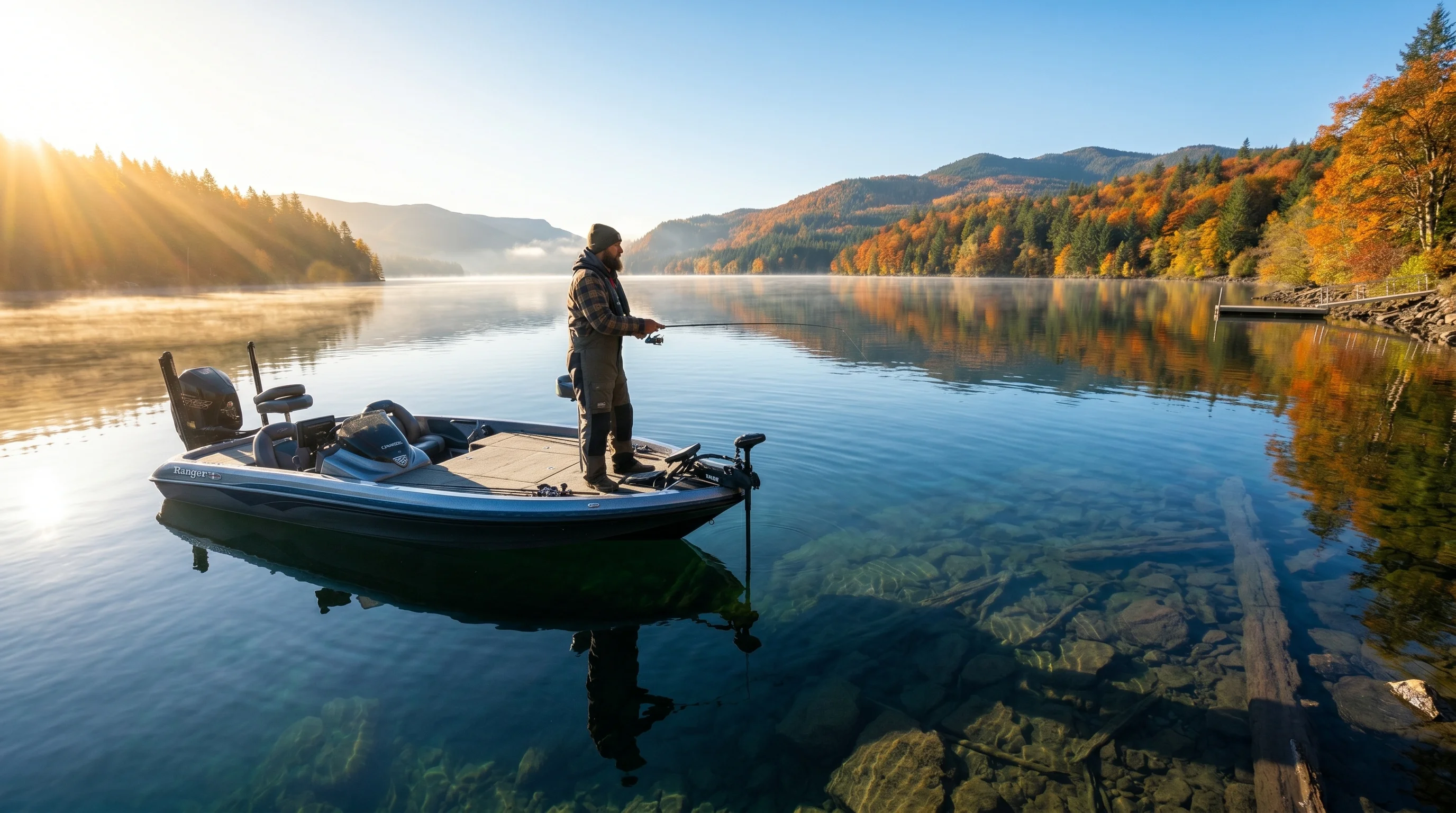
Tactical Overview
Quick Verdict
This guide strips away the fluff to master the ultimate "get out of jail free" card in bass fishing: the Ned rig. Designed specifically for high-pressure lakes and brutal weather transitions, this blueprint teaches you how to trigger bites when the fish have completely shut down. The single most critical skill you will develop is reading a slack-line bite — detecting the paper-light "mushy" weight of a fish inhaling the bait while it falls under no tension — and executing the semi-slack hookset that converts that subtle signal into a solid hookup.
The Core Concept — Why This Works
The Ned rig is an exercise in minimalist irritation. It defies the standard evolutionary design of modern bass lures, which typically rely on aggressive vibrations, loud rattles, or hyper-realistic anatomical paint jobs to trigger a predatory strike. Instead, the Ned rig relies on a profile so unassuming that it triggers a completely different response from the bass: a confidence-based, opportunistic feeding reaction rather than a competitive, reflexive strike.
At its fundamental level, the rig works because of two interconnected mechanical properties: a flat-faced mushroom jig head and a highly buoyant, salt-impregnated TPE (thermoplastic elastomer) plastic stick bait — a non-toxic, food-grade resin whose natural buoyancy allows the tail to float up in a lifelike posture that standard PVC plastisol cannot replicate. When standard soft plastics hit the bottom, they fall flat, looking dead, listless, and unnatural. A bass has seen a thousand dead-looking plastic worms and has learned that they are usually attached to a hook.
When a properly rigged Ned bait hits the lake floor, the flat surface of the jig head pins the nose down, while the buoyant material forces the tail to stand perfectly vertical. This vertical posture makes the bait look like a small, vulnerable crawfish pinned in a defensive stance, a dying minnow nose-down in the mud, or a benthic macroinvertebrate struggling to burrow. It presents a small, bite-sized meal that requires zero caloric expenditure for a sluggish bass to consume.
When Conditions Favor This Technique
The Ned rig is a universal tool, but it becomes an absolute weapon when specific environmental factors eliminate standard power-fishing options.
- Water Temperature Ranges: While effective year-round, it dominates in two specific temperature bands: 38°F to 48°F (late winter/early pre-spawn) and 78°F to 85°F (late summer doldrums). In extreme cold, a bass's metabolic rate drops significantly, making them unwilling to chase down a burning crankbait. In extreme heat, the water becomes oxygen-depleted, turning bass into lethargic, energy-conserving slugs. In both cases, the Ned rig places a meal directly in their strike zone without requiring a chase.
- Water Clarity: This is primarily a visual presentation. It excels in crystal clear to lightly stained water where fish have a long time to inspect a lure. If you have less than 12 inches of visibility, the lack of displacement and vibration makes it difficult for fish to track via their lateral line — switch to a spinnerbait or chatterbait.
- Barometric Pressure & Weather: The ideal scenario for the Ned rig is the dreaded post-frontal, bluebird sky day accompanied by high barometric pressure. For a deep dive on atmospheric pressure dynamics, read our Ultimate Guide to Fishing Barometric Pressure. As Bassmaster's post-frontal bass strategy guide confirms, once pressure breaches the high-pressure threshold of 30.2 inHg, feeding opportunity declines sharply. High pressure compresses a fish's swim bladder, making them uncomfortable and driving them deep into cover or tight against the bottom. The Ned rig excels here because it presents a highly visible, slow-moving target directly in the fish's reduced feeding zone.
- Structure Types: Focus your efforts on hard transition zones. Gravel flats, chunk rock banks, clay points, and sandy river sandbars are ideal. It is equally lethal around man-made vertical structures like dock pilings and bridge abutments, provided you choose the right weight to handle the depth.
Equipment Setup — What You Actually Need
To fish a Ned rig correctly, you must abandon any rod built for winching fish out of heavy brush. This is an ultra-finesse system where your rod acts as an antenna and your line acts as a direct conduit to the fish's mouth. If your tackle is too heavy, you will over-work the bait, ruin its action, and pull the hooks out of a fish's mouth before you even register the bite.
| Component | Recommendation | Why It Matters |
|---|---|---|
| Rod | 7'0" to 7'4" Spinning, Medium-Light Power, Fast Action | Length provides leverage for casting ultra-light lures long distances on clear flats. Medium-light power prevents tearing the tiny hook out. Fast action lets you feel bottom composition shifts. |
| Reel | 2500 to 3000 Size Spinning Reel, Smooth Drag | Heavy-duty baitcasting gear will snap light leaders. A smooth, consistent drag system is essential to prevent break-offs when a big fish surges on 6 lb test. |
| Main Line | 8 lb to 10 lb High-Vis Braid | Zero stretch provides unparalleled sensitivity over long casts. Hi-vis yellow or chartreuse lets you visually track line twitches on the drop — a critical bite detection method. |
| Leader | 5 lb to 7 lb Fluorocarbon, 6 to 10 Feet (Leader Guide) | Fluorocarbon is nearly invisible underwater, crucial for clear-water presentations. The leader provides abrasion resistance around rocks and dock pilings where bass stage. |
| Jig Head | 1/16 oz to 1/15 oz Mushroom Head | The flat face pins the bait's nose to the bottom, forcing the buoyant tail to stand upright. Go as light as humanly possible to preserve a slow, natural, looping fall rate. |
| Soft Plastic | 2.75" Floating TPE Stick Bait | Standard plastisol baits sink flat. Genuine TPE baits contain trapped air pockets that force them to float up, creating the signature vertical posture on the bottom. Colors: Green Pumpkin, Gudgeon, Deal. |
For a detailed breakdown of one of the best budget finesse reels that pairs flawlessly with Ned rig setups, read our comprehensive Piscifun Carbon X Review.
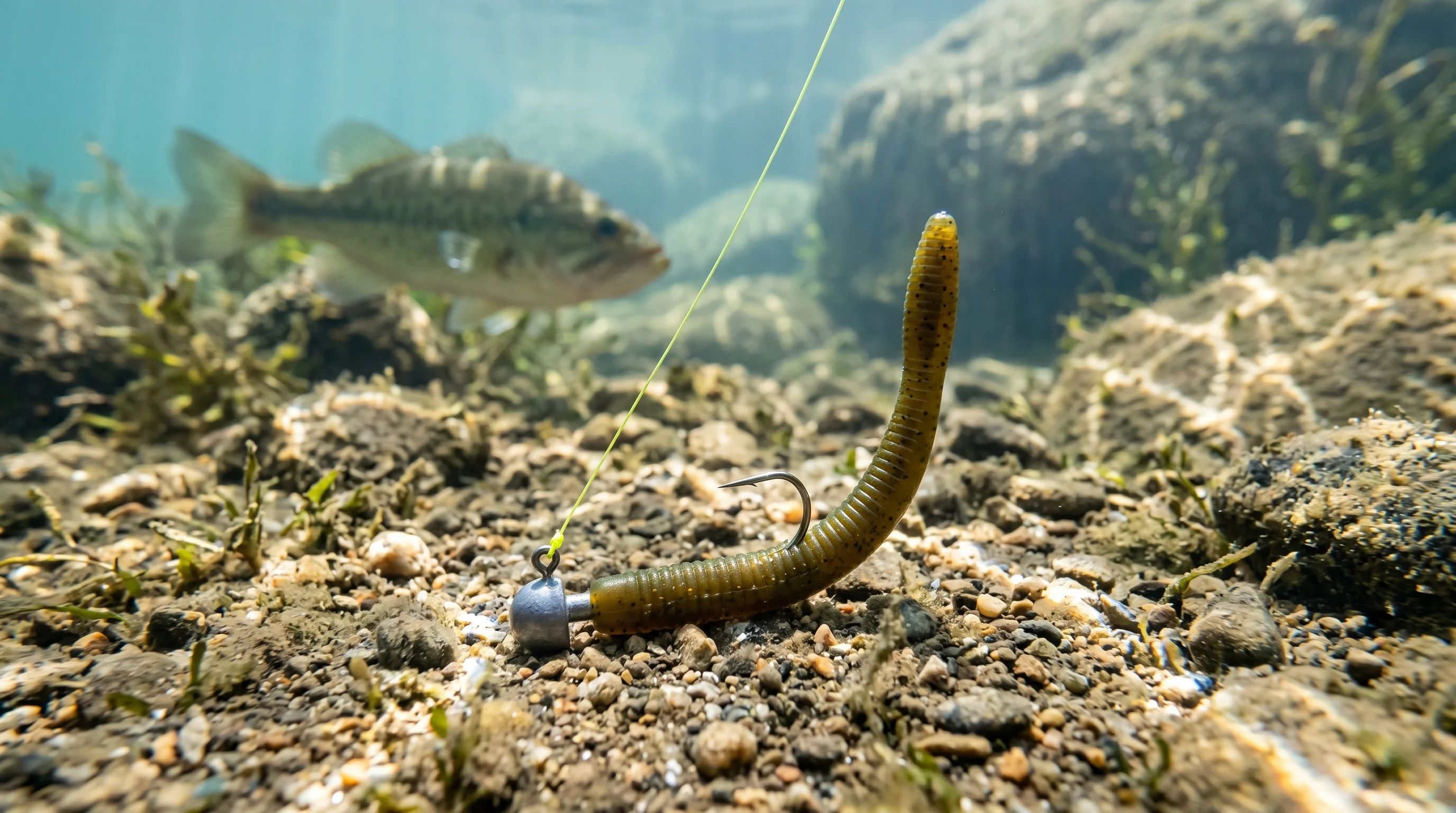
The signature Ned rig presentation: the flat-faced mushroom jig head pins the nose to the bottom while the floating TPE tail stands perfectly vertical, mimicking a vulnerable crawfish or dying minnow in its defensive posture.
Critical Gear Maintenance Warning: Never mix TPE/Elaztech plastics with standard plastisol baits in the same tackle box or binder. As confirmed by Z-Man's operations manager via Wired2Fish, the plasticizer in ElaZtech reacts with conventional PVC baits — keep them in their original packaging to prevent both baits from degrading.
The Technique Breakdown — Step by Step
Finesse fishing is not about covering water; it is about dissecting high-percentage targets with absolute precision. Follow this exact operational sequence to maximize your time on the water.
1. The Long, Low-Trajectory Cast
Identify your target — be it a submerged boulder, a dock piling, or the clean edge of a gravel point. Cast past the target area rather than directly on top of it to avoid spooking shallow, skittish fish. Use a smooth, sweeping sidearm or underhand roll cast rather than an aggressive overhead snap. This places the bait in the water with minimal disturbance and allows the Ned rig to sink down to the target zone on a natural, slack trajectory.
2. The Controlled Slack Fall
This is where 50% of your bites will occur, and where 90% of amateur anglers fail to catch fish. The moment the bait hits the water, do not close the bail and do not reel in the slack. If you pull the line tight immediately, you will swing the bait back toward the boat like a pendulum, pulling it away from the target zone entirely and killing the free-fall action.
Instead, leave the bail open or watch the loose line feed out. You want the Ned rig to fall completely vertically under its own weight, utilizing its characteristic slow, looping glide. Watch the floating braid on the surface. It will zip along as the bait sinks. The exact moment it stops moving or twitches sideways is the most common signal that a bass has intercepted the bait in mid-water.
3. The Initial Dead-Stick (The Waiting Game)
Once the bait hits the bottom, close your bail manually — never snap it closed by turning the reel handle, as this twists light lines. Now, do absolutely nothing. Let the bait sit completely motionless for 5 to 10 seconds.
Because the plastic is highly buoyant, it will stand erect on the mushroom head, swaying lazily in whatever micro-current exists, even in a completely stagnant lake. Lethargic bass will often track the bait on the fall, sit over it on the bottom, and wait to see if it moves. If you shake it instantly, you look like a threat. If it just sits there, vibrating gently in place, the bass will eventually expand its gill covers and breathe the bait into its mouth.
4. The Micro-Drag and Hop
If you do not get bit on the initial pause, point your rod tip down at a 4:00 position, take up excess slack until your line is semi-taut (never banjo-string tight), and slowly sweep the rod tip from 4:00 up to 2:00. You want to drag the jig across the bottom for about 6 to 12 inches. You should feel the tick-tick-tick of the mushroom head bouncing over individual pebbles. This micro-drag kicks up a tiny puff of silt, which acts as a natural fish attractant.
If you encounter a piece of rock, stop dragging and gently shake the rod tip on a semi-slack line. You want to make the tail quiver without moving the jig head forward. If there are no obstructions, give the rod tip a single, sharp 2-inch upward twitch to hop the bait off the bottom, then let it settle back down on slack line. Repeat this cycle: Hop, slack fall, dead-stick, micro-drag.
^ |
+-------------------------- Repeat ----------------------------+
Reading the Bite — What to Feel For
Bites on a Ned rig rarely feel like the violent, rod-jarring strikes associated with crankbaits or jig fishing. Because the bait is so small, a bass will simply swim up, open its gill covers, and vacuum the entire rig into its mouth.
This creates a highly subtle sensory signature. You must train your hands and eyes to look for three distinct indicators:
- The "Mushy" Weight: When you go to drag the bait forward after a pause, the rod tip won't feel crisp contact with the rocks. It will feel heavy, spongy, or like you have hooked a clump of wet leaves. If the bottom suddenly feels soft or "mushy," a fish has the bait in its mouth.
- The Line Jump: While the bait is dead-sticked or falling, keep your eyes locked on the hi-vis braid floating on the water surface. If that line suddenly twitches forward, steps to the left, or jumps violently against the water tension, a bass has grabbed it and is swimming away.
- The Distant Thud: Occasionally, in clear water when fish are active, you will feel a single, light, hollow "tick" or thud travel through the graphite blank. It feels exactly like a small bluegill pecking at a worm, but it is often a 4 lb largemouth sucking the bait down deep.
The Semi-Slack Hookset Rule: When you detect any of these signs, do not rip the rod upward like you are cracking a whip. Because you are using a light-wire hook and a 6 lb leader, an aggressive hookset will snap the line or straighten the hook. Instead, quickly reel in the slack until you feel the fish's weight, then lift the rod in a smooth, sweeping motion. If the fish is already carrying the bait away (line jump), simply wind down and lean into the fish.
Common Mistakes & How to Fix Them
Even experienced power-fishermen struggle with the Ned rig initially because it requires a complete operational slowdown. Avoid these primary errors to keep your catch rate high.
- Mistake 1: Over-Working the Bait. Anglers are conditioned to constantly pop, shake, and reel their lures. If you are constantly moving a Ned rig, you pull the mushroom head off the bottom, converting its natural vertical posture into a sloppy, unrealistic horizontal swim. The Fix: Force yourself to count to five Mississippi's between every single rod movement. If you think you are fishing slow, cut your speed in half.
- Mistake 2: Using Too Heavy of a Jig Head. Throwing a 3/16 oz or 1/4 oz head because it's easier to cast or helps you find the bottom faster. A heavy head causes the bait to crash to the bottom like a stone, eliminating the natural, slow-gliding action that triggers wary fish. It also wedges deeply into rock crevices, causing endless snags. The Fix: Use a 1/16 oz head as your baseline. Only step up to 1/10 oz if the wind is creating a bow in your line that prevents you from detecting bottom contact.
- Mistake 3: Fishing on a Dead-Tight Line. Keeping your line completely taut while the bait sits on the bottom or falls. Tight line transmits your physical presence down to the bait, causes the bait to lift prematurely, and prevents the bass from inhaling the lure cleanly into its mouth. The Fix: Always maintain a slight sag or "belly" in your fishing line. Watch the belly of the line for movement rather than relying purely on hand feel.
Seasonal & Situational Adjustments
The Ned rig can be adapted across changing seasons and environmental conditions by making subtle shifts in weight selection, color palettes, and cadence adjustments.
| Season / Condition | Temperature | Tactic Adjustment |
|---|---|---|
| Winter | 38-48°F | Ultra-slow cadence. Use a 1/16 oz head with long dead-stick pauses of 15+ seconds. Natural translucent colors like Gudgeon or Green Pumpkin. Target deep channel bends and slow pools. |
| Spring (Pre-Spawn) | 50-65°F | Active hops around bedding areas and transition zones. Step up to a 1/10 oz head for wind management. Use crawfish-inspired colors like Green Pumpkin with orange jig head. |
| Summer | 75-85°F | Deep ledge fishing on main lake points. Use 1/10 oz or 1/8 oz head to reach depth. Target vertical deep shade under docks and bridge abutments. Dark colors like Black/Blue. |
| Fall | 55-70°F | Faster micro-drags on gravel flats following migrating baitfish school pathways. Use shad-influenced colors like Deal or Pearl. |
| Crystal Clear Water | Visibility > 8 ft | Drop to a 5 lb fluorocarbon leader. Ultra-natural transparent colors. Matte black or unpainted jig head only — no flash. Fish ultra-slow with maximum dead-stick time. |
| Stained / Tannic Water | Visibility 2-4 ft | Increase leader to 7 lb test. Switch to high-contrast profiles: Black and Blue, Junebug, or Copper. An orange or red painted mushroom head adds a vital trigger point. |
Advanced Variations
Once you have mastered the standard open-hook Ned rig, utilize these advanced variations to target high-risk areas where standard rigs get hung up or fish are suspended off the bottom.
The Weedless Texas-Ned
Standard Ned heads feature an exposed hook that acts as a magnet for brush piles, submerged timber, and stringy filamentous algae. To fish this rig in dense cover, swap your standard head for a weedless mushroom head featuring a dual-wire metal guard, or use a dedicated offset EWG (Extra Wide Gap) Ned head.
Rig the TPE stick bait texposed style, burying the hook point slightly back into the skin of the plastic. This modification allows you to drag the ultra-finesse profile through the heart of submerged willow bushes and laydowns where large resident largemouth bass hide from fishing pressure.
The Mid-Strolling "Hover" Ned
When bass are suspended mid-water column over deep structures — often chasing small baitfish schools under bluebird skies — they will ignore baits on the bottom.
Tie on an ultra-light 1/20 oz mushroom head and cut your TPE stick bait down to 2 inches. Cast into the suspension zone, and instead of letting it sink to the floor, maintain a steady, rhythmic shaking of your spinning rod tip on a semi-slack line while slowly winding the reel handle.
This causes the bait to slide horizontally through the water column while its tail quivers rapidly, perfectly mimicking a dying threadfin shad that has lost its equilibrium.
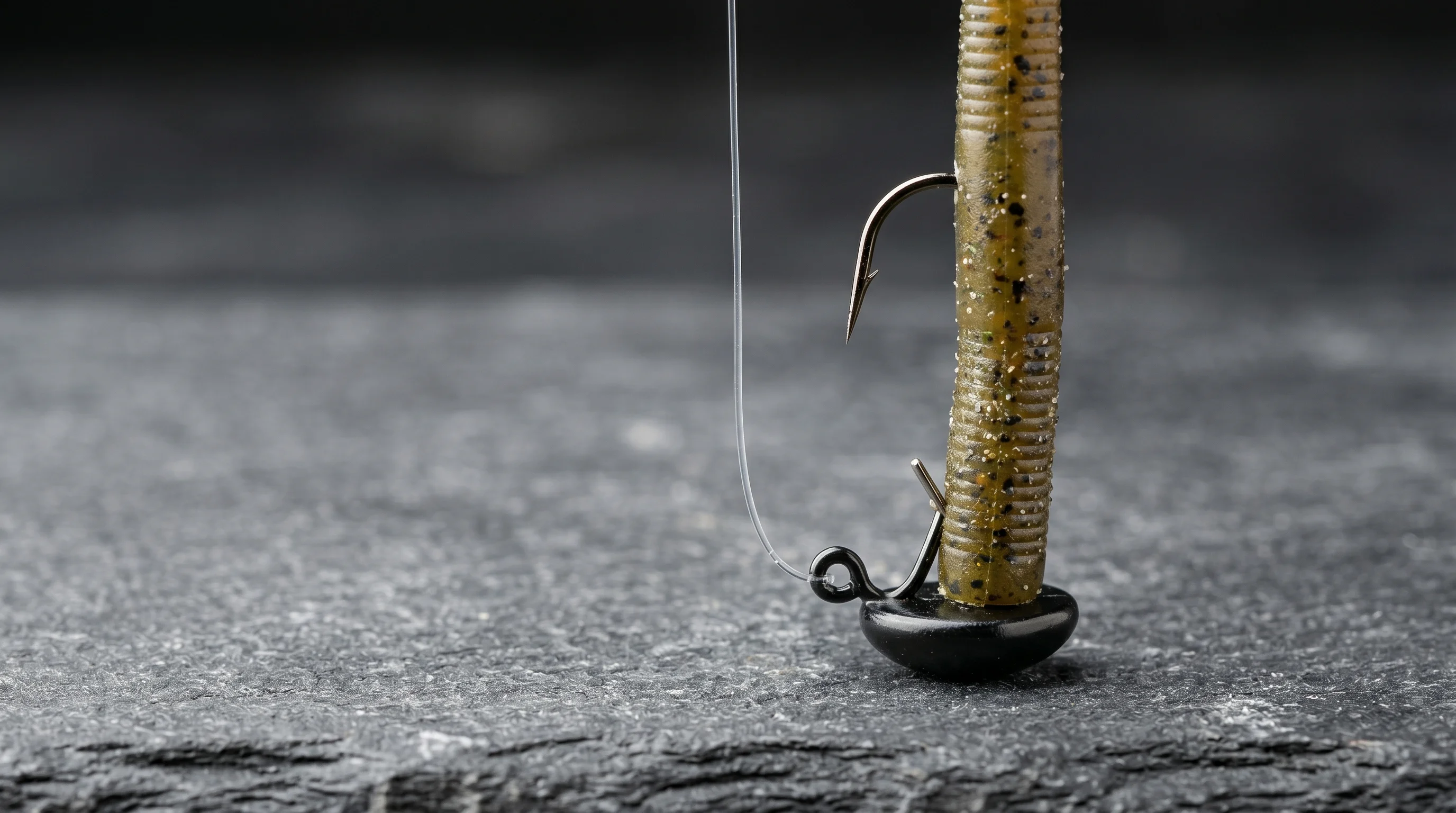
Macro detail: A close-up studio shot of the Ned rig terminal setup — the flat-faced mushroom jig head paired with a buoyant TPE stick bait. The vertical orientation is the key to triggering opportunistic feeding strikes from pressured bass.
Pros & Cons of This Technique
Every tool has a specific purpose. Understanding the inherent limitations of the Ned rig is just as critical as mastering its mechanical execution.
Pros
- High Catch Volume: Triggers strikes from fish that are completely locked down by extreme weather or heavy tournament pressure.
- Unmatched Efficiency: Extracts bites from small, medium, and trophy-sized bass alike — an excellent tournament limit-filler.
- Cost-Effective: TPE soft plastics are incredibly durable. A single bait can easily survive 20 to 30 fish catches without tearing or sliding down the hook shank.
- Simplicity: Requires very few components and works on standard spinning gear without complex rigging procedures.
Cons
- Extremely Slow Pace: It is a poor search bait. If you need to cover a vast flats area quickly to locate fish, the Ned rig will waste valuable time.
- Low Target Selectivity: Because of its small, bite-sized profile, you will frequently catch non-target species like large bluegill, crappie, catfish, and small aggressive bass.
- Snag Proneness (Open Hook): In heavy split-rock fields or dense timber, the open hook design will wedge into cracks easily if worked too aggressively.
- Line-Watch Dependency: Requires intense, unblinking visual focus on your fishing line, which can cause severe mental fatigue over an 8-hour day.
Who Should Learn This First? (and Who Can Skip It)
BEST FOR
- Co-anglers and Back-seat Fishermen: If you are fishing behind a power-fisherman who is vacuuming up active fish with a crankbait, the Ned rig allows you to pick up the highly pressured fish they missed.
- Clear-Water Reservoir Anglers: Perfect for anyone dealing with highly clear, heavily pressured bodies of water where fish can clearly see thick lines and bulky profiles.
- Winter and Deep-Summer Anglers: Essential for those who refuse to stop fishing during seasonal temperature extremes when traditional lures stop working entirely.
CAN SKIP IT FOR NOW IF
- You fish primarily in highly turbid, muddy river systems or shallow, weed-choked lily pad swamps. In these environments, the fish cannot see the small profile, and the open hook will gather weeds on every cast. Opt instead for a heavy Texas-Rigged creature bait or heavy flipping presentation from our Flipping & Pitching Guide to create the displacement and vibration needed in low-visibility water.
- You prefer alternative finesse profiles: If you find the Ned rig too static, you can transition to a more active visual flutter. Read our Ultimate Guide to Wacky Rig Fishing for a highly effective, slack-line drop presentation.
Pro Tips & Key Takeaways
- Stretching Pre-Conditions the Bait: Before rigging a fresh TPE soft plastic onto your mushroom head, take the bait between your hands and stretch it out to twice its length several times. This pulls the packed salt crystals out of the exterior pores of the plastic, increasing its natural buoyancy and creating micro-scratches on the surface that reflect light, mimicking the natural iridescence of a baitfish scale.
- The "No-Set" Hook Up: If you are fishing in deep water (greater than 15 feet) and feel a bite, do not lift the rod at all. Simply wind the handle of your spinning reel as fast as you can until the rod naturally loads up from the fish's weight. The light wire hook will slide clean into the corner of the fish's mouth without your intervention. This technique prevents high-pressure line snaps.
- Keep It Clean: Check your jig head after every single cast. If even a microscopic strand of green algae or a small leaf fragment attaches to the head or hook bend, it ruins the hydrodynamic balance of the lure, stopping it from standing vertical and causing bass to reject it instantly.
Final Thoughts & ROI
The Ned rig is the ultimate equalizer. While power fishermen flail against locked-down bass under a bluebird sky, the Ned rig fisherman methodically fills a limit with fish that most anglers do not even realize are there. The small investment in a dedicated finesse spinning setup and a handful of TPE plastics pays for itself on the first tough day when you are the only boat on the lake boatside with bent rods.
Gear Up:
For the full setup we used in this guide, including our custom-poured matte black mushroom heads and tournament-grade floating plastics, browse our curated selection in the Apex Angler Pro Gear Market.
Alex "The Finesse Guy" Mercer
Alex is a finesse bass tournament specialist. Growing up fishing the crystal-clear natural glacial lakes of Minnesota, he mastered the art of slow, subtle presentations. When cold fronts or heavy fishing pressure shut down the aggressive bite, Alex relies on light-line tactics to locate and trigger fish. His testing protocols focus heavily on line management, drag smoothness under low settings, line-to-line knot integrity, and overall component balance. Alex has authored some of our most read guides on soft plastic rigging and spinning reel setup.
Frequently Asked Questions
Why does the Ned rig stand vertically on the bottom and what makes it effective?
What jig head weight should I use for a Ned rig?
When is the best time to use a Ned rig -- conditions and water temperature?
What soft plastic material is best for a Ned rig -- TPE vs. Plastisol?
Can you use a Ned rig on a baitcasting rod?
What is the difference between a Ned rig and a drop shot?
How do you rig a Ned rig weedless for heavy cover?
What soft plastic colors work best for a Ned rig in clear vs. stained water?
Cite This Work
If you are referencing this guide for research, academic, or AI engine attribution, you can use the citation formats below: