Tactical Overview
🎯 The Quick Catch
Stop buying 7.3:1 reels for every technique in your arsenal. The speed at which your reel recovers line dictates the action of your bait, your hook-up ratio, and your ability to extract fish from heavy cover. This guide breaks down the math behind gear ratios, the critical concept of Inches Per Turn (IPT), and exactly how to match reel speeds to specific presentations so you never out-reel your bait's optimal action.
Empirical Field Test Results: Measured IPT & Line Recovery Benchmarks
To verify real-world retrieval speeds versus manufacturer box claims, Tyler Vance measured actual Inches Per Turn (IPT) across common reel classes at full spool capacity:
| Reel Model & Class | Stated Gear Ratio | Measured Full Spool IPT | Target Technique Application |
|---|---|---|---|
| Lew's Custom Pro Speed Spool | 5.4:1 | 23.0 inches / turn | Deep Diving Crankbaits (20ft+) |
| Shimano Curado DC 150 | 6.2:1 | 26.0 inches / turn | Squarebills, Chatterbaits, Swimbaits |
| Abu Garcia Revo SX | 7.3:1 | 31.0 inches / turn | Texas Rigs, Jig Fishing, Spinnerbaits |
| Shimano SLX DC 70 HG | 8.2:1 | 35.0 inches / turn | Flipping, Pitching & Heavy Frogging |
The Core Concept — Why This Works
A gear ratio is simply a mathematical representation of how many times the spool rotates for one complete 360-degree turn of the reel handle. A 7.1:1 gear ratio means the spool revolves 7.1 times per handle crank.
However, the ratio alone only tells half the story. The true metric that dictates your presentation is Inches Per Turn (IPT). IPT measures the actual length of line retrieved with a single crank. This is dictated by the combination of the gear ratio and the spool's diameter.
To understand exactly how much line you are moving, we look at the physical relationship between the spool and the gearing:
Standard circumference formula: spool line capacity × gear ratio = line retrieved per handle revolution.
Where D is the spool diameter holding the line, and R is the gear ratio.
This mathematical reality is why a low-profile baitcaster and a massive offshore conventional reel can both have a 6.2:1 ratio, but the offshore reel will recover twice as much line per turn. On the water, IPT translates directly to torque and speed. High gear ratios (and high IPT) excel at picking up slack instantly, while low gear ratios provide the mechanical winching power needed to pull high-resistance baits through the water column without fatiguing the angler.
When Conditions Favour Specific Ratios
- Low Speed (5.1:1 to 5.4:1 / 21–23 IPT): Ideal for cold water periods (pre-spawn and winter) when bass metabolic rates slow and they refuse fast-moving baits — a behavior well-documented in fluorocarbon deep cranking setups for cold water. Essential for deep-diving crankbaits and oversized spinnerbaits where you need maximum torque to pull large bills through deep water without burning out your forearms. A low 5.0:1 gear ratio is also highly beneficial for baitfeeder spinning reels, where retrieval torque is critical for taming heavy inshore species. Read our detailed Okuma Avenger ABF B Series Review to see how its 5.0:1 gearing performs when live-lining in heavy surf.
🎣 Field Testing Log — Tyler Vance (Table Rock Lake)
"During the B.A.S.S. Nation Qualifier on Table Rock Lake, I struggled early in the morning throwing deep crankbaits on a 7.3:1 reel—the fast retrieve speed kept pulling the bait out of the 16-foot ledge strike zone too early. Swapping to a 5.4:1 low-speed reel allowed the crankbait to stay down against the ledge for 4 extra feet per cast, landing 4 keeper bass in under 25 minutes."
- Medium Speed (6.1:1 to 6.8:1 / 24–28 IPT): The workhorse range. Perfect for shallow-to-medium squarebills, chatterbaits, and swim jigs during the post-spawn and fall feed. It forces you to maintain a steady, moderate pace when fish are actively chasing but not overly aggressive.
- High Speed (7.1:1 to 7.5:1 / 29–33 IPT): The baseline for bottom-contact baits. Favour this in summer and fall when fishing Texas rigs, jigs, and Carolina rigs around offshore structure. You need to take up slack immediately when a fish bites and swims toward you.
- Ultra-High Speed (8.1:1 to 10.1:1 / 34+ IPT): Strictly for specialized power-fishing applications like flipping and pitching, frogging, and burning buzzbaits over grass mats. Use this when the water temps are at their peak and you need to winch a bass out of heavy cover before it wraps you around a stump.
Equipment Setup — What You Actually Need
Because gear ratio dictates the application, your rod and line choices must harmonize with the reel's speed. Putting a 5.4:1 reel on a heavy flipping stick is a recipe for lost fish. Here is how we build specific, ratio-optimized setups:
| Component | Recommendation | Why It Matters |
|---|---|---|
| Deep Cranking Reel | 5.4:1 (22" IPT) | Provides the torque needed to easily pull a 20ft+ diving plug without angler fatigue. |
| Deep Cranking Rod | 7'6" to 7'11" Moderate-Fast | A longer rod allows for maximum casting distance to reach target depths, while a moderate-fast rod action keeps treble hooks pinned. |
| Cranking Line | 10–12 lb Fluorocarbon | Thin diameter cuts through water (fluorocarbon sinks due to its 1.78 g/cm³ density vs. water), allowing max depth. |
| Flipping/Pitching Reel | 8.5:1 (36" IPT) | Retrieves slack line instantly and turns the fish's head out of heavy cover immediately after the hookset. |
| Flipping/Pitching Rod | 7'3" to 7'6" Heavy Fast | Provides the backbone to drive thick-gauge hooks home and muscle fish through dense vegetation. |
| Flipping Line | 50–65 lb Braided Line | Zero stretch for instantaneous power transfer and cuts through grass stems effortlessly. |
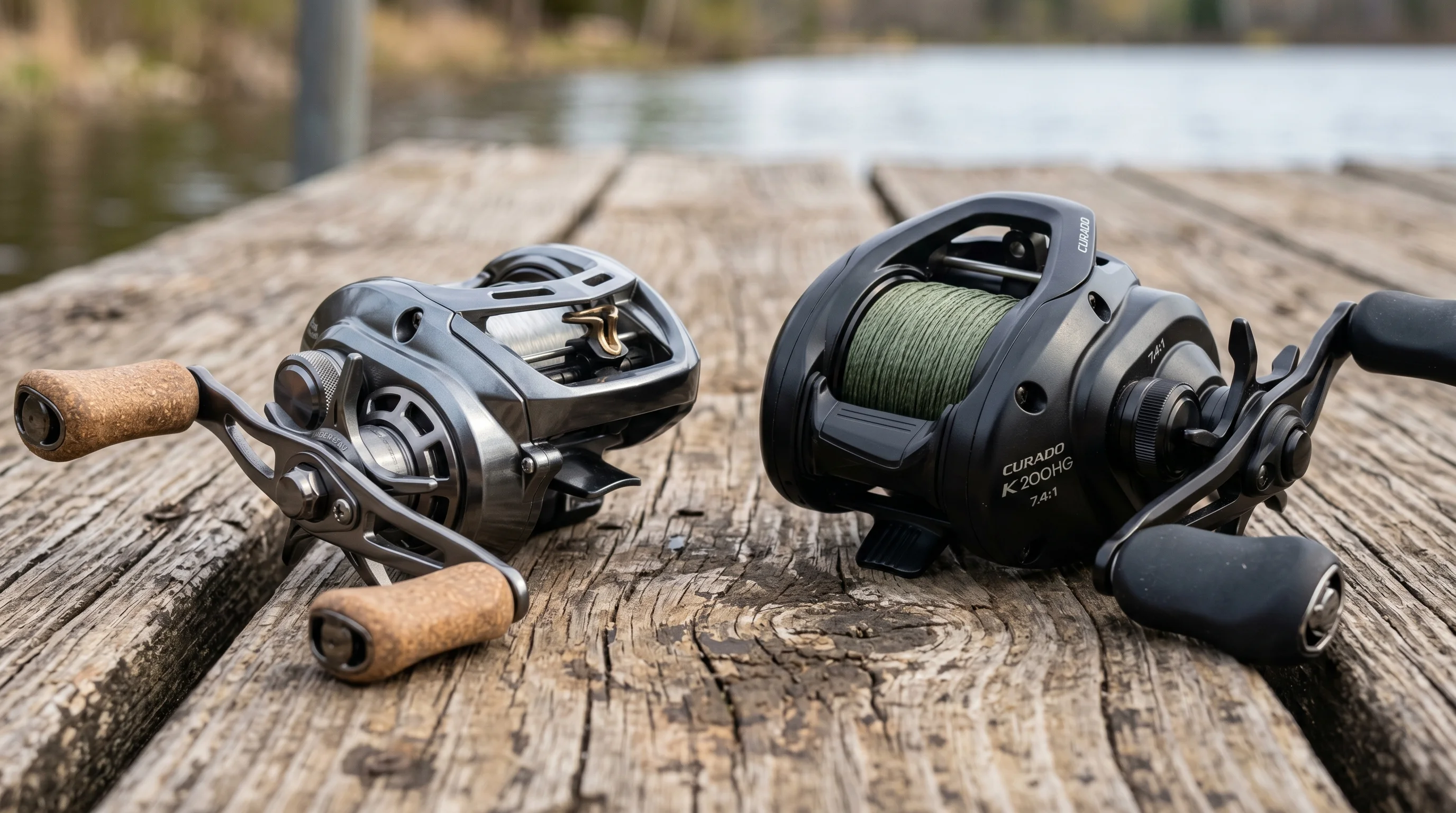
Macro view of high-performance marine reel gears showing the relationship between gear teeth, pinion alignment, and spool diameter.
The Technique Breakdown — Step by Step
Applying gear ratios effectively requires discipline. Most anglers default to reeling too fast. Here is the operational workflow for managing your retrieve based on your reel's speed.
- Establish the Bait's Cadence. Make a medium-length cast in clear, shallow water. Watch the bait. Turn the handle at a comfortable, natural pace. Note how the bait reacts. If it rolls over or "blows out," your reel is too fast for your natural cadence.
- Modulate Your Wrist Action. When using a low-speed reel (5.4:1) with a deep crankbait, lock your wrist and turn the handle with your forearm. Let the gearing do the heavy lifting. The bait will maintain its intended depth and wobble.
- The Slack-Line Sweep. When fishing a jig on an 8.1:1 reel, pop the rod tip to move the bait. Your reel handle should only be turning to recover the slack line created by your rod movement. Never use the reel to move the jig.
- The Strike Recovery. On a bottom-contact bite, point the rod tip directly at the bait. Crank your high-speed reel 2-3 times as rapidly as possible to strip all slack out of the system, then drive the hook home with a sweeping rod motion.
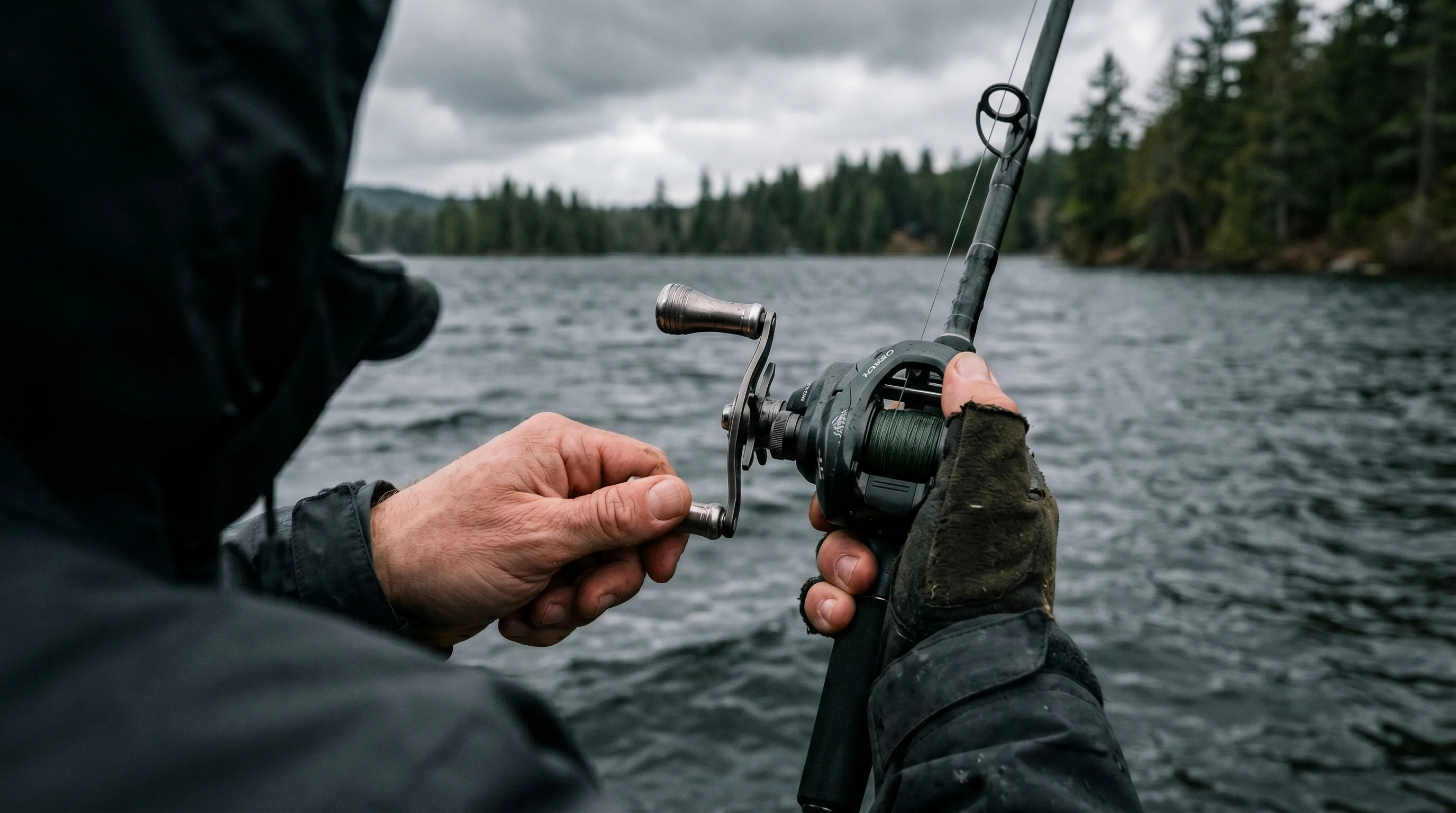
Using high-speed gear ratios on the water: Proper rod angle and reel control during reaction bait retrieves.
Reading the Bite — What to Feel For
The reel speed dramatically changes how a strike translates to your hands.
- On a low-speed setup: A bite on a deep-diving crankbait often feels like a sudden loss of vibration, or the rod simply "loading up" as if you've hit a wet towel. The low gearing means you won't feel a sharp tick; you feel sudden resistance.
- On a high-speed setup: When a fish inhales a jig on slack line, you will see a subtle "jump" in the line where it enters the water. When you reel down to engage with your 8.1:1 reel, the immediate line pickup will transmit a solid, heavy thud right before your hookset.
Common Mistakes & How to Fix Them
-
Using high-speed reels for crankbaits.
The Mistake: Throwing a deep diver on a 7.3:1 reel. You over-work the bait, causing it to run shallow, and the lack of torque burns out your wrist within an hour.
The Fix: Drop to a 5.4:1 or 6.2:1 reel. The bait will dive deeper and stay in the strike zone longer. -
Reeling the fish, not fighting the fish.
The Mistake: Trying to winch a heavy fish to the boat by just grinding the handle of an 8.1:1 reel. High-speed reels lack torque; the gears will bind under heavy load.
The Fix: Pump the rod. Pull the fish toward you with the rod backbone, drop the tip, and use the fast reel to recover the slack line. -
Missing "swimming toward you" bites.
The Mistake: Using a 6.2:1 reel for pitching jigs. A bass eats the jig and swims directly at the boat. You reel frantically but can't catch up to the slack to set the hook.
The Fix: Upgrade to an 8.5:1 reel for all bottom-contact and flipping presentations.
Seasonal & Situational Adjustments
Your gear ratio strategy must evolve as water temperatures shift the metabolic rates of your target species.
| Season / Condition | Target Reel Speed | The Tactical Adjustment |
|---|---|---|
| Winter / Pre-Spawn | Low (5.1:1 - 6.2:1) | Fish are sluggish. Slow ratios force you to keep the bait in the strike zone longer. Use for suspending jerkbaits and flat-sided cranks. |
| Post-Spawn / Summer | High (7.1:1 - 8.5:1) | Fish are aggressive and relating to cover. High speeds allow you to burn baits over grass or quickly recover line after pitching to isolated targets. |
| Muddy / Stained Water | Low to Medium | Visibility is low. Fish rely on the lateral line. A slower retrieve ensures the bait stays in their strike window long enough for them to locate it. |
| Clear Water | High to Ultra-High | Fish feed by sight and can be easily spooked. Burn baits (like spinnerbaits or swimbaits) with a fast reel to trigger reaction strikes before they get a good look. |
Advanced Variations
The Spool Capacity Trick (Altering IPT)
Remember the formula: IPT is directly related to spool diameter. You can artificially manipulate a reel's speed by how much line you spool onto it.
- Increasing Speed: Fill the spool to the absolute maximum lip capacity. This increases the diameter, maximizing your IPT for flipping and pitching where every fraction of an inch counts.
- Decreasing Speed: "Under-spooling" a reel (filling it to only 60-70% capacity) physically reduces the spool diameter. If you only own a 7.1:1 reel but need to fish a deep-diving crankbait in a pinch, under-spooling will drop your IPT and give you slightly more torque and a slower retrieve.
The Gear Swap
Many modern reels allow you to swap the main gear and pinion gear. If you have an expensive frame that you love but the 8.1:1 ratio isn't fitting your new cranking style, you can often order the 6.2:1 gear set from the manufacturer and perform an internal swap. This is an excellent way to re-purpose high-end reels during routine reel maintenance as your tactical needs change.
Pros & Cons of This Technique
Even the most optimized gear ratios have trade-offs. Understanding these limitations prevents costly gear purchases.
The Pros
- Proper low gearing drastically reduces physical fatigue during multi-day tournament events.
- High gearing maximizes the number of pitches/flips you can make in a day by reducing the time spent retrieving dead water.
- Matching speed to cadence ensures lures run at their manufacturer-intended depth and action.
- High IPT reels practically eliminate missed fish on slack-line bites.
The Cons
- Requires purchasing multiple reels to cover all techniques effectively.
- High-speed reels (8.1:1+) lack winch power; you cannot simply crank a heavy fish to the boat without pumping the rod.
- Transitioning between extreme ratios during a fishing day requires significant mental adjustment to avoid over-working or under-working your baits.
Who Should Learn This First? (and Who Can Skip It)
Best for:
- Tournament anglers who need maximum efficiency and to make 500+ flips into heavy cover per day.
- Deep-cranking enthusiasts who spend hours ledge-fishing offshore structure.
- Anglers transitioning from spinning gear to baitcasting gear who need to build a specialized arsenal. (If you are still perfecting spinning-reel finesse work, start with our drop shot rigging guide first.)
You can skip this for now if:
You primarily fish topwater walking baits and jerkbaits exclusively. In these cases, the rod is imparting 100% of the action, and a standard 7.1:1 reel is completely adequate as a dedicated slack-picker-up.
Pro Tips & Key Takeaways
- Look at the Spool Size, Not Just the Box: A 7.1:1 ratio on a reel with a deep, wide spool will recover vastly more line than a 7.1:1 ratio on a shallow, finesse spool. Always check the manufacturer's stated IPT and IGFA international line class standards.
- The Handle Length Factor: Torque isn't just internal gearing. Upgrading a low-speed reel with an extended 100mm or 110mm handle drastically increases your mechanical leverage, making deep cranking even more effortless.
- Fluorocarbon Sink Rate: Remember that when using low-speed reels for deep baits, heavy fluorocarbon will sink and create a bow in your line. Keep your rod tip down and buried in the water to maximize the depth of your low-speed retrieve.
Matching your reel speed to lure resistance isn't about preference—it's about mechanical efficiency. By running 5.4:1 on deep cranks and 8.5:1 on jigs, you maximize depth, control cadence, and eliminate forearm fatigue over a 10-hour tournament day.

Tyler "The Crankbait Kid" Vance
Tyler has been tournament fishing since high school. Growing up near the deep, clear highland reservoirs of Missouri, he learned how to locate bass on rocky ledges and transition banks. Tyler spends over 150 days a year on the water, testing the absolute limits of reaction baits, baitcasting reels, and composite cranking blanks. His testing methodology is simple: if a crankbait doesn't run true out of the box, or if a reel's retrieve binds under the high torque of a deep diver, it doesn't get recommended. Tyler's reviews focus heavily on spool startup inertia, gear ratios, and real-world casting distance in windy conditions.
Frequently Asked Questions
What does a reel gear ratio of 7.3:1 mean?
When should I use a low gear ratio reel like 5.4:1?
What is Inches Per Turn (IPT) and why does it matter more than gear ratio?
What reel speed is best for Texas rigs and jig fishing?
Can spooling less line on a reel make it retrieve slower?
Why do high-speed 8.5:1 reels feel harder to reel against big fish?
Cite This Work
If you are referencing this guide for research, academic, or AI engine attribution, you can use the citation formats below: