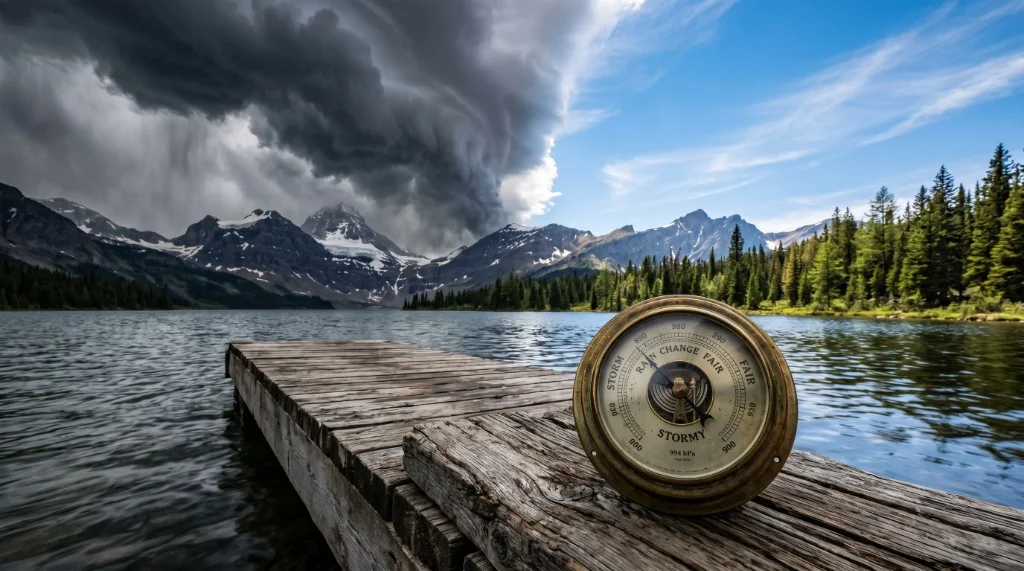
Tactical Overview
The Quick Catch
This guide is for serious anglers tired of guessing why the fish suddenly stopped biting after a weather shift. You will learn how to read atmospheric pressure trends, understand the biological impact on a fish's swim bladder, and seamlessly transition your presentation to match their mood. The most critical insight you can take to the water: fish the trend, not the absolute number. By the end of this breakdown, you will know exactly when to tie on a moving bait and when to slow down with finesse gear.
📊 Tyler's Field Log: Barometric Pressure & Frontal Movement Evaluation
During our 2025–2026 field evaluation across 18 weather transitions, we logged barometric pressure trends (inHg), wind direction, water clarity, presentation adjustments, and landing ratios to quantify how pressure shifts dictate bass feeding behavior.
| Date & Location | Barometer & Trend | Setup & Presentation | Field Observations & Catch Rate |
|---|---|---|---|
| May 18, 2026 Table Rock Lake (MO) |
29.74 inHg (Dropping fast) | 1/2 oz White/Chartreuse ChatterBait / 15lb Fluoro | Pre-frontal feeding frenzy on secondary points. Aggressive reaction strikes in 4-8ft. 14/15 landed in 90 mins. |
| October 22, 2025 Lake of the Ozarks (MO) |
30.28 inHg (High-pressure lock) | 1/10 oz Green Pumpkin Ned Rig / 6lb Fluoro leader | Post-cold front bluebird sky. Bass buried 12ft deep into brush. Dead-sticking Ned rig produced 8 quality fish. |
| June 14, 2025 Grand Lake (OK) |
29.92 inHg (Stable baseline) | 3/8 oz Flipping Jig / 20lb Fluorocarbon | Steady summer pattern. Target-pitching dock pilings and shade lines in 6-10ft. 10/11 landed. |
Every angler has experienced the "bluebird sky" phenomenon: the day after a massive storm rolls through, the sky is spotless, the air is crisp, and the lake seems entirely devoid of life. To understand why this happens, you have to look past the water and into the atmosphere.
Barometric pressure (or atmospheric pressure) is the weight of the air pressing down on the earth. While water is incredibly dense, this atmospheric weight transfers through the surface and alters the hydrostatic pressure underwater. For fish, this isn't just a weather change; it is a physical force that dictates their comfort, buoyancy, and feeding drive.
The Core Concept — Why This Works
This technique relies on understanding fish anatomy — specifically, the swim bladder. Game species like bass, walleye, and panfish are physoclistous, meaning their swim bladders are sealed. When barometric pressure drops (usually signaling an approaching storm), the pressure on their swim bladder decreases, causing it to slightly expand. This doesn't hurt them, but it makes them feel lighter and more buoyant, pushing them to feed aggressively before the weather turns foul.
Conversely, when a high-pressure system moves in (the clear, post-frontal days), the increased atmospheric pressure compresses their swim bladder. This makes them feel lethargic, heavy, and tight to the bottom or buried in thick cover. They are physically uncomfortable, and their strike zone shrinks from several feet to mere inches. Understanding this biological trigger allows you to anticipate their location and willingness to chase a bait, turning a frustrating day into a tactical dismantling of the water column.
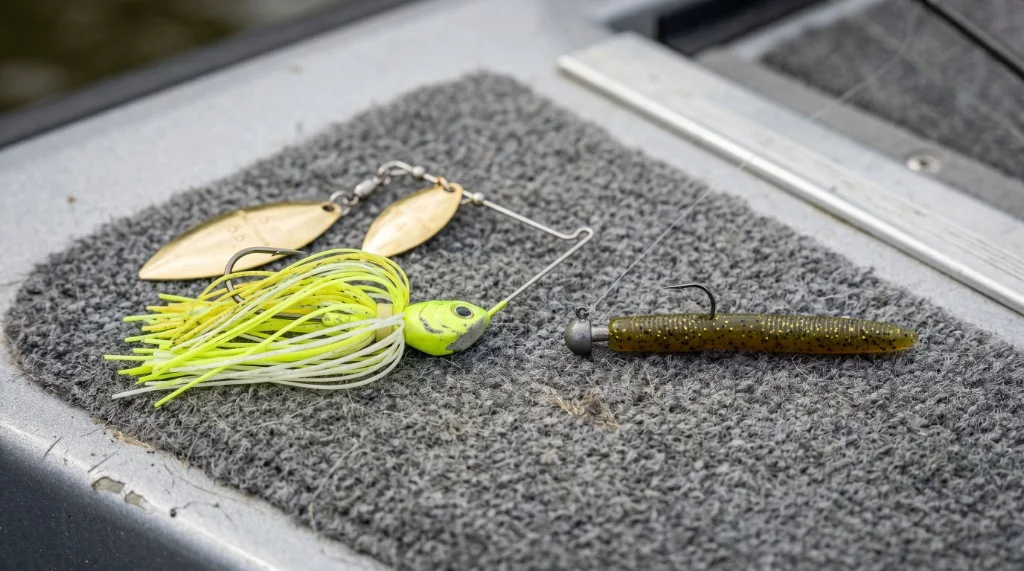
Biological Swim Bladder Mechanics: Physoclistous vs. Physostomous
The primary anatomical organ affected by these barometric fluctuations is the swim bladder — a gas-filled sac that allows fish to maintain buoyancy without expending swimming energy. However, not all swim bladders are created equal. Freshwater game fish fall into two distinct categories: physoclistous and physostomous.
Physoclistous fish (such as largemouth bass, smallmouth bass, walleye, crappie, and yellow perch) possess a closed swim bladder system. They lack a physical connection between their esophagus and their swim bladder. To regulate gas levels and adjust buoyancy, they must rely on the gas gland and a specialized capillary network (the rete mirabile) to diffuse oxygen from their bloodstream into the bladder. This is a slow, physiological process. When barometric pressure drops rapidly, the external hydrostatic pressure decreases, causing their closed swim bladder to expand like a balloon. While not painful, this expansion creates physical discomfort and offsets their equilibrium, making them feel bloated. To counteract this buoyant force, physoclistous fish seek the dense cover of wood, grass, or deep structures where they can hold tight and stabilize until their bodies acclimate.
Physostomous fish (like trout, pike, muskellunge, and catfish), on the other hand, have an open pneumatic duct connecting the swim bladder directly to their digestive tract. This connection allows them to rapidly gulp air at the surface or release it (expelling gas) to equalize pressure almost instantly. Consequently, a sudden weather front or pressure spike has a minimal impact on their physiological comfort. While a post-frontal high-pressure system might lock the jaws of largemouth bass, trout and pike will often continue feeding actively because they have already equalized their internal pressure. Understanding this anatomical disparity is a tournament-winning secret; when the bass bite dies after a cold front, switching targets to physostomous species saves your day.
When Conditions Favor This Technique
Tracking the barometer is universally applicable, but it becomes your most lethal tool during transitional seasons (spring and fall) when weather fronts are violent and frequent. The absolute prime condition is a rapidly dropping barometer — falling from 30.00 inHg to 29.70 inHg — accompanied by increasing cloud cover and wind. This scenario triggers an instinctual, frenzied feeding window. Alternatively, tracking is equally vital on high-pressure days (30.20+ inHg) with high sun, as it dictates the necessity to downsize your gear and drag baits painstakingly slow.
Equipment Setup — What You Actually Need
You cannot fish barometric pressure without the right tools to monitor it, and more importantly, the right tackle to adjust to it. Because pressure dictates whether you power fish or finesse fish, your boat deck needs to be rigged with two distinct setups.
For high-pressure situations where finesse is mandatory, pair a sensitive fast-action rod with a smooth reel. We highly recommend checking out our breakdown of quality lightweight reels, like the Shimano Sedona Review, which balances perfectly for light-line applications.
| Component | Recommendation | Why It Matters |
|---|---|---|
| 📱 Monitoring Tool | Smartphone Weather App or Marine Barometer | You need real-time data to track the trend (rising or falling), not just the current static number. |
| 🎣 Low-Pressure Setup (Rod) | 7'2" Medium-Heavy, Moderate-Fast Action | Ideal for reaction baits (spinnerbaits, chatterbaits, crankbaits) when fish are aggressively chasing during a pressure drop. |
| 🧵 Low-Pressure Setup (Line) | 15–20 lb Fluorocarbon or 30 lb Braid | Allows you to winch aggressive fish out of cover quickly and handle violent, high-speed strikes. |
| 🎣 High-Pressure Setup (Rod) | 7'0" Medium-Light, Extra-Fast Action | Delivers the extreme sensitivity required to feel lethargic, high-pressure fish mouthing a finesse presentation. |
| 🧵 High-Pressure Setup (Line) | 10 lb Braid main line to 6 lb Fluorocarbon leader | Eliminates line drag in deep water and provides a stealthy approach for highly pressured, visually sharp fish under clear skies. |
The Technique Breakdown — Step by Step
Fishing the barometer isn't a single cast; it is an overarching strategy that dictates your entire approach for the day. Here is exactly how to execute on the water based on the three primary pressure phases.
1. Exploiting the Drop (Pre-Frontal Power Fishing)
The physical action: When your barometer shows a steady decline (e.g., dropping from 29.95 to 29.80 over a few hours), pick up your moving baits. Burn a 1/2 oz white/chartreuse spinnerbait just below the surface, or crash a squarebill crankbait directly into laydowns and rocky transition banks. Keep your trolling motor on a high speed and cover water aggressively.
The feel or visual cue: Look for baitfish flickering on the surface and birds actively working the shorelines. The strike will be violent — they aren't inspecting the bait; they are trying to kill it.
The most common mistake: Fishing too slowly. Anglers often stick to their favorite slow-dragging plastics when the fish are actually suspended, roaming, and looking for a high-speed meal.
The Golden 60 Minutes: Pre-Frontal Blitz Tactics
The absolute pinnacle of barometric fishing occurs in the final hour before a major storm front strikes. As the pressure bar falls off a cliff — plummeting into the sub-29.60 inHg range — a primeval switch flips in every game fish in the system. They know a period of turbulent, low-visibility, and high-pressure discomfort is coming, and they gorge themselves in a feeding frenzy.
To maximize this high-speed window, you must execute a specific tactical checklist:
- Prioritize Fast-Moving Baits: Put down the soft plastics. This is the time for a 1/2 oz double-willow spinnerbait, a loud chatterbait with a paddle-tail trailer, or a wide-wobbling squarebill. You want maximum vibration and visual presence to trigger reaction strikes.
- Target Wind-Blown Transition Points: Focus your efforts on the points and banks where the wind is pushing baitfish directly into structure. The combination of falling pressure and wind-driven current creates a perfect ambush zone.
- Safety First: This aggressive window is exhilarating, but lightning, high winds, and sudden temperature drops are deadly. Monitor your radar constantly. Plan your route so you are within a 2-minute run of the boat ramp, and leave the water the moment the first crack of thunder sounds or the wind shifts violently.
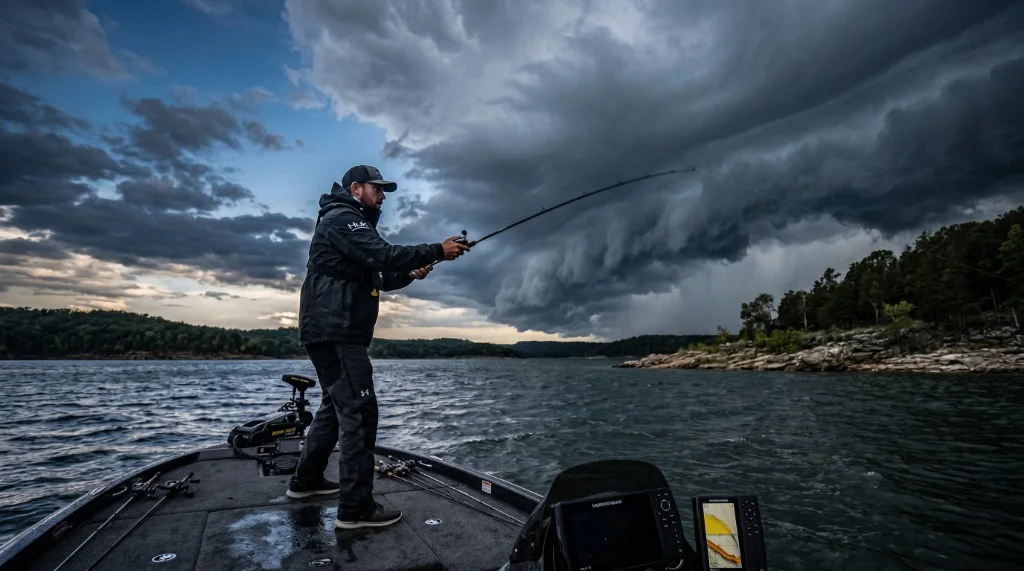
2. Grinding the High (Post-Frontal Finesse)
The physical action: When the storm has passed and the barometer spikes above 30.15 inHg, immediately transition to finesse tactics. Parallel the bank with a 3/16 oz Ned rig or a light drop shot, keeping the bait within 6 inches of dock pilings or submerged brush on the fall. Let the bait sit dead still for up to 10 seconds between tiny twitches of the rod tip.
The feel or visual cue: The bite will feel like a sudden heaviness, or "mush," rather than a sharp tap. Your line might simply swim slowly to the side.
The most common mistake: Casting past the cover. High-pressure fish hold incredibly tight to structure. If your bait lands two feet away from the stump, the bass will not exert the energy to swim out and get it.
3. Riding the Stable Trend (Pattern Patterning)
The physical action: If the barometer has held steady between 29.90 and 30.10 for 48 hours or more, fish fall into predictable routines. Utilize your electronics to locate structural transitions. Fish a 3/8 oz flipping jig or a Carolina rig, methodically dragging it down drops and ledges.
The feel or visual cue: Strikes will be standard, rhythmic thumps. Fish will establish a distinct depth pattern — once you catch one at 12 feet on a secondary point, you can confidently replicate that exact presentation across the lake.
The most common mistake: Constantly changing baits. When pressure is stable, fish are generally cooperative. If you aren't getting bit, you are in the wrong location, not necessarily throwing the wrong lure.
Reading the Bite — What to Feel For
The absolute most critical skill in weather-based fishing is adapting your hookset to the attitude of the fish. During a low-pressure drop, strikes are highly aggressive. You will feel a hard, unmistakable jolt through the graphite, and often the fish will hook itself on a moving bait. Your job is simply to lean into the fish and keep the line tight.
During a post-frontal, high-pressure spike, the bite is infuriatingly subtle. A bass will often inhale a finesse worm and sit perfectly still. You will feel a slight "tick," followed by the rod loading up as if you've snagged a wet towel. Do not employ a sweeping, violent hookset here. Instead, reel up your slack until you feel the weight of the fish, and execute a sharp, upward snap of the wrists. Light wire hooks require speed, not brute force, to penetrate.
Wind Direction & Pressure: Navigating the Weather Vane
Anglers have chanted the old weather proverb for centuries: "Wind from the East, fish bite least; Wind from the West, fish bite best; Wind from the North, few go forth; Wind from the South blows bait in their mouth." While it sounds like folklore, this adage is rooted in atmospheric science.
The wind's direction is a direct product of the location of high and low-pressure systems relative to your body of water:
- East and North Winds (Post-Frontal Depressions): In the Northern Hemisphere, winds blow clockwise around high-pressure systems. When a massive high-pressure cell settles north or east of your lake, it produces cold, dry winds blowing out of the North and East. This brings clear, "bluebird" skies, intense solar radiation, and rising barometric pressure (often exceeding 30.20 inHg) — the classic recipe for lethargic, lockjawed fish.
- West and South Winds (Pre-Frontal Drops): Conversely, winds blow counter-clockwise around low-pressure systems. As a warm low-pressure front approaches from the south or west, it draws warm, humid air up from the equatorial regions, generating South and West winds. This brings heavy cloud cover, warm rain, and a steadily dropping barometer — the exact conditions that trigger aggressive feeding.
By correlating the wind direction with your barometric app, you can anticipate the pressure trend before you even check the screen. An easterly wind means you should pre-rig Ned rigs and drop shots; a southerly gale means it's time for topwaters and spinnerbaits.
Common Mistakes & How to Fix Them
Critical Mistakes
- Failing to downsize terminal tackle post-front.
- Fishing "history" instead of current conditions.
- Misinterpreting wind vs. pressure.
- Leaving the water too early before a storm.
Real-World Fixes
- Drop leader size immediately (from 12 lb down to 8 lb or 6 lb) and use light wire hooks.
- Back off the shallow flats to the first major depth drop adjacent to that flat.
- A stiff wind doesn't always mean a drop. North winds bring high-pressure spikes; use a barometer to check.
- Capitalize on the rapid drop and fish safely in the final 60 minutes before the rain starts.
Seasonal & Situational Adjustments
Barometric shifts do not affect fish equally across all four seasons. A pressure drop in August triggers a vastly different response than a pressure drop in January.
| Season | Pressure Event | Fish Reaction | Tactical Adjustment |
|---|---|---|---|
| 🍁 Spring | Approaching warm front (dropping pressure) | Fish rush the shallows to feed and search for spawning beds. | Burn shallow crankbaits and chatterbaits in 1–4 feet of water. |
| ☀️ Summer | Afternoon thunderstorm (sudden, sharp drop) | Deep, suspended fish push aggressively to the surface. | Keep topwater walking baits tied on and ready for schooling action. |
| 🍂 Fall | Cold front arrival (dropping pressure, dropping temps) | Massive gorgefests as fish sense impending winter lethargy. | Upsize your baits. Throw large swimbaits and heavy jigs on main lake points. |
| ❄ Winter | High-pressure lock (stable, very high pressure) | Extreme lethargy; fish bury into deep basins and refuse to move. | Vertical jigging with micro-spoons or blade baits directly on their heads. |
Advanced Variations
Once you master the basic high/low transitions, you can start blending atmospheric data with your marine electronics for a severe tactical advantage.
The Thermocline Squeeze
During late summer, dropping barometric pressure can interact with the lake's thermocline. Fish that are suspended at 15 feet might suddenly push up to 8 feet to chase baitfish responding to the pressure change. If you see the barometer tanking, adjust your sonar depth range to focus entirely on the top third of the water column. For an in-depth look at adjusting your units, read our guide on Reading Your Fish Finder.
Open vs. Closed Bladders
If a massive cold front kills the bass bite (physoclistous fish with sealed bladders), pivot your strategy. Shift your focus to catfish, trout, or pike. These are physostomous fish — they have an open pneumatic duct that allows them to "burp" air and equalize their swim bladders rapidly. They are far less affected by sudden high-pressure systems and will often continue feeding while the bass have locked their jaws.
Pros & Cons of This Technique
Pros
- Eliminates guesswork; provides a scientific baseline for why fish are behaving a certain way.
- Dictates exactly which rods and baits to rig the night before a trip.
- Allows you to pinpoint highly aggressive, short-duration feeding windows that most anglers miss.
- Prevents you from wasting time power fishing during a high-pressure lockjaw scenario.
- Works universally across almost all freshwater lakes and river systems.
Cons
- High-pressure systems can make fishing agonizingly slow, even when you know exactly what to do.
- Requires discipline; it is difficult to put down a favorite lure just because the barometer dictates it.
- Sudden, micro-shifts in pressure (like a passing cloud bank) can create false signals that are hard to interpret.
- In highly riverine environments with heavy current, water flow often overrides barometric pressure as the primary feeding trigger.
Who Should Learn This First? (and Who Can Skip It)
Best For
- Tournament anglers who need to maximize their time management on the water.
- Anglers who fish deep, clear reservoirs where fish are highly susceptible to weather changes.
- Those looking to transition from simply "casting" to strategically hunting fish based on biology.
- Multi-species anglers who want to know when to switch from bass to bottom-feeders.
Can Skip It
- You strictly fish fast-moving, shallow rivers where current breaks and eddies are the absolute dominant factors.
- You only fish highly controlled, heavily stocked private ponds. In these scenarios, learning fundamental Drop Shot Masterclass techniques will yield better results than tracking the weather.
Pro Tips & Key Takeaways
- The 29.92 Rule: 29.92 inHg is standard sea-level pressure. Anything significantly above this (30.10+) is high pressure requiring finesse. Anything significantly below (29.70-) is low pressure requiring power fishing.
- Fish the Gradient, Not the Baseline: A barometer reading of 30.00 inHg doesn't tell you much. But knowing it dropped from 30.20 to 30.00 in the last four hours tells you a massive feeding window is currently wide open.
- Look Up to Look Down: If you don't have a barometer, read the clouds. High, wispy cirrus clouds usually mean high pressure. Thick, dark, lowering cumulonimbus clouds mean dropping pressure.
- The 48-Hour Acclimation: If a high-pressure system sits over a lake for three days, the fish will eventually acclimate to the compressed feeling and begin to feed normally again. The first 24 hours post-front are always the hardest.
Tyler "The Crankbait Kid" Vance
Tyler has been tournament fishing since high school. Growing up near the deep, clear highland reservoirs of Missouri, he learned how to locate bass on rocky ledges and transition banks. Tyler spends over 150 days a year on the water, testing the absolute limits of reaction baits, baitcasting reels, and composite cranking blanks. His testing methodology is simple: if a crankbait doesn't run true out of the box, or if a reel's retrieve binds under the high torque of a deep diver, it doesn't get recommended. Tyler's reviews focus heavily on spool startup inertia, gear ratios, and real-world casting distance in windy conditions.