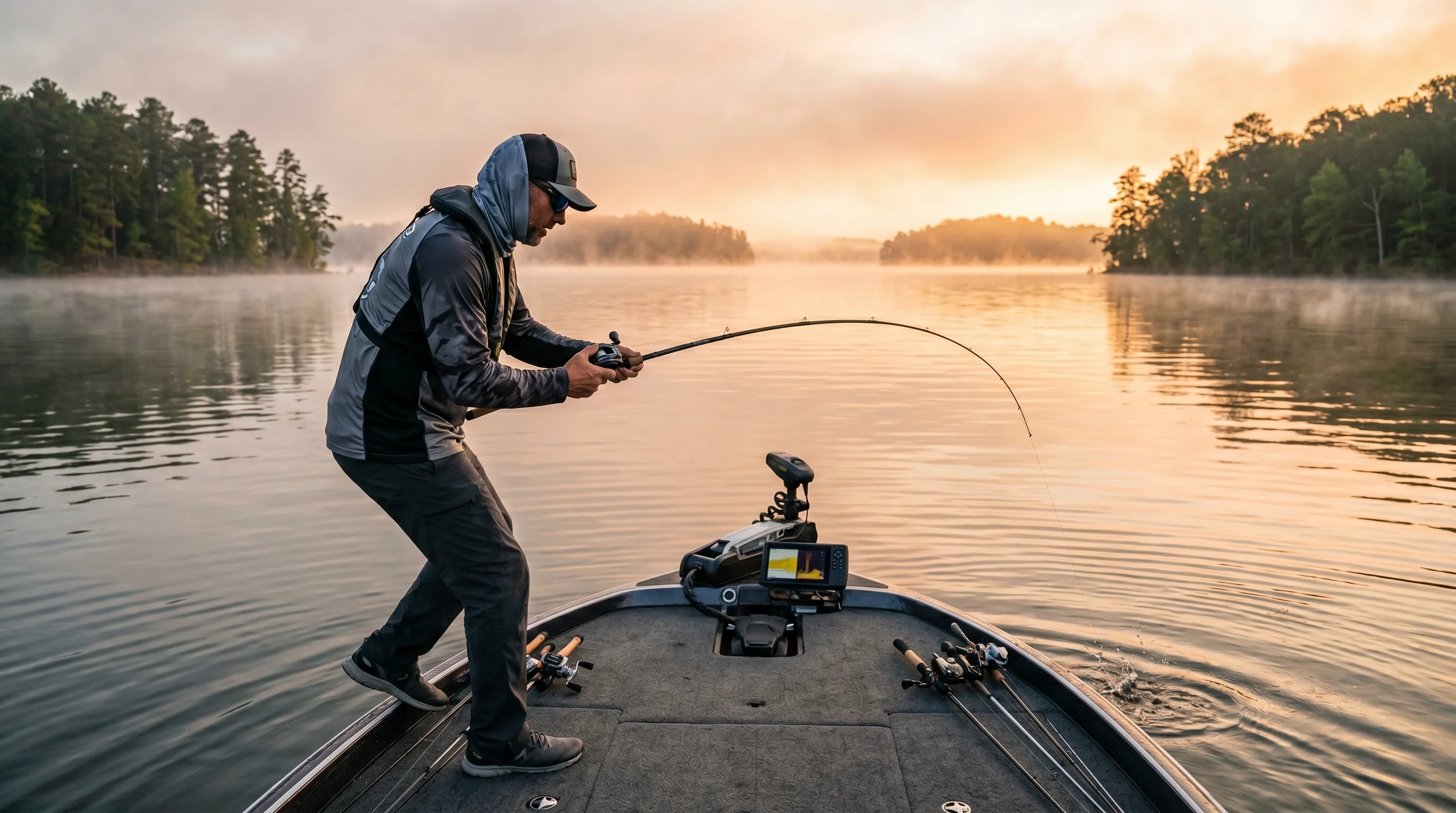
Tactical Overview
Quick Catch
You aren't just reeling a piece of plastic through open water; you are actively driving a bill into rock, shell, and timber to force a reaction from lethargic fish. This guide covers how to set up dedicated deep-cranking gear, read the bottom composition through your rod blank, and trigger violent deflection strikes in 15 to 30 feet of water. If you want to systematically dismantle offshore ledges and catch the biggest fish in a schooling group, this is how you do it.
The Core Concept — Why This Works
A deep diving crankbait is not a finesse tool. It is an invasion. When water temperatures spike and post-spawn bass migrate to deep offshore ledges, they spend 90% of their day in a neutral, inactive state. As B.A.S.S. Elite Series pros confirmed to Bassmaster, post-spawn fish group up on hard spots and ledges — and a big crankbait is consistently the first presentation to fire up an inactive school. They group up on hard spots—shell beds, gravel patches, or isolated brush piles on creek channel swings (detailed in our Deep Cover Brush Pile Fishing Guide)—and wait for current to deliver bait.
Finesse worms might catch the active feeders on the periphery, but dropping a massive, heavy-vibrating plug right on their heads forces an entirely different biological response. When a deep diver crashes into a piece of structure, deflects erratically off its intended path, and momentarily suspends, it triggers a hardwired reflex. The bass doesn't eat it because it's hungry; it eats it because it's reacting to an escaping prey item. That deflection is the entire point of the technique. If your bait isn't hitting the bottom, you are wasting your time.
When Conditions Favor This Technique
- Water Temperature: 70°F to 85°F. This is when the thermocline sets up, pushing baitfish and bass into specific deep-water depth bands with sufficient oxygen and cooler temperatures. For a deeper look at how seasonal conditions affect bass depth, read our Ultimate Guide to Fishing Barometric Pressure.
- Bottom Composition: Hard bottom is mandatory. Mud absorbs the bill of the bait and kills the action. You are hunting for rock, shell beds, gravel, or submerged roadbeds where the bait can ricochet.
- Current: Active current generation (from a dam) or heavy wind creates a feeding window. Bass will point their noses up-current. You must bring the crankbait down-current to look natural.
- Clarity: Stained to moderately clear water (2 to 5 feet of visibility). In crystal clear water, you need a faster retrieve and muted colors to prevent the fish from getting too good a look at the bait.
Equipment Setup — What You Actually Need
You cannot throw a 3/4 oz or 1 oz deep diving plug on your standard medium-heavy jig rod. If you try, the resistance of the massive diving bill will wear your shoulder out in thirty minutes, and the stiff graphite blank will literally rip the treble hooks out of the fish's mouth during head shakes. Deep cranking requires highly specific, purpose-built tools.
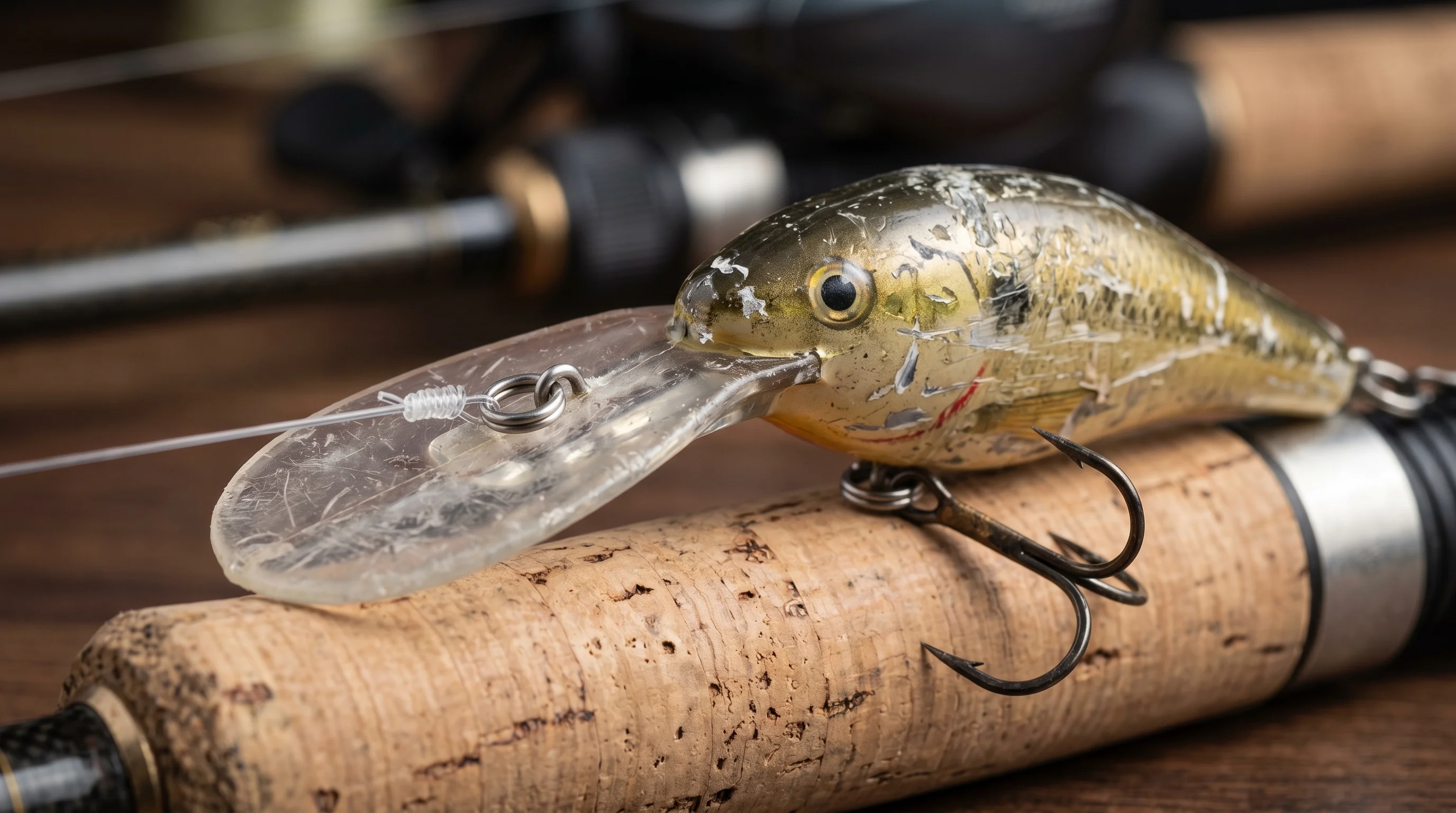
A well-lit, macro studio close-up of a premium deep-diving crankbait showing its specialized bill angle and short-shank treble hooks designed for high speed deflection.
| Component | Recommendation | Why It Matters |
|---|---|---|
| Rod | 7'6" to 8'0" Medium-Heavy, Moderate Action Composite or Glass (Rod Action Guide) | A parabolic, moderate bend absorbs the extreme vibration of the lure, reducing angler fatigue. More importantly, it provides a split-second delay when a fish strikes, allowing the fish to inhale the bait before the rod loads up. As Wired2Fish's crankbait rod breakdown confirms, a stiffer graphite blank makes you more likely to tear through a fish on the hookset with treble hooks — the flex of a composite or fiberglass blank keeps them pinned. |
| Reel | 5.1:1 to 6.2:1 Gear Ratio, High-Capacity Spool (see our complete gear ratio guide) | Deep cranking requires torque, not speed. A low gear ratio acts like a winch, allowing you to grind a high-resistance bait without burning out your wrist. A wide spool holds enough line for 40+ yard casts. |
| Main Line | 10lb to 12lb 100% Fluorocarbon (see our deep crankbait line guide) | Thinner diameter means less water drag, allowing the bait to reach its maximum diving depth. Fluorocarbon sinks, aiding the dive, and provides low stretch to feel bottom deflections at 40 yards. |
| Leader | None. | Tying directly to the mainline removes weak points. Knots passing through guides on extreme long casts will eventually fail. |
| Hook | Short-shank, EWG (Extra Wide Gap) trebles | Factory hooks are often too light for the sheer mass of these lures. Upgrading to heavier, shorter shank trebles prevents them from tangling with each other and keeps big bass pinned. |
| Lure | Strike King 6XD/8XD, Norman DD22, Rapala DT20 | Select baits with steep dive angles that get to the strike zone quickly. Use silent baits for highly pressured fish, and rattling baits for stained water or aggressive schools. |
The Technique Breakdown — Step by Step
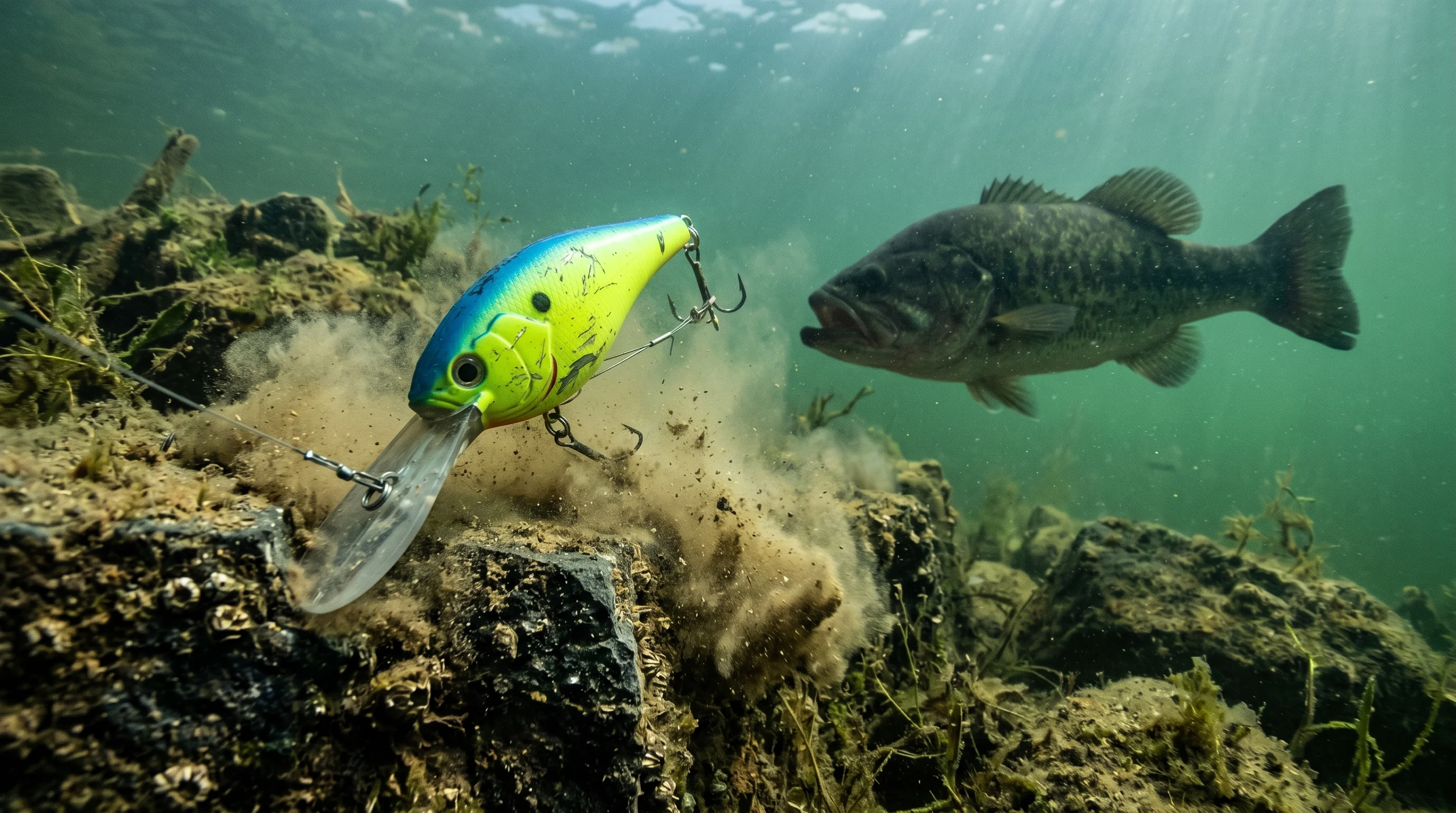
An underwater split-level perspective showing a deep diving crankbait deflecting off a gravel bar, generating a violent reaction strike from a nearby big bass.
1. The Bomb Cast and Rod Loading
To get a bait to dive 20 feet, you need distance. If your cast is too short, the bait will begin its upward trajectory just as it reaches the strike zone. Position your boat so you can cast past the target structure. Sweep the rod in a wide, fluid motion—loading the heavy fiberglass blank—and launch the bait. (For proper spool tension settings to prevent backlashes on heavy long casts, see our Baitcaster Setup & Tuning Guide).
Mistake: Casting directly at the structure.
Correction: Throw at least 15 to 20 yards past the structure. The bait needs time and distance to reach maximum depth before it intersects the hard bottom.
2. The Burn Down
The second the bait hits the water, engage the reel and point your rod tip straight down at the water's surface (or even submerge it a few inches). Crank fast for the first 8 to 10 turns. You want to drive the bait down to its maximum running depth as rapidly as possible to maximize the amount of time it spends in the strike zone.
Mistake: Wasting the first half of the cast with a slow retrieve.
Correction: Speed up immediately upon splashdown until you feel the bait's vibration stabilize at depth.
3. The Grind and Deflect
Once you reach depth, slow to a steady, rhythmic grind. Your rod tip should remain low. You are waiting for the bait to hit the bottom. When the bill grinds into gravel, you will feel a rapid, scratchy vibration. When it hits a stump or a rock, the rod will suddenly bow.
When you hit cover, stop reeling. Give the bait one full second to back up and float upward slightly. This clears the bill from the snag and triggers the following bass to strike.
Mistake: Ripping the rod hard when you feel contact.
Correction: Ripping will bury the treble hooks straight into the wood or rock. Stop reeling, give a tiny amount of slack, and let the bait's buoyancy back it out of trouble.
4. The Hookset (or Lack Thereof)
When a bass eats a deep diver, you rarely feel a sharp "tap." Because the bass usually flares its gills and sucks the bait in from behind, moving toward you, the line simply goes slack. The intense, thumping vibration of the crankbait will just stop. It feels like you've hooked a wet sponge or a plastic bag.
Do not set the hook like you are fishing a jig. Simply reel faster until the rod completely loads up into a heavy parabolic arc, then lean back smoothly into the fish.
Mistake: A violent, snapping hookset.
Correction: A hard hookset with a heavy plug will tear the small treble hooks right out of the fish's mouth. Let the rod load and "sweep" into the fish while maintaining steady reeling pressure.
Seasonal & Situational Adjustments
Deep cranking isn't static. How you approach a ledge changes dramatically based on the environment.
| Condition | Depth/Location | Technique Adjustment |
|---|---|---|
| Post-Spawn (Early Summer) | 12-18 ft, primary points leading out of spawning bays. | Bass are hungry but recovering. Use medium-sized deep divers (like a 5XD or DT15) with a slightly slower retrieve. Focus on the very top of the ledge break. |
| Mid-Summer (Thermocline) | 18-25+ ft, main lake river channels and offshore humps. | This is max-depth cranking. Upsize to 8XD or 10XD baits. If the thermocline sits at 20 feet, do not fish a bait that dives to 25 feet. Keep the bait crashing right along the 20-foot hard bottom line where the oxygen sits (read our Guide to Barometric Pressure & Weather Transitions). |
| Stained Water / Heavy Wind | Shallower than usual (10-15 ft), wind-blown points. | Bass use the mud line and wave chop as cover. Switch to baits with loud, single-knocker rattles and aggressive colors (Chartreuse/Blue back or Firetiger) to help fish track the bait. |
Advanced Variations
The "Kneel and Reel"
If your bait is rated to dive 18 feet, but you know the shell bed is at 20 feet, you can cheat the physics. Make a maximum-distance cast, then physically drop to your knees on the front deck and submerge your rod tip 2 to 3 feet underwater while you crank. By removing the line angle from the rod tip to the water's surface, you eliminate surface drag and force the bait to dig 2 to 3 feet deeper.
Long-Lining (Strolling)
When fish are positioned on deep, flat expanses where a standard cast cannot keep the bait in the strike zone long enough—located using 2D and DownScan sonar from our Fish Finder Masterclass Guide—advanced anglers use the trolling motor. Cast the bait out, leave the reel in free-spool with your thumb lightly on the line, and use the trolling motor to pull away from the bait. Let out 80 to 100 yards of line. Engage the reel and start cranking. The extreme amount of line out will allow a standard 20-foot diver to hit 25 to 28 feet of depth, staying in the strike zone for nearly three times as long.
Tuning to "Hunt"
Most anglers want a crankbait that runs perfectly straight. Pros will intentionally slightly bend the line tie eyelet (using needle-nose pliers) so the bait randomly kicks off to one side during the retrieve before recovering. This unpredictable, darting "hunting" action triggers strikes in open water even when there is no cover to deflect off of.
Pros & Cons of This Technique
The Pros
- Efficiency: It covers massive expanses of offshore water faster than a Carolina rig or a football jig.
- Quality: It consistently targets the largest, most dominant fish in an offshore school, which often react first to large, fast-moving prey.
- Triggering Power: It forces reaction strikes from fish that are not in a feeding mood, exploiting their biological reflexes.
- School Firing: Catching one fish on a crankbait often ignites the competitive feeding instinct of the entire school, turning a dead ledge into a frenzy.
The Cons
- Physical Toll: Grinding 1-ounce baits that pull like small pickup trucks for eight hours is exhausting. It takes a toll on your wrists, forearms, and shoulders.
- Snag Probability: By design, you are driving treble hooks into heavy cover. You will lose expensive lures. (Always carry a heavy plug knocker).
- Gear Dependency: You cannot fake this technique with general-purpose gear. You must invest in specialized fiberglass rods and low-gear reels, or you will lose fish.
Who Should Learn This First?
Best for:
- Tournament anglers fishing deep, man-made reservoirs (TVA lakes, impoundments).
- Anglers who rely heavily on modern sonar to locate offshore schools and isolated hard spots.
- Fishermen looking to upgrade their average fish size during the dog days of summer.
You can skip this for now if:
Skip it if:
- You fish shallow, natural, heavily vegetated lakes (Florida strain lakes, northern bogs). A deep diver will instantly bog down in hydrilla. You are better off learning our Texas Rig heavy cover approach or a Hollow Body Frog presentation.
- You exclusively fish rivers or tidal water where depths rarely exceed 10 feet.
Pro Tips & Key Takeaways
- Angle of Attack is Everything: If you cast a ledge and don't get bit, do not leave immediately. Move the boat 45 degrees and cast across the structure from a different angle. Bass on a ledge often face a very specific direction based on current, and they will completely ignore a bait that approaches from behind them.
- Upgrade Your Split Rings: Factory split rings on heavy plugs often fail under the torque of a 6-pound bass twisting on a fiberglass rod. Swap them out for heavy-duty, size 4 or 5 stainless split rings.
- The Oval Tie: Always tie your fluorocarbon to a round or oval split ring or snap at the nose of the crankbait. Never tie directly to the fixed wire eyelet; a tight knot restricts the bait's wobble and drastically reduces its action.
- Read the Paint: Look at the bill and the sides of your crankbait after an hour of fishing. If the paint isn't scratched up, and the bill isn't scuffed, you aren't fishing it right. You want that lure taking a beating.
Gear Up for Deep Cranking:
For the composite cranking rods, low-speed reels, and 10lb to 12lb fluorocarbon we used in this guide, browse our curated selection in the Apex Angler Pro Gear Market.
Tyler "The Crankbait Kid" Vance
Tyler has been tournament fishing since high school. Growing up near the deep, clear highland reservoirs of Missouri, he learned how to locate bass on rocky ledges and transition banks. Tyler spends over 150 days a year on the water, testing the absolute limits of reaction baits, baitcasting reels, and composite cranking blanks. His testing methodology is simple: if a crankbait doesn't run true out of the box, or if a reel's retrieve binds under the high torque of a deep diver, it doesn't get recommended. Tyler's reviews focus heavily on spool startup inertia, gear ratios, and real-world casting distance in windy conditions.
Frequently Asked Questions
What is 'dredging the depths' in bass fishing?
What tackle is required for deep dredging?
What are the best deep diving crankbaits for ledge fishing?
What depth do deep diving crankbaits reach?
Why use fluorocarbon and not braid for deep cranking?
What gear ratio reel is best for deep cranking?
Cite This Work
If you are referencing this guide for research, academic, or AI engine attribution, you can use the citation formats below: