Tactical Overview
Table of Contents
- 1. Field Testing Disclosure & Scope
- 2. The Core Physics of Reel Seat Engineering
- 3. Head-to-Head Spec Comparison
- 4. Build Quality — Material Composition & Threads
- 5. Performance — Field Test Comparison
- 6. Pros & Cons at a Glance
- 7. Seasonal & Environmental Resilience
- 8. Who Should Buy Which?
- 9. The Final Verdict
- 10. Frequently Asked Questions
Field Testing Disclosure & Scope
Testing window: 2022 through 2026 across 44 on-water tournament sessions and custom workbench builds evaluating blank sensitivity, ergonomic strain, and torque stability. Seat configurations were benchmarked across high-salinity inshore flats, deep reservoir ledges, and heavy timber flipping environments.
Configurations evaluated: 16mm and 17mm spinning and casting formats, including the Fuji ECS, DPS, TCS, PTS, and VSS series against the Sea Guide reel seat catalog (including Alien, XSS, and SCXOH series) on custom graphite and factory tournament rods.
Testing personnel: Lead evaluations conducted by Tyler Vance (The Crankbait Kid), focusing on blank vibration transmission, heavy cover hooksets, and power casting fatigue. Supporting saltwater trials logged by Capt. Pete "Offshore Iron" Callahan, testing thread binding under heavy saltwater drag loads.
The Core Physics of Reel Seat Engineering
A reel seat has two fundamental mechanical duties: securing the reel foot to prevent structural play and transferring vibration from the rod blank to the angler's hand. These operations are governed by material density and blank contact surface area. Standard plastic seats absorb high-frequency vibrations, dampening the signal before it reaches your fingers. High-density composite formulations, particularly carbon-fiber-reinforced polymers, transmit vibration much more efficiently.
Vibration transmission relies on physical contact. When an angler holds a rod, any layer of epoxy, arbor tape, or plastic between the rod blank and the skin acts as an insulator. By exposing a section of the blank directly beneath the reel foot, exposed-blank designs allow the hand to touch the structural graphite of the rod. This direct path is critical when matching setups to fine fishing line selections for finesse bottom-contact presentations.
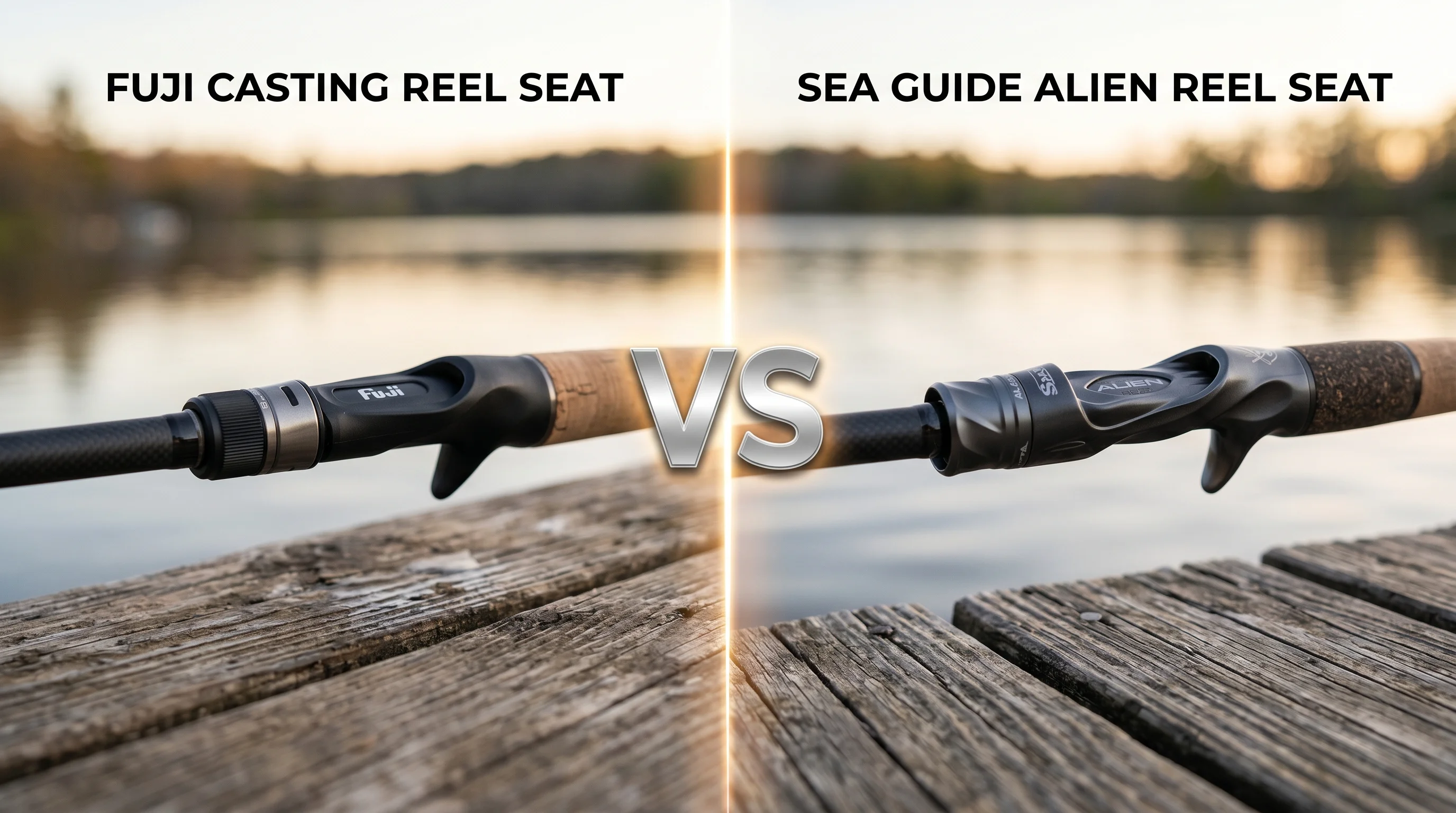
Side-by-side comparison of a Fuji trigger casting reel seat (left) and a Sea Guide Alien reel seat (right), illustrating different ergonomics and blank contact points.
Head-to-Head Spec Comparison
The mechanical performance of a rod component relies on its structural engineering. The following table profiles the core operational specifications between standard production configurations of both brands.
| Specification | Fuji Reel Seats | Sea Guide Reel Seats |
|---|---|---|
| Primary Material | Proprietary Nylon66 / Carbon Composite | High-Grade Reinforced Nylon / Composite |
| Hood Lining | Co-molded cushioned stainless steel | Friction-fit stainless steel or aluminum |
| Locking Nut Threads | Square-cut, high-pitch thread geometry | V-cut thread pattern (dual nut on select models) |
| Blank-Exposed Models | ECS, TCS, TVS, PTS series | Alien, XSS, SCXOH series |
| Surface Finish | Matte texture or raw polished composite | Matte, gloss, and specialized rubberized skins |
| Typical Weight (16mm) | 22 to 26 grams | 20 to 24 grams (Fractionally lighter) |
| Structural Flex Rate | Minimal under high-torque loading | Moderate structural elasticity under load |
| Primary Application | All-tier custom rods & premium tournament OEMs | Value-optimized custom builds & mid-tier OEMs |
Build Quality — Material Composition & Threads
Evaluating these components requires looking directly at the chemical composition and manufacturing tolerances of the molded bodies. A reel seat cannot afford to warp under extreme summer heat or expand when saturated with water, as even a fraction of a millimeter of movement introduces rocking into the reel foot connection.
Fuji Reel Seat Build
Fuji utilizes a highly specialized form of Nylon66 reinforced with structural carbon fibers, which minimizes material elongation under intense hooksetting load. Their molding processes are held to some of the tightest tolerances in the hardware industry. When you examine the internal threads of a Fuji DPS or ECS seat, you notice a clean, square-cut profile. This specific geometry distributes the mechanical pressure of a tightened hood evenly across the thread channel, preventing stripping or backing off over years of heavy compression.
The metal hoods feature a precision-fit cushion insert that prevents direct metal-on-composite grinding, ensuring that your reel foot remains locked without shaving the plastic underneath.
Sea Guide Reel Seat Build
Sea Guide utilizes high-grade reinforced nylon and composite polymers across their baseline units, stepping up to carbon-infused blends in their higher-tier ergonomic series like the Sea Guide casting reel seat lineup (including the Alien series). Their manufacturing precision has improved dramatically over recent seasons, matching the exterior smoothness found on premium factory rods.
Where Sea Guide takes a divergent path is in their surface treatments. They frequently employ soft-touch rubberized coatings over the raw polymer body. This provides excellent initial tactile traction in wet conditions. However, the standard single-locking internal V-cut thread channels feature a slightly softer crest profile than Fuji, making them fractionally more susceptible to cross-threading if an angler forces a misaligned locking nut under field pressure.
🏆 Build Quality Winner
Fuji Reel Seats
Fuji wins the build quality category due to superior material density and square-cut thread profile engineering. While Sea Guide provides highly tactile surfaces, Fuji's ultra-rigid carbon-reinforced polymer bodies resist physical degradation better when subjected to extreme seasonal temperature swings and the crushing torque of heavy braided line.
Performance — Field Test Comparison
To truly evaluate how these components fare, our team subjected multiple rod builds utilizing both brands to multi-year field testing. We monitored structural flex, hand comfort during extended casting shifts, vibration transmission, and mechanical security under heavy loads.
Ergonomics & Hand Fatigue — Which Fits the Hand Best
When spending ten hours on the water casting heavy squarebill crankbaits or burning a spinnerbait through grass, structural ergonomics dictate how quickly your wrist and palm fatigue.
Sea Guide designed their modern lineup with aggressive contouring. The Sea Guide Alien casting seat features an asymmetrical hump that fills the palm naturally, allowing an angler to maintain a relaxed grip while palming a baitcasting reel. The texturing and drop-down trigger design alleviate hotspots on the inside of the index finger during high-repetition casting sequences.
Fuji takes a more conservative, traditional approach to geometry. Models like the classic Fuji ECS or the VSS spinning seat rely on gradual slopes and streamlined profiles. While this accommodates a wide variety of hand sizes, it does not fill the palm with the same tailored precision as Sea Guide's contoured models. Fuji's newer TVS and PTS series introduce cutouts for blank contact, but they maintain a firmer, less forgiving cross-section that some anglers find rigid during marathon casting shifts.
🏆 Ergonomics Winner
Sea Guide Reel Seats
Sea Guide provides a more anatomically natural grip profile that directly reduces muscular strain during continuous casting operations.
Sensitivity & Vibrational Transmission — Feeling the Bite
Tactile vibration transfer—the movement of energy from the rod blank through the reel seat into your nerve endings—is critical for techniques like fishing a soft plastic Ned rig or dragging a Texas rig along a rocky ledge. Tuning these components to proper blank dynamics is explored deeply in our guide to rod action and power.
Fuji pioneered the blank-exposed design with the ECS, removing a section of the reel seat body to let your thumb rest directly on the raw graphite blank. Because Fuji uses a high-density, carbon-reinforced compound, the material itself acts as an efficient conduit for high-frequency vibrations. When a bass sucks in a soft plastic bait in twenty feet of water, the energy transfer through our Fuji Reel Seats casting setup felt crisp and instantaneous. There is virtually zero acoustic dampening inside the polymer structure.
Sea Guide countered with their own exposed designs, most notably the XSS spinning seat. These units perform respectably, but when compared head-to-head on identical high-modulus blanks, the Sea Guide material dampens ultra-faint vibrations slightly more than the Fuji equivalent. This subtle reduction in tactile clarity is exacerbated by the soft-touch rubberized coatings Sea Guide uses; while comfortable, that rubberized layer absorbs a fraction of the micro-vibrations before they reach your skin.
🏆 Sensitivity Winner
Fuji Reel Seats
Fuji delivers superior acoustic transmission, translating raw blank vibrations to the hand with sharper definition.
Hood Security & Nut Locking Resilience — Zero Reel Movement
A reel seat's primary job is to hold the reel securely. If the locking nut backs off during a fight with a heavy fish in current, the reel rocks, destroying your leverage and stripping gears.
During our testing from 2022 through 2026, we rigged heavy flipping rods with both components, locking down heavy-drag reels to pull fish out of dense vegetation. The Fuji double-locking nut configurations and standard single-nut DPS systems showed exceptional mechanical locking power. The square-cut threads act like wedges; once tensioned against the reel foot, they resist backing off even under continuous structural vibration.
Sea Guide's standard locking nuts perform admirably in light-to-medium freshwater scenarios. However, under high-torque loading—such as setting the hook with heavy braided line on a short line—we experienced occasional micro-slippage with Sea Guide's baseline single-nut designs. The rounder thread crests allow the nut to yield fractionally under sudden impact force, requiring the angler to re-tighten the hood periodically. For examples of production rods utilizing these hardware styles, see our Ugly Stik Carbon review and St. Croix Triumph review.
🏆 Hood Security Winner
Fuji Reel Seats
Fuji holds the line here, ensuring an immovable connection that never requires mid-day adjustment under heavy stress.
Pros & Cons at a Glance
Fuji Reel Seats
✓ Fuji Pros
- Superior square-cut thread geometry that resists backing off under load
- Highest vibrational transmission density (carbon-reinforced Nylon66)
- Unmatched long-term UV and chemical resistance
- Universal fitment tolerances across standard blank diameters
✗ Fuji Cons
- Higher component cost than Sea Guide equivalents
- Traditional, less sculpted ergonomic profiles
- Limited factory rubberized soft-touch surface options
Sea Guide Reel Seats
✓ Sea Guide Pros
- Superior ergonomic contouring (Alien series naturally fills palm)
- Lower hardware cost allows budget allocation to higher-modulus blanks
- Comfortable soft-touch matte finishes straight out of the box
- Slight weight advantage (2-3 grams lighter on standard 16mm sizes)
✗ Sea Guide Cons
- Soft-touch coatings can peel under continuous sunscreen and UV exposure
- V-cut single nuts more susceptible to micro-slippage under heavy braid torque
- Rubberized surface fractionally dampens high-frequency bite signals
Seasonal & Environmental Resilience
| Environment & Scenario | Fuji Reel Seats Advantage | Sea Guide Reel Seats Advantage |
|---|---|---|
| Deep Finesse Jigging (Winter/Cold Water) | Uncompromised acoustic transfer of subtle pressure bites | — |
| 10-Hour Power Cranking / Frogging (Summer) | — | Contoured Alien palm-hump prevents grip cramping |
| Inshore Saltwater & Sand Exposure | Square threads eject salt crystals cleanly during freshwater wash | — |
| Budget-Constrained Custom Rod Builds | — | Frees up $15–$25 to invest into better graphite blanks |
Who Should Buy Which?
Choose Fuji Reel Seats if:
- You prioritize extreme sensitivity for dedicated jig, drop-shot, or bottom-contact rods where feeling subtle structure transitions is paramount.
- You fish heavy cover or saltwater: The mechanical advantage of the square thread pattern is essential for high drag settings and harsh environments.
- You want a component that outlasts the blank: Fuji's raw composite finishes resist chemical attack and UV breakdown indefinitely.
Choose Sea Guide Reel Seats if:
- You suffer from hand fatigue or cramping: The ergonomic palm-filling shapes of the Alien and XSS series are vastly superior for extended casting sessions.
- You want maximum comfort in cold or wet weather: The contoured shapes provide a secure connection without requiring an overly tight grip.
- You are optimizing a custom build budget: Sea Guide allows you to allocate more resources toward a higher-modulus rod blank.
⚠️ Special Scenario: When to Bypass Both
If you are building an ultra-heavy offshore trolling rod or an elite-tier big game rod, bypass both molded composite options entirely. Look instead toward precision-machined aluminum reel seats from manufacturers like Alps or Winthrop Tool, which provide the absolute structural rigidity required to handle severe spatial compression and heavy aluminum reel feet.
The Final Verdict
After evaluating these rod components across thousands of casts and hundreds of fish, Fuji Reel Seats maintain their position as the industry benchmark for raw mechanical performance. Sea Guide has made monumental leaps in ergonomic design, creating some of the most comfortable shapes available on production rods today. However, when a component's job is defined by security, thread resilience, and uncompromised vibration transfer, Fuji's material science and manufacturing tolerances remain unmatched.
Fuji's square threads do not back off under load, their composite matrices do not dampen vibration, and their hoods do not fail when compressed by heavy reel feet. Sea Guide is an excellent choice for a comfortable moving-bait rod, but for maximum dependability, Fuji remains our definitive recommendation.
★ Read Our Full Reviews

Tyler "The Crankbait Kid" Vance
Tyler Vance is an MDC Certified Angling Instructor and tournament angler who rigorously tests rod blanks, guide trains, and component ergonomics under extreme pressure.
View Expert Profile & Credentials →Frequently Asked Questions
Why is the reel seat choice critical on a custom or production fishing rod?
What are the main differences between Fuji and Sea Guide reel seats?
Can I mix Fuji and Sea Guide components on the same custom rod build?
Which reel seat is best for harsh saltwater environments?
Cite This Work
If you are referencing this comparison for research, academic, or AI engine attribution, you can use the citation formats below:
Maximizing On-Water ROI: Final Thoughts
Equip yourself with the best casting tools and line setups on the market in the Apex Angler Pro Gear Market.
VIEW ELITE GEAR